 Indietro
Polyatomic Ions, Covalent and Ionic Compounds, and Electronegativity: Core Concepts in General Chemistry
Guida di studio - Note intelligenti
 Appunti personalizzati basati sui tuoi materiali, ampliati con definizioni chiave, esempi e contesto.
Polyatomic Ions and Their Nomenclature
Definition and Common Examples
Polyatomic ions are ions composed of two or more atoms covalently bonded, that act as a single charged entity in chemical reactions. They are fundamental in the formation of many ionic compounds and are commonly encountered in both inorganic and organic chemistry.
Polyatomic ion: A charged species (ion) consisting of two or more atoms covalently bonded.
Examples include nitrate (NO3-), sulfate (SO42-), and ammonium (NH4+).
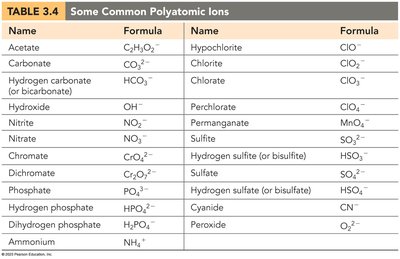
Naming Polyatomic Ions
The nomenclature of polyatomic ions is systematic and based on the number of oxygen atoms present, as well as the presence of hydrogen atoms in the ion.
The most common or first discovered ion in a series ends in "-ate" (e.g., sulfate SO42-).
"-ite" indicates one fewer oxygen than the "-ate" form (e.g., sulfite SO32-).
"hypo-...ite" means one fewer oxygen than "-ite" (e.g., hypochlorite ClO-).
"per-...ate" means one more oxygen than "-ate" (e.g., perchlorate ClO4-).
"bi-" or "hydrogen" indicates the presence of an additional hydrogen (e.g., hydrogen carbonate HCO3-).
Naming Compounds with Polyatomic Ions
When naming ionic compounds containing polyatomic ions, the name of the cation is given first, followed by the name of the polyatomic ion. If more than one polyatomic ion is present, parentheses are used to indicate the number.
Example: Ca(NO3)2 is calcium nitrate.
Example: (NH4)2SO4 is ammonium sulfate.
Covalent Compounds and Bonding
Formation and Properties
Covalent compounds are formed when two or more nonmetal atoms share electrons to achieve a stable octet configuration. The shared electrons count toward the octet of both atoms involved in the bond.
Covalent bond: A chemical bond formed by the sharing of electron pairs between atoms.
Octet rule: Atoms tend to share electrons so that each atom has eight electrons in its valence shell.
Electronegativity and Bond Polarity
Electronegativity (EN) is a measure of an atom's ability to attract electrons in a chemical bond. The difference in electronegativity between two atoms determines the type of bond formed:
Nonpolar covalent bond: Electrons are shared equally (ΔEN ≤ 0.4).
Polar covalent bond: Electrons are shared unequally (0.4 < ΔEN < 2.0).
Ionic bond: Electrons are transferred from one atom to another (ΔEN ≥ 2.0).

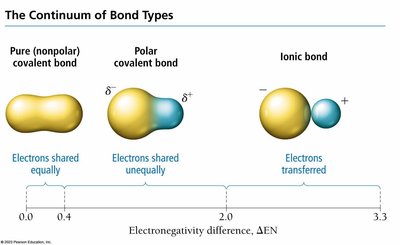
Examples of Bond Types
Nonpolar covalent: F2 (ΔEN = 0)
Polar covalent: H2O (ΔEN = 1.3; O is more electronegative, so it pulls electrons closer, resulting in partial charges)
Ionic: NaCl (ΔEN = 2.1)
Ionic Compounds
Formation and Structure
Ionic compounds are formed when electrons are transferred from a metal (which becomes a cation) to a nonmetal (which becomes an anion). The resulting oppositely charged ions are held together by electrostatic forces in a crystal lattice structure.
Cation: Positively charged ion (e.g., Na+).
Anion: Negatively charged ion (e.g., Cl-).
Lattice energy: The energy released when gaseous ions form an ionic solid; a measure of the strength of the ionic bond.


Naming Ionic Compounds
Binary ionic compounds are named by stating the cation first, followed by the anion with its ending changed to "-ide." For compounds containing polyatomic ions, the name of the polyatomic ion is used directly.
Example: NaCl is sodium chloride.
Example: MgI2 is magnesium iodide.
Example: Al2O3 is aluminum oxide.
Electronegativity Trends in the Periodic Table
Periodic Trends
Electronegativity increases across a period (left to right) and decreases down a group (top to bottom) in the periodic table. Fluorine is the most electronegative element.

Summary Table: Common Polyatomic Ions
The following table summarizes the names and formulas of some of the most common polyatomic ions encountered in general chemistry:
Name | Formula | Name | Formula |
|---|---|---|---|
Acetate | CH3CO2- | Hypochlorite | ClO- |
Carbonate | CO32- | Chlorite | ClO2- |
Hydrogen carbonate (bicarbonate) | HCO3- | Chlorate | ClO3- |
Hydroxide | OH- | Perchlorate | ClO4- |
Nitrite | NO2- | Pemanganate | MnO4- |
Nitrate | NO3- | Sulfite | SO32- |
Chromate | CrO42- | Hydrogen sulfite (bisulfite) | HSO3- |
Dichromate | Cr2O72- | Sulfate | SO42- |
Phosphate | PO43- | Hydrogen sulfate (bisulfate) | HSO4- |
Hydrogen phosphate | HPO42- | Cyanide | CN- |
Dihydrogen phosphate | H2PO4- | Peroxide | O22- |
Ammonium | NH4+ |
Key Equations
Electronegativity difference (ΔEN): Used to predict bond type.
ΔEN = |ENatom1 - ENatom2|
Lattice energy (ΔHo):
Additional info: The images included are directly relevant to the explanation of polyatomic ions, bond types, electronegativity trends, and the structure of ionic compounds. The tables provide a concise reference for polyatomic ions and the relationship between electronegativity difference and bond type.
