 Indietro
Practice Exam 1 – General Chemistry Study Guidance
Guida di studio - Note intelligenti
 Appunti personalizzati basati sui tuoi materiali, ampliati con definizioni chiave, esempi e contesto.
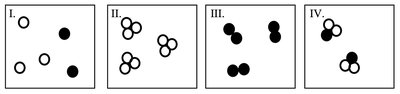
Q2. Which of the following represent molecules that are compounds?
Background
Topic: Classification of molecules and compounds
This question tests your understanding of the difference between elements and compounds, and how to identify compounds based on molecular representations.
Key Terms:
Element: A substance made of only one type of atom.
Compound: A substance made of two or more different types of atoms chemically bonded together.
Molecule: Two or more atoms bonded together, which can be either elements (same type) or compounds (different types).
Step-by-Step Guidance
Examine each molecular diagram (I, II, III, IV) and identify whether the molecules are made of one type of atom or more than one type.
Recall that compounds must contain at least two different types of atoms bonded together.
For each diagram, look for molecules that have different colored or shaped atoms, indicating different elements.
Determine which diagrams show molecules that are compounds, and which show molecules that are elements.
Try solving on your own before revealing the answer!
Final Answer: II and IV
Diagrams II and IV show molecules made of two or more different types of atoms, which means they are compounds. Diagrams I and III show molecules made of only one type of atom, so they are elements.
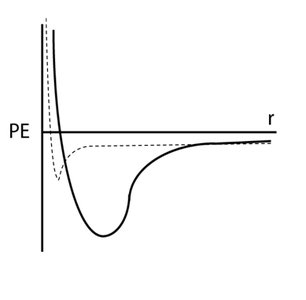
Q13. The potential energy curves for two atoms interacting with each other are shown to the right. One curve represents two atoms interacting through a London Dispersion Force and the other curve represents two atoms forming a covalent bond. Which curve represents the atoms that form a covalent bond?
Background
Topic: Potential energy curves and types of atomic interactions
This question tests your ability to interpret potential energy diagrams and distinguish between London Dispersion Forces (LDFs) and covalent bonds based on energy and stability.
Key Terms and Concepts:
Potential Energy Curve: A graph showing how the energy of a system changes as the distance between two atoms changes.
London Dispersion Force (LDF): A weak intermolecular force due to temporary dipoles.
Covalent Bond: A strong bond formed when two atoms share electrons.
Step-by-Step Guidance
Observe the two curves: one solid and one dotted. Notice the depth and position of the minimum (the 'well') in each curve.
Recall that covalent bonds are much stronger than LDFs, so the potential energy well for a covalent bond will be deeper (more negative) and require more energy to separate the atoms.
Compare the curves: the deeper well indicates a stronger, more stable interaction (covalent bond), while the shallower well indicates a weaker interaction (LDF).
Consider the distance at which the minimum occurs; covalent bonds typically form at shorter distances than LDFs.
Try solving on your own before revealing the answer!
Final Answer: The solid line represents the covalent bond.
The solid line shows a deeper potential energy well, meaning it takes more energy to separate the atoms, which is characteristic of a covalent bond. The dotted line represents the weaker London Dispersion Force.
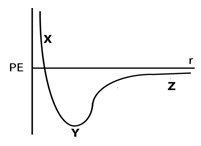
Q12. Consider a system of two atoms with a stable interaction between them (the atoms are stuck in the bottom of the potential energy well). The potential energy curve for this system is shown to the right. What would happen to the system for the potential energy to change from Y to Z?
Background
Topic: Potential energy and atomic interactions
This question tests your understanding of how energy changes affect the stability and interactions between atoms, as shown on a potential energy curve.
Key Terms:
Potential Energy Well: The minimum point on the curve where atoms are most stable.
Energy Transfer: Energy can be transferred to or from the system, affecting the interaction.
Overcoming Interaction: Moving from the well (Y) to a higher energy state (Z) means the interaction is broken.
Step-by-Step Guidance
Identify the points Y and Z on the curve: Y is the minimum (stable interaction), Z is higher up (interaction overcome).
Consider what must happen for the system to move from Y to Z: energy must be added to the system.
Think about possible ways energy can be transferred: collision with another atom, or energy transfer from surroundings.
Recall that overcoming the interaction means breaking the bond or force holding the atoms together.
Try solving on your own before revealing the answer!
Final Answer: I, II, and V
To move from Y to Z, a third atom could collide with the system (I), energy would transfer from the surroundings to the system (II), and the interaction between the atoms would be overcome (V).
