 Indietro
Predicting and Balancing Double Displacement Reactions
Guida di studio - Note intelligenti
 Appunti personalizzati basati sui tuoi materiali, ampliati con definizioni chiave, esempi e contesto.
Q3. Predict the reaction (including correctly balanced, write “no reaction” if one does not react)
a) 2 LiOH(aq) + CuCl2(aq) → ?
Background
Topic: Double Displacement (Metathesis) Reactions & Precipitation
This question tests your ability to predict the products of a double displacement reaction and determine if a precipitate forms. You must also balance the equation and identify the physical states of the products.
Key Terms and Formulas
Double Displacement Reaction: Two compounds exchange ions to form two new compounds.
Solubility Rules: Used to determine if a product is insoluble (forms a precipitate) or soluble (remains aqueous).
General Formula:
Step-by-Step Guidance
Identify the cations and anions in each reactant: LiOH contains Li+ and OH-; CuCl2 contains Cu2+ and Cl-.
Exchange the ions to predict the products: Li+ pairs with Cl- and Cu2+ pairs with OH-.
Write the formulas for the products: LiCl and Cu(OH)2.
Determine the physical states using solubility rules: LiCl is soluble (aq), Cu(OH)2 is insoluble (s, forms a precipitate).
Balance the equation by adjusting coefficients so that the number of atoms of each element is the same on both sides.
Try solving on your own before revealing the answer!
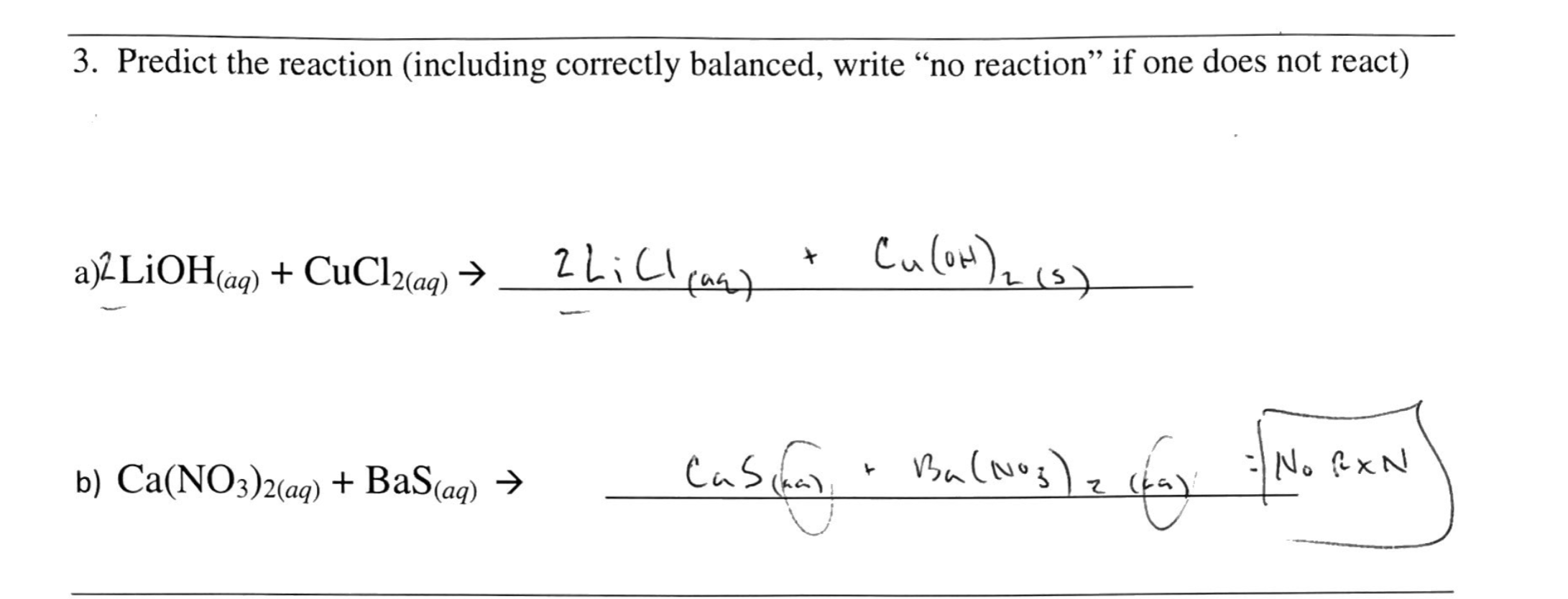
b) Ca(NO3)2(aq) + BaS(aq) → ?
Background
Topic: Double Displacement (Metathesis) Reactions & Solubility
This question asks you to predict the products of a reaction between two aqueous ionic compounds and determine if a reaction occurs (i.e., if a precipitate forms).
Key Terms and Formulas
Double Displacement Reaction: Two ionic compounds exchange ions.
Solubility Rules: Used to check if any product is insoluble (forms a precipitate).
General Formula:
Step-by-Step Guidance
Identify the ions: Ca(NO3)2 contains Ca2+ and NO3-; BaS contains Ba2+ and S2-.
Exchange the ions: Ca2+ pairs with S2- and Ba2+ pairs with NO3-.
Write the formulas for the products: CaS and Ba(NO3)2.
Check the solubility of each product: Use solubility rules to determine if either product is insoluble (forms a precipitate) or if both are soluble (no reaction).
If both products are soluble, write "no reaction"; if one is insoluble, indicate which is the precipitate and balance the equation.
Try solving on your own before revealing the answer!
Final Answers:
a) 2 LiOH(aq) + CuCl2(aq) → 2 LiCl(aq) + Cu(OH)2(s)
LiCl is soluble, and Cu(OH)2 is insoluble (forms a precipitate). The equation is balanced as written.
b) Ca(NO3)2(aq) + BaS(aq) → no reaction
Both possible products (CaS and Ba(NO3)2) are soluble in water, so no precipitate forms and thus no reaction occurs.
