 Indietro
Properties and States of Matter: Foundations of General Chemistry
Guida di studio - Note intelligenti
 Appunti personalizzati basati sui tuoi materiali, ampliati con definizioni chiave, esempi e contesto.
Properties of Matter
Physical vs. Chemical Properties
The properties of matter are fundamental characteristics that help us identify and classify substances. These properties are divided into two main categories: physical properties and chemical properties.
Physical Properties: Characteristics that can be observed or measured without changing the substance's chemical identity. Examples include density, color, hardness, melting point, and boiling point.
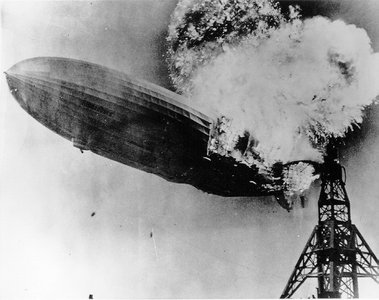
Chemical Properties: Characteristics that can only be observed when a substance undergoes a chemical change or reaction, resulting in the formation of a new substance. Examples include reactivity with oxygen, flammability, and acidity.
Example: Hydrogen gas reacts explosively with oxygen to form water, demonstrating a chemical property (reactivity).
Extensive vs. Intensive Properties
Properties of matter can also be classified based on their dependence on the amount of substance present:
Intensive Properties: Independent of the amount of substance. Examples include color, temperature, density, boiling point, and conductivity.
Extensive Properties: Dependent on the quantity of substance. Examples include mass, volume, length, and energy.
Key Point: The ratio of two extensive properties that scale in the same way (such as mass and volume) yields an intensive property (such as density).
Density: A Key Physical Property
Definition and Formula
Density is an intensive property defined as the mass of a substance per unit volume. It is a useful parameter for identifying substances and predicting their behavior in mixtures.
Formula:
Rearranged forms:
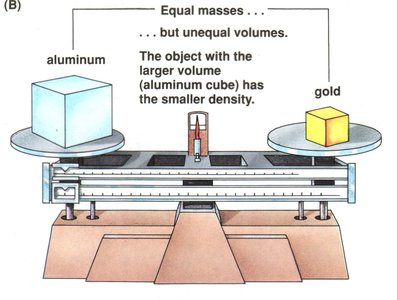
Example Calculation: If a liquid has a density of 0.87 g/mL, what volume is occupied by 25 g of the liquid?
States of Matter
Classification and Properties
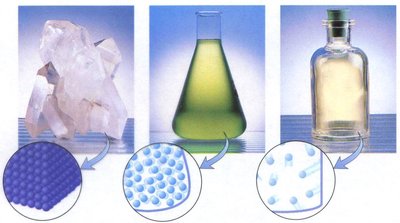
Matter exists in three primary states, each with distinct physical characteristics:
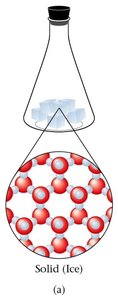
Solid (s): Definite shape and volume. Particles are closely packed in a fixed arrangement.
Liquid (l): Definite volume but no definite shape. Particles are close together but can move past one another.
Gas (g): Neither definite shape nor volume. Particles are far apart and move freely.
Microscopic View of States
The arrangement and movement of particles differ in each state:
Solids: Particles vibrate in fixed positions.
Liquids: Particles move more freely but remain in contact.
Gases: Particles move independently and are widely separated.
Phase Changes and Energy
Energy Changes Accompanying Phase Transitions
Transitions between states of matter involve energy changes:
Melting: Solid to liquid (energy absorbed)
Freezing: Liquid to solid (energy released)
Vaporization: Liquid to gas (energy absorbed)
Condensation: Gas to liquid (energy released)
Sublimation: Solid to gas (energy absorbed)
Deposition: Gas to solid (energy released)
Phase Diagrams
Understanding Phase Diagrams
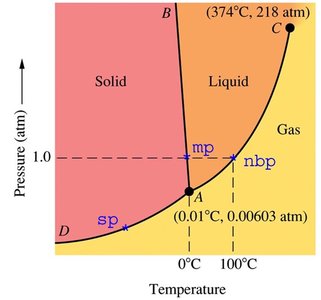
A phase diagram is a graphical representation showing the state of a substance as a function of temperature and pressure. It helps predict the conditions under which a substance exists as a solid, liquid, or gas.
Key Points: The lines (boundaries) indicate conditions where two phases coexist in equilibrium. The triple point is where all three phases coexist. The critical point marks the end of the liquid-gas boundary.
Summary Table: Properties of Matter
Property Type | Definition | Examples |
|---|---|---|
Physical | Observed without changing chemical identity | Density, color, melting point |
Chemical | Observed during a chemical change | Reactivity, flammability |
Intensive | Independent of amount | Density, temperature |
Extensive | Dependent on amount | Mass, volume |
