 Indietro
Properties of Solutions: Structure, Formation, and Colligative Properties
Guida di studio - Note intelligenti
 Appunti personalizzati basati sui tuoi materiali, ampliati con definizioni chiave, esempi e contesto.
Properties of Solutions
Introduction to Solutions
Solutions are homogeneous mixtures composed of two or more pure substances. The substance present in the smaller amount is called the solute, while the substance in the larger amount is the solvent. The process of solvation involves the clustering of solvent molecules around solute particles, and when the solvent is water, this process is called hydration. The ability of substances to form solutions depends on their natural tendency toward mixing and the strength of intermolecular forces.
Solute: Substance dissolved in the solvent.
Solvent: Substance in which the solute is dissolved.
Solution: Homogeneous mixture of solute and solvent.
Solvation: Interaction of solvent molecules with solute particles.
Hydration: Solvation when the solvent is water.
Types of Solutions
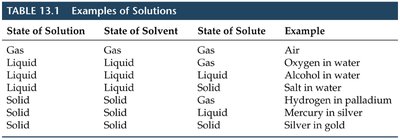
Solutions can exist in various combinations of states of matter. The table below summarizes common examples:
State of Solution | State of Solvent | State of Solute | Example |
|---|---|---|---|
Gas | Gas | Gas | Air |
Liquid | Liquid | Gas | Oxygen in water |
Liquid | Liquid | Liquid | Alcohol in water |
Liquid | Liquid | Solid | Salt in water |
Solid | Solid | Gas | Hydrogen in palladium |
Solid | Solid | Liquid | Mercury in silver |
Solid | Solid | Solid | Silver in gold |
Intermolecular Forces in Solution Formation
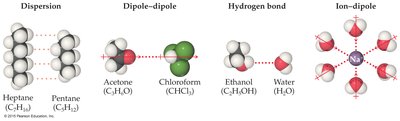
Intermolecular forces play a crucial role in the formation of solutions. The types of forces include dispersion (London forces), dipole-dipole interactions, hydrogen bonding, and ion-dipole interactions. The strength and compatibility of these forces between solute and solvent determine whether a solution will form.
Dispersion forces: Present in all molecules, especially nonpolar ones.
Dipole-dipole interactions: Occur between polar molecules.
Hydrogen bonding: Strong dipole-dipole interaction involving H bonded to N, O, or F.
Ion-dipole interactions: Occur between ions and polar molecules.
Energy Changes in Solution Formation
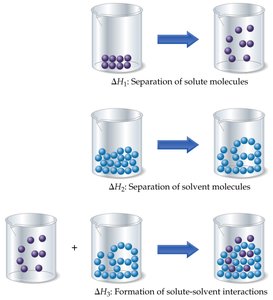
The formation of a solution involves three main steps, each associated with an enthalpy change:
ΔH1: Separation of solute molecules (endothermic).
ΔH2: Separation of solvent molecules (endothermic).
ΔH3: Formation of solute-solvent interactions (exothermic).
The overall enthalpy change for solution formation is:
Exothermic and Endothermic Solution Formation
Breaking attractive intermolecular forces is always endothermic, while forming new attractive forces is exothermic. The total enthalpy change () can be positive (endothermic) or negative (exothermic), depending on the balance of these processes.
Example (Exothermic): MgSO4 added to water ( kJ/mol)
Example (Endothermic): NH4NO3 added to water ( kJ/mol)
Entropy and Spontaneity of Solution Formation
Solutions are also favored by the increase in entropy (disorder) that accompanies mixing. Even if the enthalpy change is close to zero, the increase in entropy can drive the spontaneous formation of a solution.
Saturated, Unsaturated, and Supersaturated Solutions
Saturated Solutions and Solubility
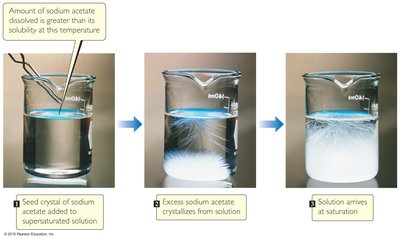
The process of solution formation and crystallization are opposing processes. When the rates of these processes are equal, the solution is saturated, and no more solute will dissolve unless some crystallizes out. Solubility is the maximum amount of solute that can dissolve in a given amount of solvent at a specific temperature.
Saturated solution: Contains the maximum amount of dissolved solute.
Unsaturated solution: Contains less than the maximum amount of solute.
Supersaturated solution: Contains more solute than is normally possible at that temperature; unstable and can crystallize upon addition of a seed crystal.
Factors Affecting Solubility
Solute–Solvent Interactions
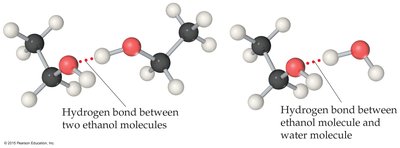
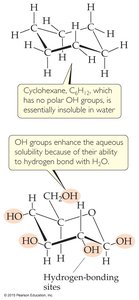
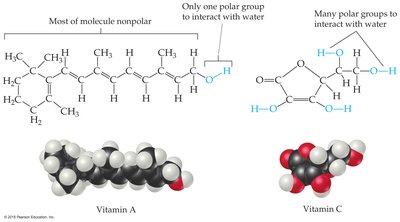
The principle "like dissolves like" summarizes solubility behavior. Polar solutes dissolve best in polar solvents, and nonpolar solutes dissolve best in nonpolar solvents. The more polar bonds (such as –OH groups) a molecule has, the better it dissolves in a polar solvent like water.
Solubility Trends in Alcohols
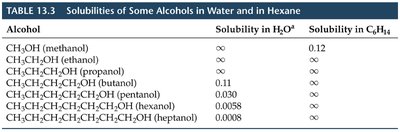
As the number of carbon atoms in an alcohol increases, its solubility in water decreases, while its solubility in nonpolar solvents increases.
Alcohol | Solubility in H2O | Solubility in C6H14 |
|---|---|---|
CH3OH (methanol) | ∞ | 0.12 |
CH3CH2OH (ethanol) | ∞ | ∞ |
CH3CH2CH2OH (propanol) | ∞ | ∞ |
CH3CH2CH2CH2OH (butanol) | 0.11 | ∞ |
CH3CH2CH2CH2CH2OH (pentanol) | 0.030 | ∞ |
CH3CH2CH2CH2CH2CH2OH (hexanol) | 0.0058 | ∞ |
CH3CH2CH2CH2CH2CH2CH2OH (heptanol) | 0.0008 | ∞ |
Biological Importance of Solubility
Fat-soluble vitamins (e.g., vitamin A) are nonpolar and stored in fatty tissues, while water-soluble vitamins (e.g., vitamin C) must be consumed regularly as they are not stored.
Liquid/Liquid Solubility: Miscibility and Immiscibility
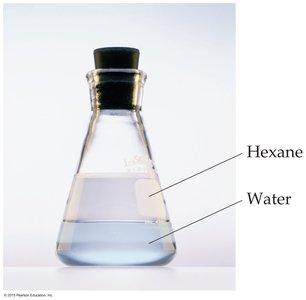
Liquids that mix in all proportions are called miscible, while those that do not mix are immiscible. For example, hexane (nonpolar) and water (polar) are immiscible.
Pressure Effects on Solubility
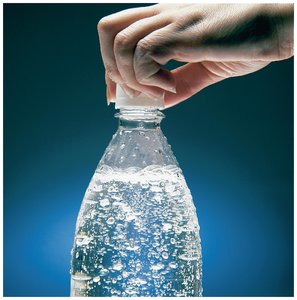
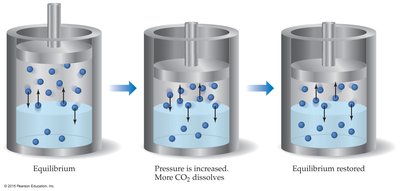
The solubility of gases in liquids increases as the partial pressure of the gas above the solvent increases. The solubility of solids and liquids is not appreciably affected by pressure.
Temperature Effects on Solubility
For most solids, solubility increases with temperature, though exceptions exist. For all gases, solubility decreases as temperature increases.
Expressing Solution Concentration
Units of Concentration
Several units are used to express the concentration of solutions:
Mass percentage:
Parts per million (ppm):
Parts per billion (ppb):
Mole fraction (χ):

Molarity (M):
Molality (m):

Molarity vs. Molality
Molarity varies with temperature (volume changes).
Molality does not vary with temperature (mass does not change).
Colligative Properties
Definition and Types
Colligative properties depend only on the number of solute particles, not their identity. These include:
Vapor pressure lowering
Boiling-point elevation
Freezing-point depression
Osmotic pressure
Vapor Pressure Lowering
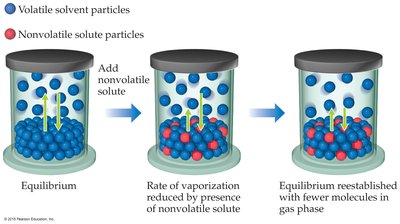
Adding a nonvolatile solute to a solvent reduces the solvent's vapor pressure, making it harder for solvent molecules to escape to the vapor phase.
Boiling-Point Elevation
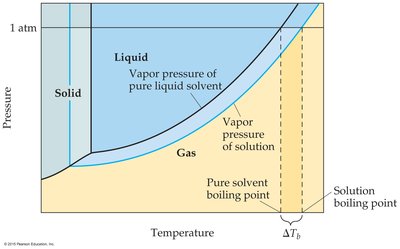
Lower vapor pressure means a higher temperature is required to reach atmospheric pressure, thus raising the boiling point of the solution.
Freezing-Point Depression
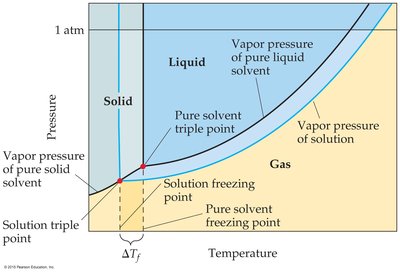
The freezing point of a solution is lowered compared to the pure solvent, as shown in the phase diagram.
Boiling-Point Elevation and Freezing-Point Depression Formulas
The change in temperature is directly proportional to the molality and the van’t Hoff factor:
(boiling-point elevation)
(freezing-point depression)
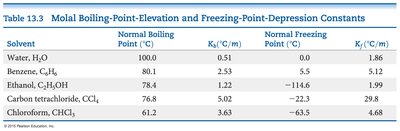
Solvent | Normal Boiling Point (°C) | Kb (°C/m) | Normal Freezing Point (°C) | Kf (°C/m) |
|---|---|---|---|---|
Water, H2O | 100.0 | 0.51 | 0.00 | 1.86 |
Benzene, C6H6 | 80.1 | 2.53 | 5.5 | 5.12 |
Ethanol, C2H5OH | 78.4 | 1.22 | -114.6 | 1.99 |
Carbon tetrachloride, CCl4 | 76.8 | 5.02 | -22.3 | 29.8 |
Chloroform, CHCl3 | 61.2 | 3.63 | -63.5 | 4.68 |
The van’t Hoff Factor (i)
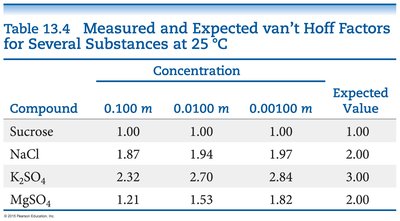
The van’t Hoff factor accounts for dissociation in solution. For example, NaCl dissociates into two particles, so theoretically .
Compound | 0.100 m | 0.0100 m | 0.00100 m | Expected Value |
|---|---|---|---|---|
Sucrose | 1.00 | 1.00 | 1.00 | 1.00 |
NaCl | 1.87 | 1.94 | 1.97 | 2.00 |
K2SO4 | 2.32 | 2.70 | 2.84 | 3.00 |
MgSO4 | 1.21 | 1.53 | 1.82 | 2.00 |
Osmosis and Osmotic Pressure
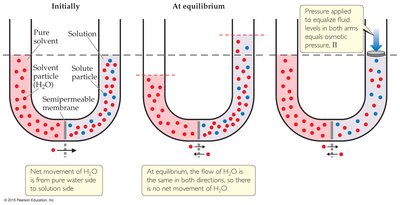
Osmosis is the net movement of solvent molecules from a region of low solute concentration to high concentration across a semipermeable membrane. The pressure required to stop this flow is called osmotic pressure, a colligative property.
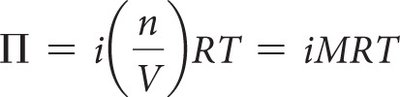
The formula for osmotic pressure is:
Example Calculation
Sample Exercise: The average osmotic pressure of blood is 7.7 atm at 25°C. What molarity of glucose (C6H12O6) will be isotonic with blood?
Use the formula to solve for M.
Summary Table: Key Solution Properties
Property | Definition | Formula |
|---|---|---|
Mass Percentage | Ratio of solute mass to total solution mass | |
ppm | mg solute per kg solution | |
ppb | μg solute per kg solution | |
Mole Fraction | Ratio of moles of component to total moles | |
Molarity (M) | Moles of solute per liter of solution | |
Molality (m) | Moles of solute per kg of solvent | |
Boiling-Point Elevation | Increase in boiling point | |
Freezing-Point Depression | Decrease in freezing point | |
Osmotic Pressure | Pressure to stop osmosis |
Additional info: Academic context was added to clarify definitions, formulas, and examples, and to ensure completeness for exam preparation.
