 Indietro
Protein Structure, Function, and Regulation: Post-Translational Modifications and Ligand Binding
Guida di studio - Note intelligenti
 Appunti personalizzati basati sui tuoi materiali, ampliati con definizioni chiave, esempi e contesto.
Protein Structure and Function
Overview of Protein Regulation
Proteins are dynamic molecules whose function can be regulated by covalent modifications and ligand binding. These regulatory mechanisms are essential for cellular processes and allow proteins to respond to signals and environmental changes.
Covalent modifications alter the chemical properties of amino acid side chains, affecting protein activity, stability, and localization.
Ligand binding involves reversible, non-covalent interactions that modulate protein function.
Post-Translational Modifications
Covalent Modification of Amino Acids
Post-translational modifications (PTMs) are chemical changes to proteins after translation. These modifications can change protein structure, activity, and interactions.
Phosphorylation: Addition of a phosphate group to serine, threonine, tyrosine, or histidine residues. Catalyzed by protein kinases and reversed by protein phosphatases.
Proteolytic cleavage: Removal of amino acids from the original sequence, often activating or deactivating the protein.
Ubiquitylation: Attachment of ubiquitin, a small protein, to lysine residues, marking proteins for degradation or directing them to specific cellular locations.
Phosphorylation
Phosphorylation is a reversible modification that plays a central role in regulating protein structure and activity.
Mechanism: Phosphate group from ATP is transferred to the protein, forming a phosphorylated residue and ADP.
Effects: Each phosphate adds two negative charges, potentially causing major structural and functional changes.
Recognition: Phosphorylation can create new binding sites for other proteins (e.g., SH2 domains recognize phosphotyrosine).
Ubiquitylation
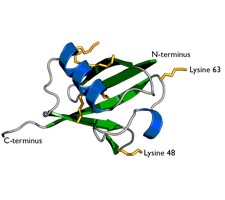
Ubiquitylation is the covalent attachment of ubiquitin to lysine residues, serving as a tag for protein degradation or cellular localization.
Ubiquitin: Small cytosolic protein (76 amino acids).
Function: Marks proteins for degradation or directs them to specific locations.
Other Covalent Modifications
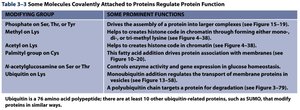
Proteins can undergo various other covalent modifications, each with distinct functional consequences.
Modifying Group | Some Prominent Functions |
|---|---|
Phosphorylation on Ser, Thr, or Tyr | Drives assembly of protein complexes |
Methyl on Lys | Histone code in chromatin, gene regulation |
Acetyl on Lys | Histone code, gene regulation |
Palmitoyl group on Cys | Membrane association |
N-acetylglucosamine on Ser or Thr | Enzyme activity, gene expression |
Ubiquitin on Lys | Protein degradation, transport |
Protein-Ligand Interactions
Ligand Binding and Protein Function
Proteins interact with other molecules called ligands. The physical interaction between a protein and its ligand determines the protein's biological properties.
Binding is reversible due to non-covalent bonds.
Binding strength depends on 3D complementarity and the number of non-covalent bonds.
Importance of Protein Folding
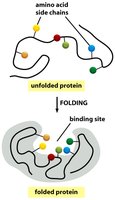
The amino acids involved in ligand binding may be distant in the primary sequence but are brought together in the folded protein, forming a specific binding site.
Quantifying Binding Strength
The strength of protein-ligand binding is measured by the dissociation constant () and association constant ().
Dissociation constant:
Association constant:
Lower values indicate stronger binding.
Example: Antibody binding to a bacterial toxin ( M) is stronger than calmodulin binding to calcium ( M).
Regulation of Protein Activity
Regulation by Phosphorylation and GTP Binding
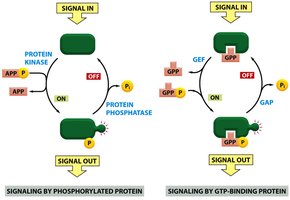
Protein activity can be regulated by phosphorylation or by binding to nucleotides such as GTP. These mechanisms act as molecular switches, turning proteins on or off in response to cellular signals.
Phosphorylation: Protein kinases add phosphate groups; protein phosphatases remove them.
GTP binding: GTP-binding proteins are regulated by GEFs (guanine nucleotide exchange factors) and GAPs (GTPase activating proteins).
Integration of Multiple Regulatory Inputs
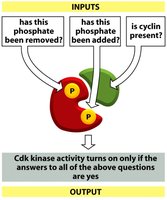
Some proteins, such as cyclin-dependent kinases (Cdks), integrate multiple regulatory signals, including phosphorylation at different sites and binding to other proteins (e.g., cyclins).
Cdks: Activity is regulated by phosphorylation, dephosphorylation, and cyclin binding.
Molecular integration: Multiple modification/interaction sites allow proteins to act as molecular integrators.
Summary
The Big Picture
Covalent modifications and ligand binding are fundamental mechanisms for regulating protein function. These processes enable proteins to respond dynamically to cellular signals and environmental changes, ensuring proper cellular function and homeostasis.
