 Indietro
Quantum Chemistry & Atomic Theory: Waves, Light, and Atomic Structure
Guida di studio - Note intelligenti
 Appunti personalizzati basati sui tuoi materiali, ampliati con definizioni chiave, esempi e contesto.
Chapter 2: Quantum Chemistry & Atomic Theory
Introduction to Electromagnetic Radiation
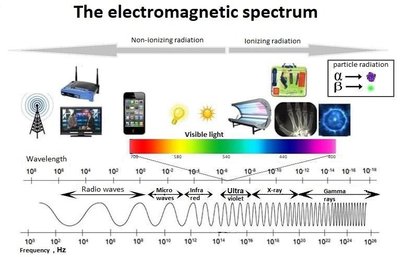
Electromagnetic radiation is a form of energy that exhibits wave-like behavior as it travels through space. Understanding its properties is essential for explaining atomic structure and the behavior of electrons in atoms.
Electromagnetic Spectrum: The range of all types of electromagnetic radiation, from radio waves to gamma rays.
Visible Light: The small portion of the spectrum that can be detected by the human eye, typically from about 400 nm (violet) to 700 nm (red).
Properties of Waves
Waves are characterized by several key properties that determine their behavior and interaction with matter.
Wavelength (\( \lambda \)): The distance between two consecutive peaks or troughs in a wave, measured in meters (m) or nanometers (nm).
Frequency (\( \nu \)): The number of wave cycles that pass a given point per second, measured in hertz (Hz).
Amplitude: The height of the wave from the center line to the peak (or trough), related to the intensity of the wave.
Speed (\( c \)): The speed of light in a vacuum, \( c = 3.00 \times 10^8 \) m/s.
The relationship between wavelength, frequency, and speed is given by:

Wave Interactions: Interference and Diffraction
Waves can interact with each other and with obstacles, leading to phenomena such as interference and diffraction.
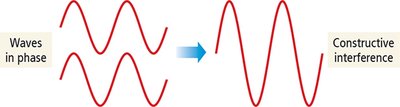
Constructive Interference: When waves are in phase, their amplitudes add, resulting in a larger wave.
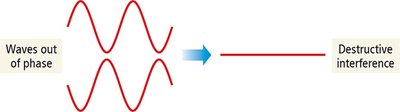
Destructive Interference: When waves are out of phase, their amplitudes subtract, possibly canceling each other out.
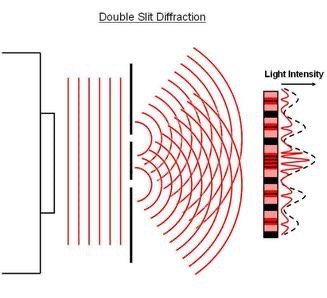
Diffraction: The bending and spreading of waves around obstacles or through slits, producing characteristic patterns.
Blackbody Radiation and Planck's Quantum Hypothesis
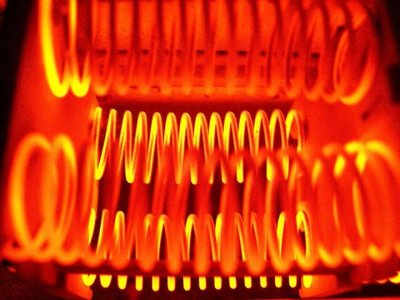
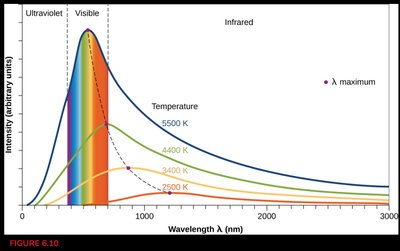
Blackbody radiation refers to the electromagnetic radiation emitted by an object as a result of its temperature. Classical physics could not explain the observed spectrum, leading to the development of quantum theory.
Planck's Quantum Hypothesis: Energy is emitted or absorbed in discrete packets called quanta (or photons).
Planck's Constant (\( h \)): J·s
Energy of a photon:

Photoelectric Effect
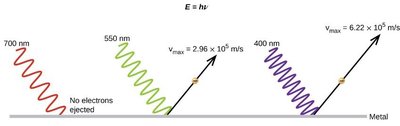
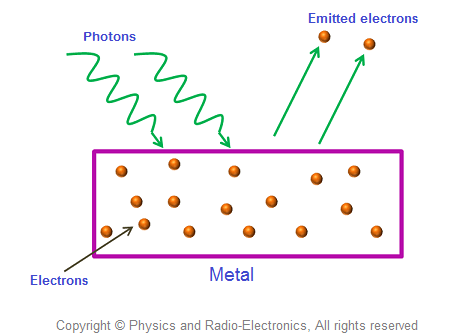
The photoelectric effect demonstrates the particle nature of light. When light of sufficient frequency strikes a metal surface, electrons are ejected. This effect could not be explained by wave theory alone.
Threshold Frequency (\( \nu_0 \)): The minimum frequency required to eject electrons from a metal surface.
Work Function (\( \phi \)): The minimum energy needed to remove an electron from the surface of a metal.
Einstein's Equation:
Atomic Spectra and the Bohr Model
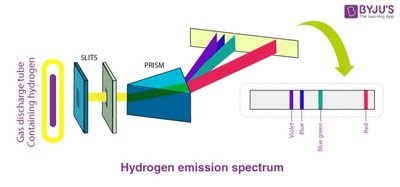
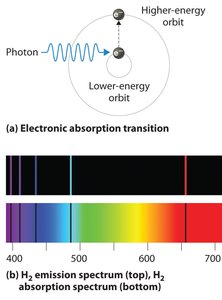
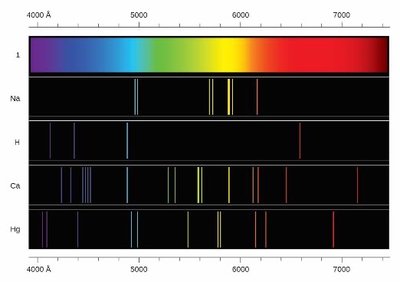
Atoms emit or absorb light at specific wavelengths, producing line spectra. The Bohr model explains these spectra by quantizing electron energy levels.
Emission Spectrum: The set of wavelengths emitted by excited atoms as electrons fall to lower energy levels.
Absorption Spectrum: The set of wavelengths absorbed by atoms as electrons are promoted to higher energy levels.
Bohr Model: Electrons orbit the nucleus in fixed energy levels; transitions between levels involve absorption or emission of photons.
Energy Difference:
Rydberg Equation: , where m
De Broglie Wavelength and Wave-Particle Duality
Louis de Broglie proposed that particles such as electrons have wave-like properties, characterized by a wavelength dependent on their momentum.
De Broglie Wavelength:
Wave-Particle Duality: All matter exhibits both particle and wave properties, especially significant for small particles like electrons.
Quantum Mechanical Model: Wavefunctions and Atomic Orbitals
The quantum mechanical model describes electrons in terms of wavefunctions (\( \psi \)), which provide information about the probability of finding an electron in a particular region of space.
Wavefunction (\( \psi \)): A mathematical function describing the wavelike behavior of an electron.
Probability Density (\( \psi^2 \)): The probability of finding an electron in a given region of space.
Atomic Orbital: A region in space where there is a high probability of finding an electron.
Quantum Numbers and Atomic Orbitals
Quantum numbers describe the properties of atomic orbitals and the electrons within them.
Principal Quantum Number (n): Indicates the main energy level or shell.
Angular Momentum Quantum Number (l): Indicates the shape of the orbital (s, p, d, f).
Magnetic Quantum Number (ml): Indicates the orientation of the orbital in space.
Spin Quantum Number (ms): Indicates the spin direction of the electron (+1/2 or -1/2).
Electron Configuration Principles
Electron configurations describe the arrangement of electrons in an atom. Several principles govern this arrangement:
Pauli Exclusion Principle: No two electrons in an atom can have the same set of four quantum numbers.
Aufbau Principle: Electrons fill the lowest energy orbitals first.
Hund's Rule: Electrons occupy degenerate orbitals singly before pairing up.
Periodic Trends
Periodic trends describe how certain properties of elements change across the periodic table.
Atomic Radius: Generally decreases across a period and increases down a group.
Ionization Energy: The energy required to remove an electron from an atom; increases across a period and decreases down a group.
Electron Affinity: The energy change when an atom gains an electron; generally becomes more negative across a period.
Electronegativity: The tendency of an atom to attract electrons in a chemical bond.
Summary Table: Key Equations and Constants
Concept | Equation | Constant/Value |
|---|---|---|
Speed of Light | m/s | |
Photon Energy | J·s | |
De Broglie Wavelength | ||
Rydberg Equation | m |
