 Indietro
Quantum Mechanical Model, Electron Configuration, and Periodic Trends: Study Notes for General Chemistry
Guida di studio - Note intelligenti
 Appunti personalizzati basati sui tuoi materiali, ampliati con definizioni chiave, esempi e contesto.
Wave-Particle Duality and the Nature of Light
Wavelength, Frequency, and the Electromagnetic Spectrum
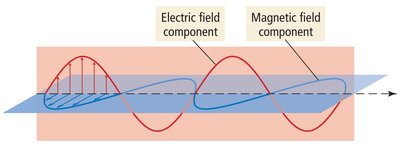
The study of light is fundamental to understanding atomic structure. Light exhibits both wave-like and particle-like properties, a concept known as wave-particle duality.
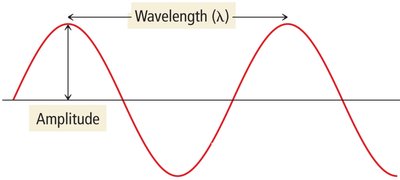
Wavelength (\(\lambda\)): The distance between two consecutive peaks of a wave. Units include meters (m), nanometers (nm), etc.
Frequency (\(\nu\)): The number of wave cycles that pass a point per second. Units: Hertz (Hz) or s-1.
Speed of Light (\(c\)): All electromagnetic radiation travels at \(c = 2.998 \times 10^8\) m/s in a vacuum.
Relationship:
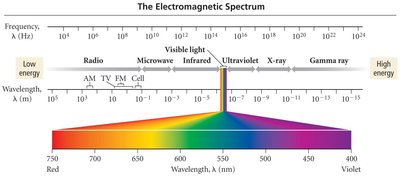
Electromagnetic Spectrum: The range of all types of electromagnetic radiation, from radio waves (low energy, long wavelength) to gamma rays (high energy, short wavelength). Visible light is a small portion of this spectrum.
Key Points:
Energy and frequency are directly related; frequency and wavelength are inversely related.
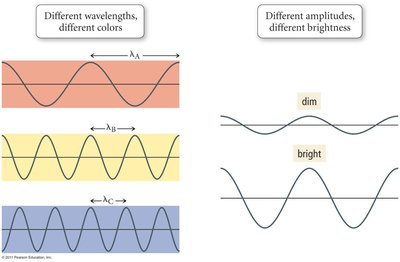
Color of visible light is determined by wavelength/frequency.
Amplitude and Brightness
Amplitude is the height of the wave from the center line to the peak. It determines the brightness (intensity) of light, not its color.
Wave Behavior: Diffraction and Interference
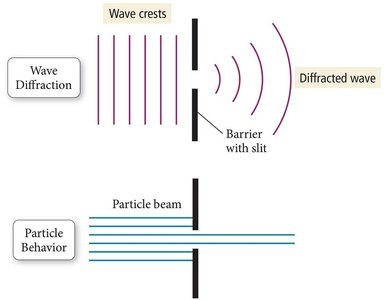
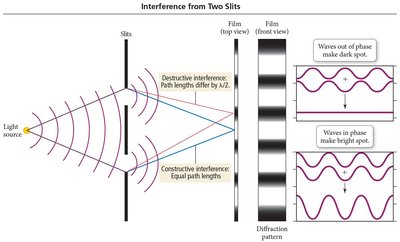
Light demonstrates wave behavior through diffraction (bending around obstacles) and interference (interaction of waves).
Constructive interference: Waves in phase combine to make a brighter spot.
Destructive interference: Waves out of phase cancel each other, resulting in darkness.
Dispersion and Spectra
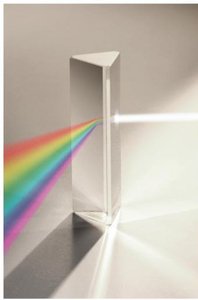
When white light passes through a prism, it separates into its component colors (dispersion), forming a spectrum.
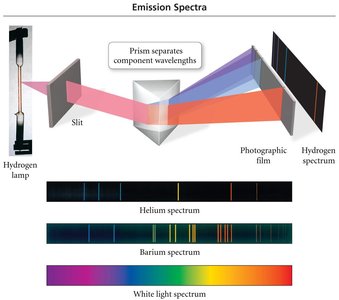
Absorption spectrum: Shows wavelengths absorbed by a substance. Emission spectrum: Shows wavelengths emitted when electrons fall to lower energy levels.
Atomic Structure and Electron Transitions
Bohr Model and Electron Transitions
The Bohr model describes electrons in fixed energy levels (orbits) around the nucleus. While not fully accurate, it helps explain electron transitions:
Ground state: Lowest energy level of an electron.
Excited state: Higher energy level; electron absorbs energy to reach this state.
When an electron falls from an excited state to a lower energy level, it emits a photon of light.
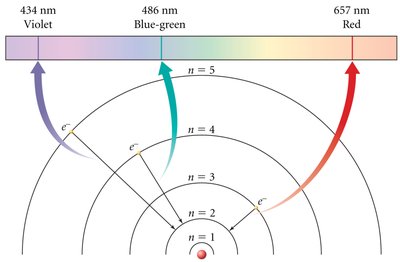
Applications: Flame tests and fireworks colors are due to electron transitions in different elements.


Particle Nature of Light: The Photoelectric Effect
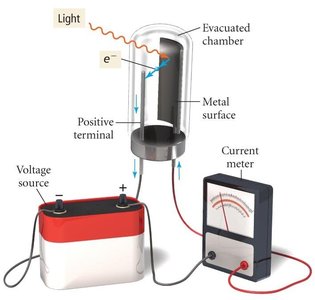
Light also behaves as particles called photons. The photoelectric effect demonstrates that light can eject electrons from a metal surface if its energy exceeds a threshold.
Energy of a photon:
Planck's constant: J·s
Quantum Mechanics and Atomic Orbitals
Wave-Particle Duality of Electrons
Electrons exhibit both wave and particle properties. Their behavior is described by quantum mechanics, not classical physics.
de Broglie equation:
Wavelength is significant for small particles like electrons.
Heisenberg Uncertainty Principle
It is impossible to know both the exact position and momentum of an electron simultaneously:
Electrons are described by probability clouds, not fixed orbits.

Quantum Numbers and Atomic Orbitals
Quantum numbers describe the probable location and properties of electrons in atoms:
Quantum Number | Symbol | Allowed Values | Significance |
|---|---|---|---|
Principal | n | 1, 2, 3, ... | Energy level, distance from nucleus |
Azimuthal (Angular Momentum) | l | 0 to n-1 | Shape of orbital (s, p, d, f) |
Magnetic | m_l | -l to +l | Orientation of orbital |
Spin | m_s | +1/2, -1/2 | Electron spin direction |
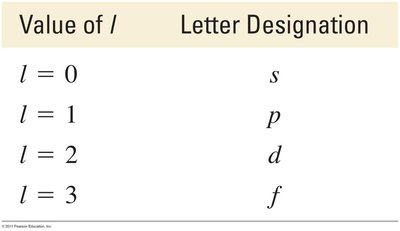
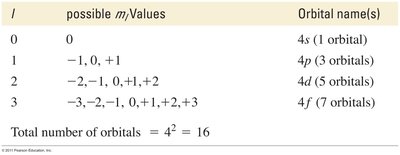
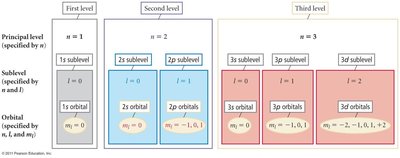
Pauli Exclusion Principle: No two electrons in an atom can have the same set of four quantum numbers.
Shapes of Atomic Orbitals
s orbitals: Spherical shape, one per energy level.
p orbitals: Dumbbell (figure-8) shape, three per energy level (except n=1).
d orbitals: Four-lobed (cloverleaf) shapes, five per energy level (n ≥ 3).
f orbitals: Complex shapes, seven per energy level (n ≥ 4).
Electron Configuration and Periodic Trends
Electron Configuration Principles
Aufbau Principle: Electrons fill lowest energy orbitals first.
Pauli Exclusion Principle: Each orbital holds two electrons with opposite spins.
Hund's Rule: Electrons occupy degenerate orbitals singly before pairing up.
Core and Valence Electrons
Core electrons are in inner shells; valence electrons are in the outermost shell and determine chemical reactivity.
Periodic Trends
Atomic radius: Increases down a group, decreases across a period.
Ionization energy: Energy required to remove an electron; increases across a period, decreases down a group.
Electron affinity: Energy change when an atom gains an electron; generally becomes more negative across a period.
Effective nuclear charge (Zeff): Net positive charge felt by valence electrons; increases across a period.
Coulomb's Law: The force between charged particles is proportional to the product of their charges and inversely proportional to the square of the distance between them.
Ionic Size
Cations are smaller than their parent atoms.
Anions are larger than their parent atoms.
Isoelectronic species (same number of electrons) decrease in size with increasing nuclear charge.
Practice Problems and Applications
Predict electron configurations for atoms and ions.
Identify paramagnetic (unpaired electrons) and diamagnetic (all electrons paired) species.
Apply periodic trends to explain chemical properties and reactivity.
Example: Arrange Na, S, and Al in order of increasing first ionization energy: Na < Al < S.
Example: Write the electron configuration for the sodium ion: 1s2 2s2 2p6.
Example: Which of the following transitions for an electron in a hydrogen atom would release a photon with the largest amount of energy? n = 3 → n = 1.
