 Indietro
Quantum-Mechanical Model of the Atom: Study Notes
Guida di studio - Note intelligenti
 Appunti personalizzati basati sui tuoi materiali, ampliati con definizioni chiave, esempi e contesto.
Ch.2 - The Quantum-Mechanical Model of the Atom
Wavelength and Frequency
The study of light as electromagnetic radiation is fundamental to understanding atomic structure. Light can behave as both a wave and a particle, and its properties are described by wavelength, frequency, and amplitude.
Wavelength (\( \lambda \)): The distance between consecutive crests or troughs of a wave. It is typically measured in meters (m), nanometers (nm), or other units of length.
Frequency (\( \nu \)): The number of wave cycles that pass a given point per second. It is measured in Hertz (Hz), where 1 Hz = 1 s–1.
Amplitude: The height of the wave from the origin to the crest or trough, related to the intensity of the wave.
Relationship: At a fixed speed, frequency is inversely proportional to wavelength: as wavelength increases, frequency decreases, and vice versa.
Example: Among waves with wavelengths 453 nm, 707 nm, 325 nm, and 910 nm, the wave with the shortest wavelength (325 nm) has the highest frequency.
N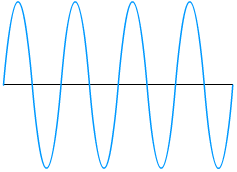
Speed of Light
The speed of light (c) in a vacuum is a fundamental constant, relating wavelength and frequency:
Formula:
c: Speed of light, m/s
\( \lambda \): Wavelength in meters
\( \nu \): Frequency in s–1 (Hz)
Example: To find the frequency of red light with a wavelength of 663.8 nm, use .
Practice: Calculate the wavelength in angstroms for a radio station broadcasting at 97.7 MHz. (1 Å = m)
Energy of Light
Light energy is quantized in packets called photons. The energy of a photon depends on its frequency or wavelength:
Planck's Constant (h): J·s
Photon Energy (frequency):
Photon Energy (wavelength):
Relationship: Energy is directly proportional to frequency and inversely proportional to wavelength.
Example: Calculate the energy of a photon with a wavelength of 293.7 m.
Mole of Photons: 1 mole of photons = photons (Avogadro's number).
The Electromagnetic Spectrum
The electromagnetic spectrum encompasses all types of electromagnetic radiation, from radio waves to gamma rays. As you move from radio waves to gamma rays, wavelength decreases and frequency increases.
Visible Light: The small portion of the spectrum visible to the human eye (about 400–700 nm).
Energy: Higher frequency (shorter wavelength) radiation, such as X-rays and gamma rays, carries more energy per photon.
Example: X-rays have more energy per photon than microwaves or radio waves.
The Photoelectric Effect
The photoelectric effect demonstrates the particle nature of light. When light of sufficient energy strikes a metal surface, electrons are ejected.
Binding Energy (Work Function, \( E_{B.E.} \)): Minimum energy required to remove an electron from a metal.
Kinetic Energy (\( E_{K.E.} \)): Energy of the ejected electron.
Photoelectric Effect Formula:
Unit Conversion: 1 electronvolt (eV) = J
Example: If a photon with energy greater than the binding energy strikes the metal, the excess energy becomes the kinetic energy of the ejected electron.
De Broglie Wavelength
Louis de Broglie proposed that all matter has wave-like properties. The wavelength of a particle is inversely proportional to its mass and velocity:
Formula:
h: Planck's constant
m: Mass in kg
v: Velocity in m/s
Example: Calculate the wavelength of a proton moving at m/s.
Heisenberg Uncertainty Principle
Werner Heisenberg established that it is impossible to simultaneously know both the exact position and momentum of an electron.
Formula:
\( \Delta x \): Uncertainty in position
\( \Delta p \): Uncertainty in momentum
This principle is a consequence of the wave-particle duality of electrons.
Bohr Model of the Atom
Niels Bohr proposed that electrons orbit the nucleus in fixed energy levels (shells). Electrons can move between shells by absorbing or emitting energy.
Shell (n): Principal quantum number, indicates energy level.
Absorption: Electron moves to a higher shell (energy absorbed).
Emission: Electron falls to a lower shell (energy released).
Energy Formula: , where is the Rydberg constant and is atomic number.
Example: Calculate the energy of an electron in the second shell of hydrogen.
Emission Spectrum
When electrons transition between energy levels, they emit light at specific wavelengths, producing an emission spectrum. Each element has a unique line spectrum.
Balmer Series: Transitions ending at n = 2 (visible region).
Lyman Series: Transitions ending at n = 1 (ultraviolet).
Pfund, Brackett, Paschen Series: Transitions ending at higher n values (infrared).

Bohr Equation
The Bohr equation calculates the energy change when an electron transitions between two energy levels:
Energy Change:
Wavelength:
ni: Initial energy level
nf: Final energy level
Introduction to Quantum Mechanics
Quantum mechanics describes the behavior of electrons in atoms using mathematical equations and quantum numbers.
Schrodinger's Wave Equation: Describes the probability distribution of electrons.
Quantum Numbers: Specify the energy, shape, and orientation of atomic orbitals.
Quantum Numbers
Principal Quantum Number (n): Indicates the main energy level (shell). n = 1, 2, 3, ...
Angular Momentum Quantum Number (l): Indicates the subshell (shape of orbital). l = 0 to n–1. (s, p, d, f)
Magnetic Quantum Number (ml): Indicates the orientation of the orbital. ml = –l to +l.
Spin Quantum Number (ms): Indicates the spin of the electron. ms = +1/2 or –1/2.

Number of Electrons in Shells, Subshells, and Orbitals
Maximum electrons in a shell: 2n2
Maximum electrons in subshells:
s: 2 electrons
p: 6 electrons
d: 10 electrons
f: 14 electrons
Pauli Exclusion Principle: No two electrons in the same atom can have the same set of four quantum numbers.
Summary Table: Quantum Numbers and Subshells
Quantum Number | Symbol | Possible Values | Physical Meaning |
|---|---|---|---|
Principal | n | 1, 2, 3, ... | Shell (energy level) |
Angular Momentum | l | 0 to n–1 | Subshell (orbital shape) |
Magnetic | ml | –l to +l | Orbital orientation |
Spin | ms | +1/2, –1/2 | Electron spin |
Additional info: These notes cover the foundational quantum concepts necessary for understanding atomic structure, electron configuration, and the periodic properties of elements in general chemistry.
