 Indietro
Quantum-Mechanical Model of the Atom: Structure, Properties, and Electron Behavior
Guida di studio - Note intelligenti
 Appunti personalizzati basati sui tuoi materiali, ampliati con definizioni chiave, esempi e contesto.
Quantum Mechanics and the Atomic Model
Introduction to Quantum Mechanics
The quantum-mechanical model of the atom explains the unique and often counterintuitive behavior of electrons at the subatomic level. Early twentieth-century scientists such as Einstein, Bohr, de Broglie, Planck, Heisenberg, Dirac, and Schrödinger laid the foundation for our understanding of matter and its behavior at the quantum scale.
Subatomic particles include electrons, protons, and neutrons.
Electrons exhibit both particle-like and wave-like properties, a phenomenon known as wave–matter duality.
Direct observation of electrons is impossible without altering their behavior.
Importance of Quantum Mechanics in Chemistry
The quantum-mechanical model forms the foundation of chemistry by explaining:
The structure and periodic trends of the periodic table
The behavior of elements in chemical bonding
The colors and sizes of atoms
Why elements are metals, nonmetals, reactive, or inert
The Nature of Light and Electromagnetic Radiation
Wave Nature of Light
Light is a form of electromagnetic radiation, composed of perpendicular oscillating waves—one for the electric field and one for the magnetic field. All electromagnetic waves travel at the speed of light, m/s.
Electric field: Region where an electrically charged particle experiences a force.
Magnetic field: Region where a magnetized particle experiences a force.
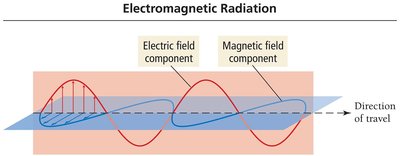
Characteristics of Energy Waves
Amplitude: Height of the wave; determines light intensity (brightness).
Wavelength (λ): Distance from one crest to the next; determines color.
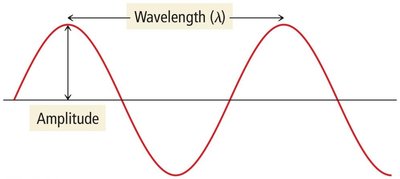
Wavelength and amplitude are independent properties. The wavelength determines color (intensive property), while amplitude determines brightness (extensive property).
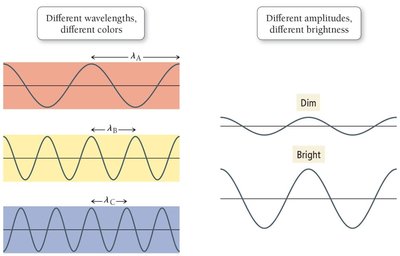
Color and Frequency
The color of light is determined by its wavelength or frequency. White light is a mixture of all visible wavelengths. When an object absorbs some wavelengths and reflects others, it appears colored.
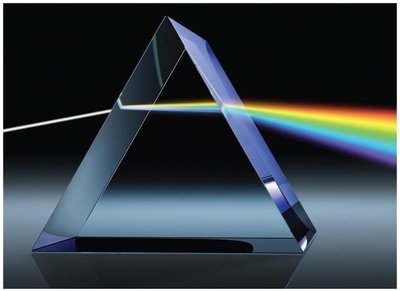
Frequency (ν): Number of waves passing a point per unit time (Hz or s−1).
Total energy (E): Proportional to amplitude and frequency.
Relationship Between Wavelength and Frequency
Wavelength and frequency are inversely proportional for electromagnetic waves:
Long wavelength → low frequency
Short wavelength → high frequency
Mathematically:
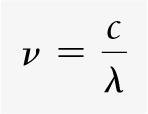
Example Calculation: Wavelength and Frequency
Given frequency, calculate wavelength:
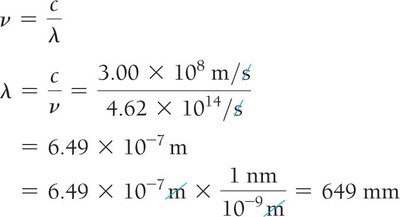
The Electromagnetic Spectrum
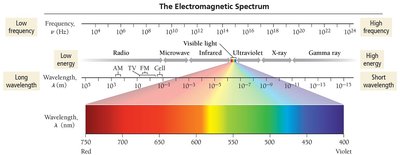
Visible light (400–700 nm) is only a small fraction of the electromagnetic spectrum. Shorter wavelength (higher frequency) light has higher energy. High-energy radiation (UV, X-ray, gamma) can damage biological molecules.
Wave Properties: Interference and Diffraction
Interference
Interference is the interaction between waves:
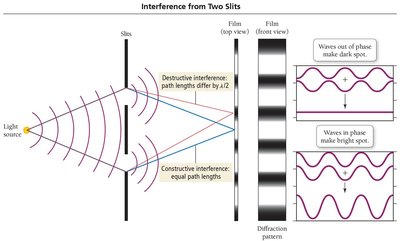
Constructive interference: Waves add to make a larger wave (in phase).
Destructive interference: Waves cancel each other (out of phase).
Diffraction
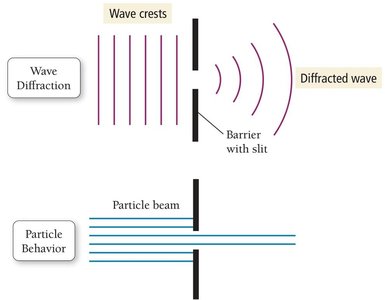
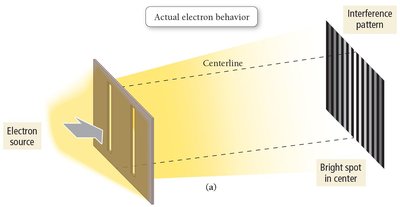
When waves encounter an obstacle or opening similar in size to their wavelength, they bend around it (diffraction). Particles do not diffract. Diffraction through two slits produces an interference pattern.
The Photoelectric Effect
Einstein's Observations
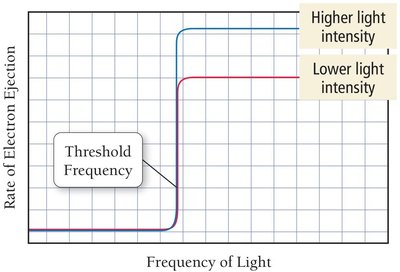
When light shines on a metal surface, electrons are emitted (photoelectrons). This is the photoelectric effect.
Classical vs Quantum Theory
Classical theory: Electron emission depends on light intensity and wavelength.
Quantum theory: A minimum frequency (threshold frequency) is required, regardless of intensity.
Energy of Photons
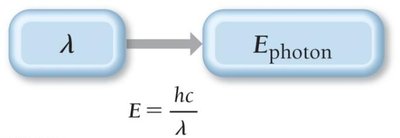
Einstein proposed that light energy is delivered in packets called quanta or photons. The energy of a photon is:
Or, in terms of wavelength:
Planck’s constant (h): J·s
Speed of light (c): m/s
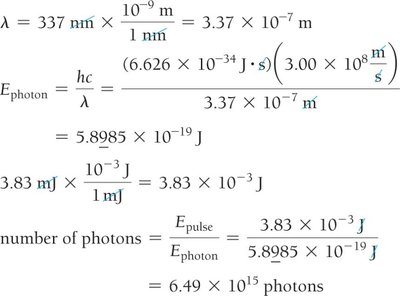
Example Calculation: Photon Energy
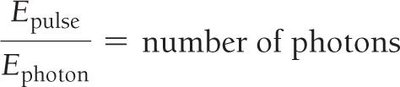
Calculate the number of photons in a pulse:
Atomic Spectra and the Bohr Model
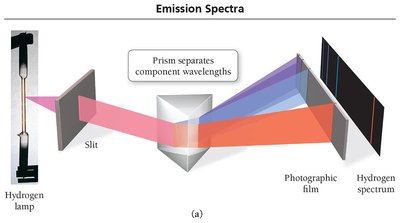
Emission Spectra
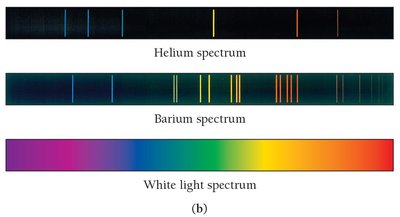
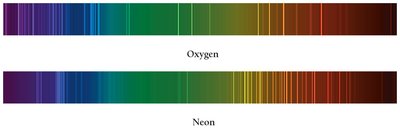
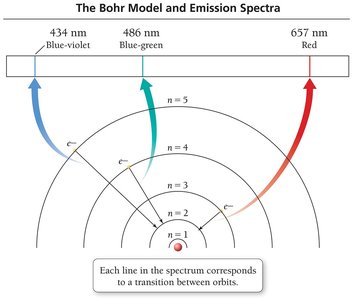
When atoms absorb energy, they emit light at specific wavelengths, producing a unique emission spectrum. Each element has its own line spectra.
The Bohr Model
Bohr proposed that electrons travel in fixed orbits (stationary states) around the nucleus. The energy of the electron is quantized and proportional to the orbit's distance from the nucleus. Electrons emit photons when they transition between orbits.
Wave Behavior of Electrons: de Broglie Relation
de Broglie Wavelength
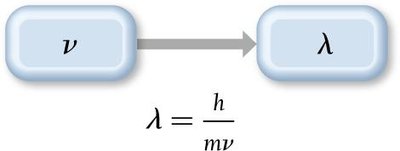
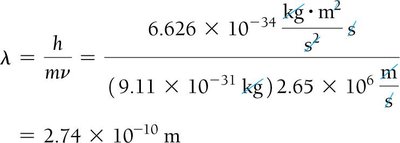
de Broglie proposed that particles have wave-like properties. The wavelength of a particle is inversely proportional to its momentum:
Electron Diffraction
Electron beams produce interference patterns, demonstrating their wave nature.
Complementary Properties and Uncertainty Principle
Wave–Particle Duality and Uncertainty
Electrons exhibit both particle (position) and wave (interference) properties, but both cannot be observed simultaneously. The more precisely one property is known, the less precisely the other can be known.
Heisenberg’s Uncertainty Principle:
Determinacy vs Indeterminacy
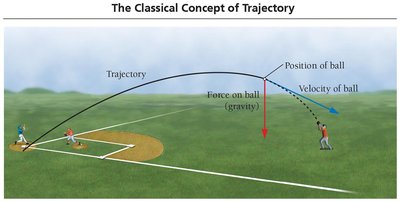
Classical physics predicts definite trajectories, but quantum mechanics only predicts probabilities.

Schrödinger’s Equation and Quantum Numbers
Schrödinger’s Equation
Schrödinger’s equation calculates the probability of finding an electron with a particular energy at a particular location. The solutions are wave functions (ψ), and ψ2 represents probability density.
Quantum Numbers
Quantum numbers describe the size, shape, orientation, and spin of atomic orbitals:
Principal quantum number (n): Energy level; n = 1, 2, 3, ...
Angular momentum quantum number (l): Orbital shape; l = 0 to n–1
Magnetic quantum number (ml): Orbital orientation; ml = –l to +l
Spin quantum number (ms): Electron spin; ms = +½ or –½


Energy Levels and Sublevels
Each set of n, l, and ml describes one orbital. Orbitals with the same n are in the same principal energy level (shell), and those with the same n and l are in the same sublevel (subshell).
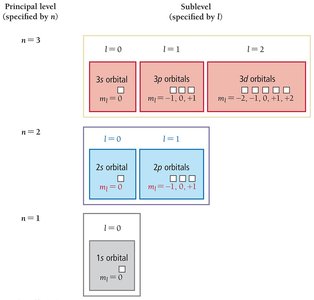
l | Possible ml Values | Orbital name(s) |
|---|---|---|
0 | 0 | 4s (1 orbital) |
1 | −1, 0, +1 | 4p (3 orbitals) |
2 | −2, −1, 0, +1, +2 | 4d (5 orbitals) |
3 | −3, −2, −1, 0, +1, +2, +3 | 4f (7 orbitals) |
Electron Transitions and Atomic Spectra
Electron Excitation and Relaxation
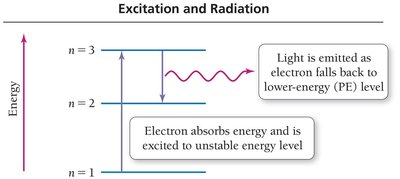
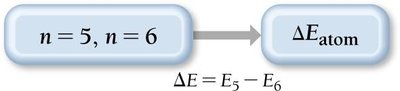
Electrons transition between energy levels by absorbing or emitting energy. Each line in the emission spectrum corresponds to a transition between two energy states.
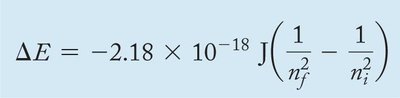
Calculating Energy and Wavelength of Transitions
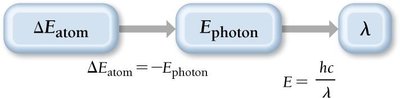
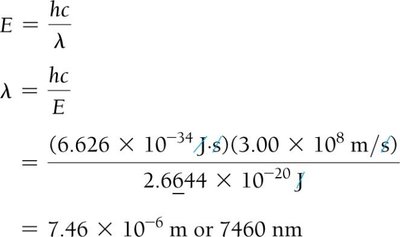
The energy of a photon released is equal to the difference in energy between two levels:
For hydrogen:
Probability and Atomic Orbitals
Probability Density and Radial Distribution
ψ2 is the probability density of finding an electron at a particular point. The radial distribution function represents the total probability at a certain distance from the nucleus, with a maximum at the most probable radius.
Shapes of Atomic Orbitals
s orbitals (l = 0): Spherical shape; one per energy level.
p orbitals (l = 1): Dumbbell shape; three per energy level above n = 1.
d orbitals (l = 2): Four-lobed shape; five per energy level above n = 2.
f orbitals (l = 3): Eight-lobed shape; seven per energy level above n = 3.
Nodes are regions where the probability of finding an electron is zero.
Orbital Phase
Wave functions can have positive or negative values (phases). When orbitals interact, their wave functions may be in phase (same sign) or out of phase (opposite signs).
