 Indietro
Quantum-Mechanical Model of the Atom: Study Notes
Guida di studio - Note intelligenti
 Appunti personalizzati basati sui tuoi materiali, ampliati con definizioni chiave, esempi e contesto.
Quantum-Mechanical Model of the Atom
Introduction to the Quantum-Mechanical Model
The quantum-mechanical model provides a framework for understanding the unique behavior of electrons within atoms. This model explains how electrons exist and move, and how their arrangement determines the chemical and physical properties of elements.
Quantum-Mechanical Model: Describes electrons as both particles and waves, accounting for their strange behavior.
Electron Properties: The arrangement and movement of electrons influence element properties.
Wave Nature of Light
Electromagnetic Radiation and Its Properties
Light exhibits both wave-like and particle-like properties. Electromagnetic radiation includes various types such as x-rays, ultraviolet (UV), visible light, infrared (IR), and radio waves. The wave properties of light are fundamental to understanding atomic structure.
Amplitude: The height of the wave, related to the intensity of light.
Wavelength (\( \lambda \)): The distance between two consecutive peaks of a wave.
Frequency (\( \nu \)): The number of wave cycles per second (measured in Hz).
Energy: Related to frequency by Planck’s constant (\( h = 6.63 \times 10^{-34} \) J·s).
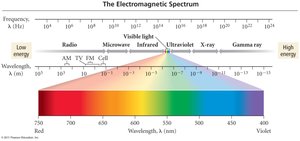
Examples of Wave Calculations
Wavelength Calculation: What is the wavelength of light with a frequency of \( 7.5 \times 10^{14} \) s-1?
Frequency Calculation: What is the frequency of light with a wavelength of 450 nm?
Energy Calculation: What is the energy of 450 nm light?
Key Equations:
\( c = \lambda \nu \) — Speed of light equation (\( c = 3.00 \times 10^8 \) m/s)
\( E = h \nu \) — Energy of a photon
\( \lambda = \frac{c}{\nu} \) — Wavelength-frequency relationship
Properties of Electromagnetic Radiation
Wave and Particle Properties
Electromagnetic radiation demonstrates both wave and particle characteristics. Three main wave properties are interference, refraction, and diffraction. The particle property is illustrated by the photoelectric effect.
Interference: When waves overlap, they can reinforce or cancel each other.
Refraction: Bending of light as it passes through different media.
Diffraction: Spreading of waves around obstacles.
Photoelectric Effect: Ejection of electrons from a material when light shines on it (Einstein).
Photons: Light particles responsible for the photoelectric effect.
Duality of Light: Light behaves as both a wave and a particle.
The Bohr Theory
Atomic Line Spectra and Bohr’s Postulates
The Bohr model explains atomic line spectra and introduces the concept of quantized energy levels. Electrons can only occupy specific energy levels and transition between them by absorbing or emitting energy.
Energy Level Postulate: Electrons have specific, quantized energies.
Transitions: Electrons change energy by moving between levels.
Quantum Mechanics
Wave-Particle Duality and De Broglie Relation
Quantum mechanics applies to submicroscopic particles like electrons. Einstein showed that light is both a wave and a particle. De Broglie proposed that small particles of matter, such as electrons, can have a wavelength.
De Broglie Relation: \( \lambda = \frac{h}{mv} \) — Wavelength of a particle (\( m \) = mass, \( v \) = velocity)
Examples:
Calculate the wavelength of a golf ball (mass = 65 g, velocity = 240 m/s).
Calculate the wavelength of an electron (mass = \( 9.11 \times 10^{-31} \) kg, velocity = \( 4.7 \times 10^7 \) m/s).
Wave Functions and the Uncertainty Principle
Schrödinger’s Wave Functions and Heisenberg’s Uncertainty Principle
Electrons do not move in precise paths. Schrödinger’s wave functions allow statistical predictions about electron locations. Heisenberg’s uncertainty principle states that the more precisely we know an electron’s position, the less precisely we know its momentum.
Wave Function: Mathematical expression describing the probability of finding an electron in a given energy level.
Uncertainty Principle: \( \Delta x \Delta p \geq \frac{h}{4\pi} \) — Fundamental limit to precision.
Quantum Numbers & Atomic Orbitals
Quantum Numbers
Each electron in an atom is described by four quantum numbers, which define its energy, shape, orientation, and spin.
Principal Quantum Number (n): Determines energy and size of the orbital. Values: 1, 2, 3, ... (Shells: K, L, M, N)
Angular Momentum Quantum Number (l): Determines shape of the orbital. Values: 0 to n-1 (s, p, d, f, g)
Magnetic Quantum Number (ml): Determines orientation in space. Values: -l to +l
Spin Quantum Number (ms): Describes electron spin. Values: +½ or –½
Atomic Orbitals and Their Shapes
Atomic orbitals are wave functions for electrons in atoms. The shape of the orbital depends on the angular momentum quantum number.
s orbitals (l = 0): Spherical shape
p orbitals (l = 1): Peanut-shaped (px, py, pz)
d orbitals (l = 2): Propeller-shaped
Possible Combinations of Quantum Numbers
The possible values for quantum numbers depend on the principal quantum number (n) and angular momentum quantum number (l). Each combination defines a unique electron state.
n | l | ml | ms |
|---|---|---|---|
4 | 3 | -3, -2, -1, 0, +1, +2, +3 | -1/2 or +1/2 |
4 | 2 | -2, -1, 0, +1, +2 | -1/2 or +1/2 |
4 | 1 | -1, 0, +1 | -1/2 or +1/2 |
4 | 0 | 0 | -1/2 or +1/2 |
3 | 2 | -2, -1, 0, +1, +2 | -1/2 or +1/2 |
3 | 1 | -1, 0, +1 | -1/2 or +1/2 |
3 | 0 | 0 | -1/2 or +1/2 |
2 | 1 | -1, 0, +1 | -1/2 or +1/2 |
2 | 0 | 0 | -1/2 or +1/2 |
1 | 0 | 0 | -1/2 or +1/2 |
Examples of Quantum Numbers
3s electron in Na: n = 3, l = 0, ml = 0, ms = +½ or –½
2p electron in Cl: n = 2, l = 1, ml = -1, 0, +1, ms = +½ or –½
Last electron in Fe: n = 3, l = 2, ml = -2, -1, 0, +1, +2, ms = +½ or –½
