 Indietro
Quantum-Mechanical Model of the Atom: Study Notes for General Chemistry
Guida di studio - Note intelligenti
 Appunti personalizzati basati sui tuoi materiali, ampliati con definizioni chiave, esempi e contesto.
Chapter 8: The Quantum-Mechanical Model of the Atom
Schrödinger’s Cat and the Beginnings of Quantum Mechanics
The quantum-mechanical model revolutionized our understanding of atomic and subatomic phenomena, introducing concepts of indeterminacy and probability. Schrödinger’s Cat is a famous thought experiment illustrating quantum superposition and the role of observation in determining outcomes. Early quantum mechanics challenged the deterministic view of classical physics, especially for subatomic particles.


Key Physicists: Albert Einstein, Niels Bohr, Louis de Broglie, Max Planck, Werner Heisenberg, P. A. M. Dirac, Erwin Schrödinger.
Quantum mechanics forms the foundation of chemistry, explaining the periodic table, chemical bonding, and practical applications like lasers and computers.
Electron behavior determines atomic properties, but direct observation alters their behavior due to their small size.
The Nature of Light: Wave Properties
Light is a form of electromagnetic radiation, consisting of oscillating electric and magnetic fields perpendicular to each other. All electromagnetic waves travel at the same speed in a vacuum, known as the speed of light.
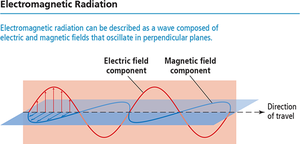
Electric field: Region where charged particles experience force.
Magnetic field: Region where magnetized particles experience force.
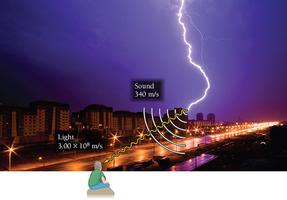
Speed of light: m/s.
Characterizing Waves: Amplitude, Wavelength, and Frequency
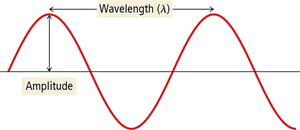
Waves are described by their amplitude, wavelength, and frequency. These properties determine the energy and appearance of light.
Amplitude: Height of the wave; relates to light intensity.
Wavelength (\(\lambda\)): Distance between crests or troughs; determines color.
Frequency (\(\nu\)): Number of cycles per second; measured in Hertz (Hz).
Relationship: For waves at constant speed, wavelength and frequency are inversely proportional: (where is the speed of light).
Color and the Electromagnetic Spectrum
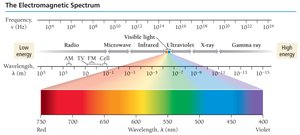
The color of visible light is determined by its wavelength or frequency. White light is a mixture of all visible wavelengths, and objects appear colored based on which wavelengths they reflect or absorb.
Visible spectrum: Red, Orange, Yellow, Green, Blue, Indigo, Violet.
Shorter wavelength: Higher energy (e.g., violet).
Longer wavelength: Lower energy (e.g., red).


The Electromagnetic Spectrum
Visible light is only a small part of the electromagnetic spectrum, which includes radio waves, microwaves, infrared, ultraviolet, X-rays, and gamma rays. Energy increases with frequency and decreases with wavelength.
Radio waves: Lowest energy.
Gamma rays: Highest energy; can damage biological molecules (ionizing radiation).
Continuous Spectrum
A continuous spectrum contains all wavelengths of visible light, as seen when white light passes through a prism.

Wave Interactions: Interference and Diffraction
Waves can interact through interference and diffraction. Constructive interference occurs when waves add together, while destructive interference occurs when they cancel each other. Diffraction is the bending of waves around obstacles or through slits, producing characteristic patterns.
Interference: In phase (constructive), out of phase (destructive).
Diffraction: Unique to waves; produces interference patterns.
The Particle Nature of Light: The Photoelectric Effect
The photoelectric effect demonstrates that light can behave as particles (photons). When light of sufficient frequency strikes a metal, electrons are emitted. The energy of a photon is proportional to its frequency and inversely proportional to its wavelength.
Threshold frequency: Minimum frequency required to emit electrons.
Photon energy: , where is Planck’s constant ( J·s).
Atomic Spectroscopy and the Bohr Model
Atoms emit light when electrons transition between energy levels. The emission spectrum is unique for each element and can be used for identification. The Bohr model explains quantized energy levels and electron transitions.
Emission spectrum: Noncontinuous; each line corresponds to a specific electron transition.
Bohr model: Electrons travel in fixed orbits; energy is quantized.
Energy of electron in hydrogen: J.
The Wave Nature of Matter: de Broglie Wavelength and the Uncertainty Principle
Louis de Broglie proposed that particles, such as electrons, have wave-like properties. The de Broglie wavelength is inversely proportional to momentum. Heisenberg’s uncertainty principle states that position and velocity cannot both be precisely known.
de Broglie wavelength:
Uncertainty principle:
Complementary properties: Wave and particle nature cannot be observed simultaneously.
Quantum Numbers and Atomic Orbitals
Quantum numbers describe the properties of atomic orbitals and electrons:
Principal quantum number (n): Energy level and size;
Angular momentum quantum number (l): Shape; (s), $1 (d), $3$ (f)
Magnetic quantum number (ml): Orientation; to
Spin quantum number (ms): Electron spin; or
Quantum Number | Symbol | Allowed Values | Physical Meaning |
|---|---|---|---|
Principal | n | 1, 2, 3, ... | Energy level, size |
Angular Momentum | l | 0 to n-1 | Shape |
Magnetic | ml | -l to +l | Orientation |
Spin | ms | +1/2, -1/2 | Spin direction |
Shapes of Atomic Orbitals
The shape of an orbital is determined by the angular momentum quantum number (l):
s orbitals (l = 0): Spherical
p orbitals (l = 1): Two-lobed
d orbitals (l = 2): Four-lobed
f orbitals (l = 3): Eight-lobed
Probability density and radial distribution functions describe the likelihood of finding an electron at a particular location or distance from the nucleus.
Summary Table: Energy Levels, Sublevels, and Orbitals
Principal Level (n) | Sublevels (l) | Number of Orbitals | Maximum Electrons |
|---|---|---|---|
1 | 0 (s) | 1 | 2 |
2 | 0 (s), 1 (p) | 4 | 8 |
3 | 0 (s), 1 (p), 2 (d) | 9 | 18 |
4 | 0 (s), 1 (p), 2 (d), 3 (f) | 16 | 32 |
Key Equations
Speed of light:
Photon energy:
de Broglie wavelength:
Energy of electron in hydrogen: J
Uncertainty principle:
Additional info: These notes expand on brief lecture points, providing definitions, examples, and equations for clarity and completeness. Practice problems and conceptual connections are included throughout the original material to reinforce understanding.
