 Indietro
Quantum-Mechanical Model of the Atom: Structure, Properties, and Electron Behavior
Guida di studio - Note intelligenti
 Appunti personalizzati basati sui tuoi materiali, ampliati con definizioni chiave, esempi e contesto.
Quantum Mechanics and the Atomic Model
Introduction to Quantum Mechanics
Quantum mechanics is the branch of physics that explains the behavior of matter and energy at the atomic and subatomic levels. Early twentieth-century scientists such as Einstein, Bohr, de Broglie, Planck, Heisenberg, Dirac, and Schrödinger laid the foundation for our understanding of the quantum world. - Key Point: Subatomic particles (electrons, protons, neutrons) behave differently from macroscopic matter. - Key Point: Electrons exhibit both particle-like and wave-like properties, a concept known as wave–matter duality.
Wave–Matter Duality
The dual nature of electrons means they can behave as particles (with mass and volume) or as waves (with energy characteristics), depending on the experimental conditions. - Example: Electrons show particulate behavior in some experiments and energy-like (wave) behavior in others.
The Nature of Light
Electromagnetic Radiation
Light is a form of electromagnetic radiation, consisting of oscillating electric and magnetic fields perpendicular to each other and to the direction of travel. - Key Point: All electromagnetic waves travel at the speed of light, m/s. 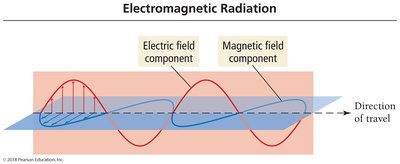
Characteristics of Energy Waves
Waves are described by their amplitude and wavelength. - Amplitude: Height of the wave; determines light intensity (brightness). - Wavelength (\lambda): Distance between successive crests or troughs; determines color. 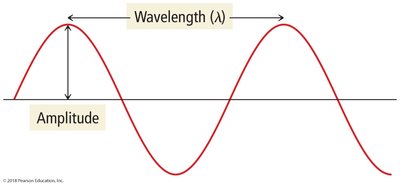
Wavelength and Amplitude
Wavelength and amplitude are independent properties. - Wavelength: Determines color (intensive property). - Amplitude: Determines brightness (extensive property). 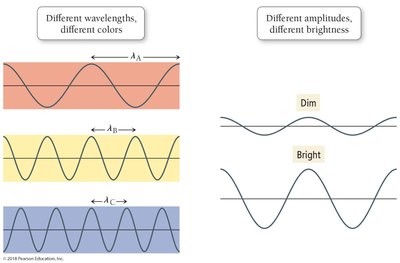
Color and the Visible Spectrum
The color of light is determined by its wavelength or frequency. White light is a mixture of all visible wavelengths. - Key Point: Objects appear colored when they absorb some wavelengths and reflect others. 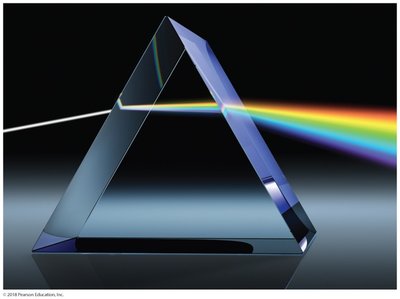
Relationship Between Wavelength and Frequency
Wavelength and frequency are inversely proportional for waves traveling at the same speed. - Formula: where is frequency, is speed of light, is wavelength. 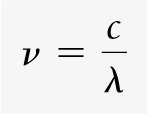
The Electromagnetic Spectrum
The electromagnetic spectrum includes all wavelengths of light, from radio waves (long wavelength, low energy) to gamma rays (short wavelength, high energy). - Visible light: 400–700 nm, a small fraction of the spectrum. - High-energy radiation: UV, X-ray, gamma rays can damage biological molecules (ionizing radiation). 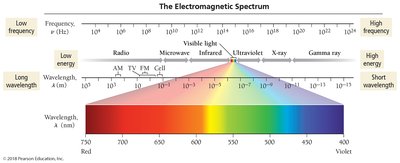
Wave Properties: Interference and Diffraction
Interference
Waves can interact through interference. - Constructive interference: Waves add together (in phase) to make a larger wave. - Destructive interference: Waves cancel each other (out of phase).
Diffraction
When waves encounter an obstacle or opening similar in size to their wavelength, they bend around it (diffraction). - Key Point: Diffraction produces interference patterns, a characteristic of waves. - Particles: Do not diffract. 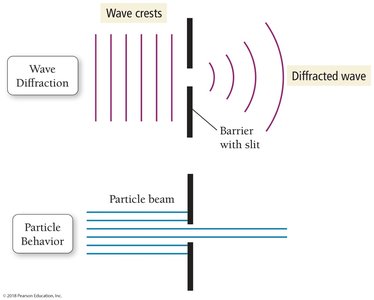
The Photoelectric Effect
Einstein's Explanation
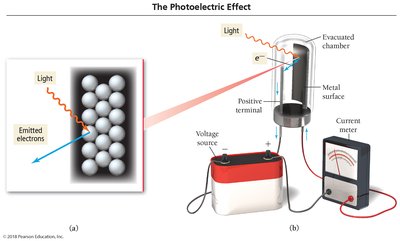
When light shines on a metal surface, electrons are emitted (photoelectrons). This is the photoelectric effect. - Classic theory: Predicted electron emission based on light intensity and wavelength. - Quantum theory: Observed that a minimum frequency (threshold frequency) is required, regardless of intensity. - Key Point: High-frequency light (even if dim) can cause immediate electron emission. 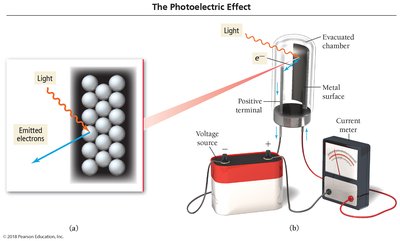
Threshold Frequency and Electron Ejection
The rate of electron ejection depends on the frequency of light, not just intensity. - Key Point: Electrons are ejected only if the light's frequency exceeds the threshold frequency. 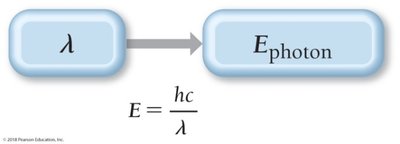
Photon Energy Calculation
The energy of a photon is related to its wavelength: where is Planck's constant, is speed of light, is wavelength. 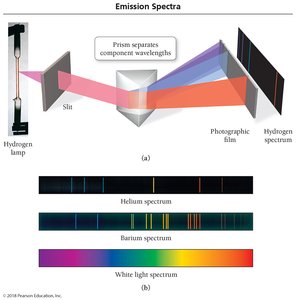
Atomic Spectra and the Bohr Model
Emission Spectra
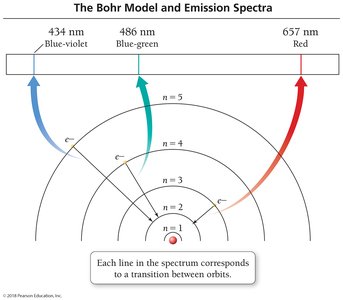
Each element has a unique emission spectrum, consisting of distinct lines. - Example: Hydrogen has four visible lines. 
The Bohr Model of the Atom
Bohr proposed that electrons travel in fixed orbits (stationary states) around the nucleus, with quantized energy levels. - Key Point: Electrons emit photons when transitioning from higher to lower energy orbits. - Quantized energy: Only specific energy values are allowed. 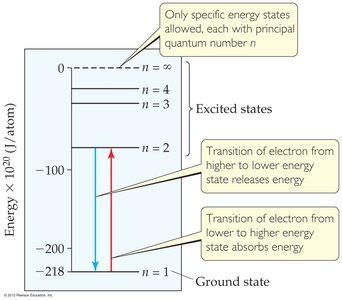
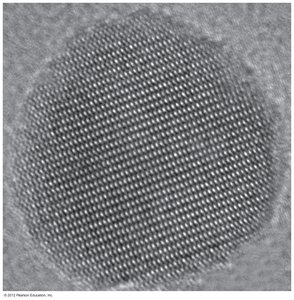
Energy Calculation for Electron Transitions
The energy absorbed or emitted during electron transitions can be calculated: where is the Rydberg constant, and are initial and final energy levels.
The Wave Nature of Matter
de Broglie Relation
Louis de Broglie proposed that matter, like light, exhibits wave properties. - Formula: where is wavelength, is Planck's constant, is mass, is velocity. 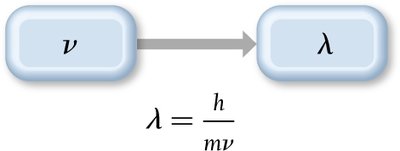
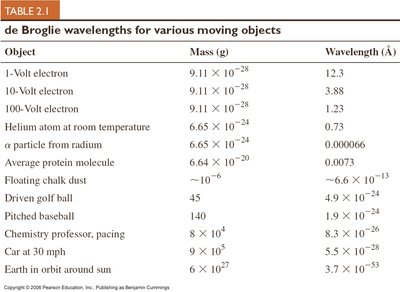
de Broglie Wavelengths for Various Objects
Object | Mass (g) | Wavelength (Å) |
|---|---|---|
1-Volt electron | 9.11 × 10⁻²⁸ | 12.3 |
10-Volt electron | 9.11 × 10⁻²⁸ | 3.88 |
100-Volt electron | 9.11 × 10⁻²⁸ | 1.23 |
Helium atom at room temperature | 6.65 × 10⁻²⁴ | 0.73 |
α particle from radium | 6.65 × 10⁻²⁴ | 0.000066 |
Average protein molecule | 6.64 × 10⁻²⁰ | 0.0073 |
Floating chalk dust | 1 | ~6.6 × 10⁻¹³ |
Driven golf ball | 45 | 4.9 × 10⁻³⁴ |
Pitched baseball | 145 | 1.5 × 10⁻³⁴ |
Chemistry professor, pacing | 8 × 10⁴ | 8.3 × 10−36 |
Car at 30 mph | 9 × 10⁴ | 5.5 × 10−36 |
Earth in orbit around sun | 6 × 1027 | 3.7 × 10−63 |
Electron Diffraction and Wave Behavior
Electron Diffraction
Electrons produce interference patterns when passed through slits, demonstrating their wave nature. - Key Point: If electrons behaved only as particles, only two bright spots would appear. 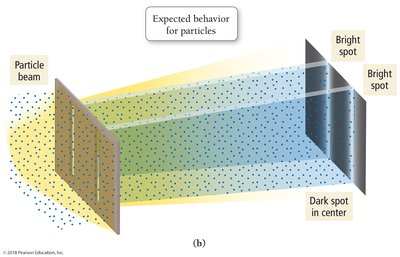
Complementary Properties and Uncertainty
Wave–Particle Duality and Heisenberg's Uncertainty Principle
Electrons have complementary properties: particle nature (position) and wave nature (interference pattern). - Heisenberg's Uncertainty Principle: - Key Point: The more precisely the position is known, the less precisely the velocity is known, and vice versa.
Determinacy vs. Indeterminacy
Classical physics predicts definite trajectories (determinacy), but quantum mechanics only allows prediction of probabilities (indeterminacy). 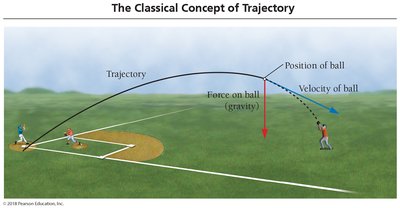
Schrödinger's Equation and Quantum Numbers
Schrödinger's Equation
Schrödinger's equation () calculates the probability of finding an electron with a particular energy at a particular location. - Wave function (\psi): Solutions describe orbitals, regions of high probability for finding electrons.
Quantum Numbers
Four quantum numbers describe the properties of atomic orbitals: - Principal quantum number (n): Energy level; n = 1, 2, 3, ... - Angular momentum quantum number (l): Orbital shape; l = 0 (s), 1 (p), 2 (d), 3 (f) - Magnetic quantum number (ml): Orbital orientation; ml = −l to +l - Spin quantum number (ms): Electron spin; ms = +½ or −½
Energy Levels and Sublevels
- Number of sublevels in a level: n - Number of orbitals in a sublevel: 2l + 1 - Number of orbitals in a level: n2
Atomic Orbitals: Shapes and Probability Functions
Probability and Radial Distribution Functions
- Probability density (\psi^2): Probability of finding an electron at a point in space. - Radial distribution function: Total probability at a certain distance from the nucleus; maximum at most probable radius.
Shapes of Atomic Orbitals
- s orbitals (l = 0): Spherical; one per energy level; number of nodes = n − 1. - p orbitals (l = 1): Dumbbell-shaped; three per energy level above n = 1; one node at nucleus. - d orbitals (l = 2): Four-lobed; five per energy level above n = 2; planar and spherical nodes. - f orbitals (l = 3): Eight-lobed; seven per energy level above n = 3; planar and spherical nodes.
Orbital Phase
- Wave function sign: Orbitals can have positive or negative values (phase); nodes occur where wave function = 0. - Orbital interactions: In-phase (same sign) or out-of-phase (opposite sign) interactions affect bonding.
Summary Table: Quantum Numbers and Orbitals
Quantum Number | Symbol | Allowed Values | Property |
|---|---|---|---|
Principal | n | 1, 2, 3, ... | Energy level, size |
Angular momentum | l | 0 to n−1 | Shape (s, p, d, f) |
Magnetic | ml | −l to +l | Orientation |
Spin | ms | +½, −½ | Spin direction |
Conclusion
The quantum-mechanical model of the atom explains the behavior of electrons, the structure of atomic orbitals, and the properties of elements. It forms the foundation for understanding chemical bonding, periodic trends, and the unique spectra of elements. Additional info: Academic context was added to clarify the relationships between quantum numbers, atomic orbitals, and electron behavior, as well as to expand on the significance of quantum mechanics in chemistry.
