 Indietro
Quantum Mechanics and Atomic Structure: Study Notes for General Chemistry
Guida di studio - Note intelligenti
 Appunti personalizzati basati sui tuoi materiali, ampliati con definizioni chiave, esempi e contesto.
Quantum Mechanics: The Atomic Model
Introduction to Quantum Mechanics
Quantum mechanics is the branch of physics that explains the behavior of matter and energy at the atomic and subatomic levels. Early twentieth-century scientists such as Einstein, Bohr, de Broglie, Planck, Heisenberg, Dirac, and Schrödinger developed the foundational concepts. - Subatomic particles: electrons, protons, neutrons - Wave–matter duality: Electrons exhibit both particle-like and wave-like properties depending on experimental conditions.
Wave–Matter Duality
The concept of wave–matter duality states that subatomic particles, such as electrons, can behave as both particles and waves. - Particulate behavior: Mass and volume under certain conditions - Energy-like behavior: Exhibits characteristics such as wavelength and frequency under other conditions
The Nature of Light
Electromagnetic Radiation
Light is a form of electromagnetic radiation, composed of oscillating electric and magnetic fields that are perpendicular to each other and travel at the speed of light in a vacuum. 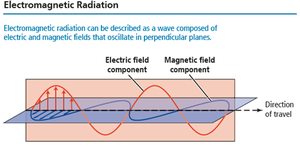
Characteristics of Energy Waves
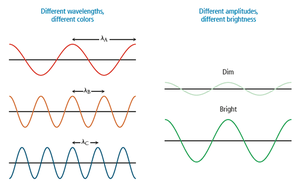
- Amplitude: Height of the wave; determines light intensity (brightness) - Wavelength (\lambda): Distance between successive crests or troughs; determines color - Frequency (\nu): Number of waves passing a point per unit time; measured in hertz (Hz) 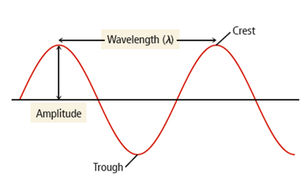
Color and the Electromagnetic Spectrum
The color of light is determined by its wavelength or frequency. White light is a mixture of all visible wavelengths. When light passes through a prism, it separates into its component colors (spectrum). 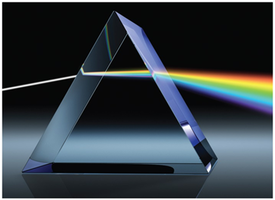
Electromagnetic Spectrum
Visible light is only a small part of the electromagnetic spectrum, which ranges from radio waves (long wavelength, low energy) to gamma rays (short wavelength, high energy). 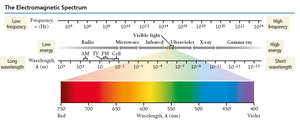
Wave Behavior: Interference and Diffraction
Interference
- Constructive interference: Waves add together to make a larger wave (in phase) - Destructive interference: Waves cancel each other out (out of phase)
Diffraction
When waves encounter an obstacle or slit comparable to their wavelength, they bend around it, producing a diffraction pattern. Particles do not diffract. 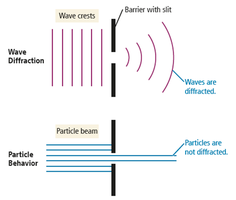
Two-Slit Interference
Light passing through two slits produces an interference pattern, characteristic of wave behavior. 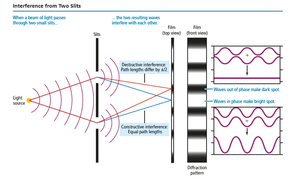
The Photoelectric Effect
Einstein's Explanation
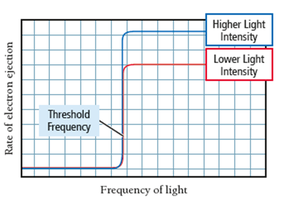
When light shines on a metal surface, electrons are emitted (photoelectrons). Classical theory could not explain the threshold frequency required for emission. Einstein proposed that light energy is delivered in packets called quanta or photons. 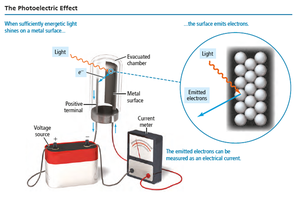
Energy of a Photon
The energy of a photon is directly proportional to its frequency and inversely proportional to its wavelength: where is Planck's constant and is the speed of light. 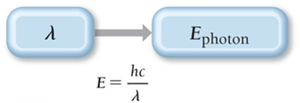
Atomic Spectra and the Bohr Model
Emission Spectra
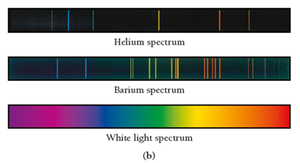
When atoms absorb energy, they emit light at specific wavelengths, producing a line spectrum unique to each element. 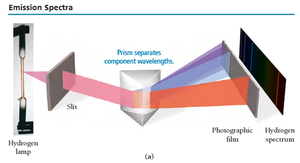

The Bohr Model of the Atom
Bohr proposed that electrons travel in fixed orbits (stationary states) around the nucleus, and the energy of the atom is quantized. Electrons emit photons when they transition between energy levels. 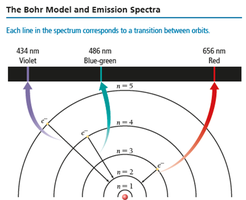
Wave Behavior of Electrons
De Broglie Relation
De Broglie proposed that particles, such as electrons, have wave-like properties. The wavelength of a particle is inversely proportional to its momentum:
Electron Diffraction
Electron beams produce interference patterns, demonstrating their wave nature. 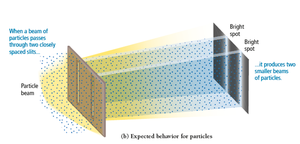
Quantum Mechanical Model and Quantum Numbers
Schrödinger's Equation
Schrödinger's equation calculates the probability of finding an electron with a particular energy at a specific location. The solutions are wave functions (\psi), which describe orbitals.
Quantum Numbers
Four quantum numbers describe the properties of electrons in atoms:
Quantum Number | Symbol | Description |
|---|---|---|
Principal | n | Energy level; size of orbital |
Angular Momentum | l | Shape of orbital (s, p, d, f) |
Magnetic | ml | Orientation of orbital |
Spin | ms | Spin direction (+1/2 or -1/2) |
Principal Quantum Number (n)
- Characterizes the energy and size of the orbital - Values: n = 1, 2, 3, ...
Angular Momentum Quantum Number (l)
- Determines the shape of the orbital - Values: l = 0 (s), 1 (p), 2 (d), 3 (f)
Magnetic Quantum Number (ml)
- Specifies the orientation of the orbital - Values: integers from -l to +l
Spin Quantum Number (ms)
- Describes the spin of the electron - Values: +1/2 or -1/2
Atomic Orbitals and Probability Functions
Probability Density and Radial Distribution Functions
The probability density function describes the likelihood of finding an electron at a specific point in space. The radial distribution function shows the probability of finding an electron at a certain distance from the nucleus.
Shapes of Atomic Orbitals
- s-orbitals: Spherical shape, l = 0 - p-orbitals: Dumbbell shape, l = 1
- d-orbitals: Four-lobed shape, l = 2 - f-orbitals: Eight-lobed shape, l = 3
Phase of an Orbital
Orbitals have phases (positive or negative values of the wave function). When orbitals interact, their phases determine constructive or destructive interference.
Summary Table: Quantum Numbers and Orbitals
n | l | ml | Orbital Name | Number of Orbitals |
|---|---|---|---|---|
1 | 0 | 0 | 1s | 1 |
2 | 0,1 | 0; -1,0,1 | 2s, 2p | 1, 3 |
3 | 0,1,2 | 0; -1,0,1; -2,-1,0,1,2 | 3s, 3p, 3d | 1, 3, 5 |
Key Equations
Speed of Light, Wavelength, and Frequency
Energy of a Photon
De Broglie Wavelength
Applications and Examples
- Photoelectric effect: Used in solar cells and light sensors - Emission spectra: Used to identify elements in stars and materials - Quantum numbers: Fundamental for understanding electron configurations and chemical bonding Additional info: Academic context was added to clarify quantum numbers, orbital shapes, and the relationship between wavelength, frequency, and energy. ----------------------------------------
