 Indietro
Quantum Mechanics, Atomic Structure, and Periodic Properties: Study Notes for General Chemistry
Guida di studio - Note intelligenti
 Appunti personalizzati basati sui tuoi materiali, ampliati con definizioni chiave, esempi e contesto.
Quantum Mechanics and Atomic Structure
Electromagnetic Radiation
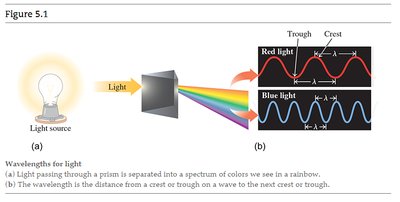
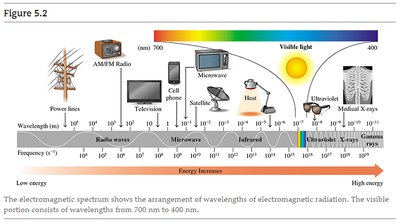
Electromagnetic radiation is a form of energy that travels through space as waves. It includes radio waves, microwaves, infrared, visible light, ultraviolet (UV), X-rays, and gamma rays. The properties of these waves are characterized by their wavelength (distance between two crests or troughs) and frequency (number of wave crests passing a point per second). All electromagnetic radiation travels at the speed of light, m/s, and the relationship between speed, wavelength, and frequency is given by .
Wavelength (): The distance between two consecutive crests or troughs.
Frequency (): The number of wave cycles passing a point per second.
Electromagnetic Spectrum: Arrangement of electromagnetic radiation types by wavelength and frequency.
Visible Light: Wavelengths from 700 nm (red) to 400 nm (violet); our eyes detect this range.
Energy: As frequency increases, wavelength decreases, and energy increases.
Atomic Spectra and Energy Levels
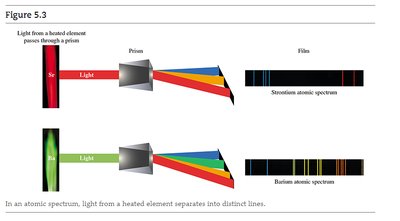
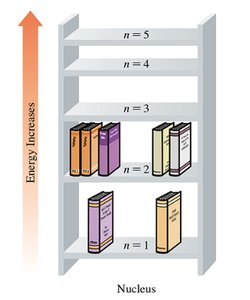
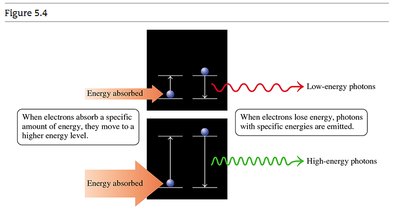
When elements are excited, they emit light at specific wavelengths, producing an atomic spectrum unique to each element. Light is emitted as photons, with high-energy photons having short wavelengths and low-energy photons having long wavelengths. The energy levels of electrons are quantized and described by the principal quantum number (), which correlates to the period number in the periodic table.
Photon: A particle of light; energy depends on wavelength.
Energy Levels: Electrons occupy discrete energy levels, each with a specific value of (1-7).
Excited State: When an electron absorbs energy, it moves to a higher energy level.
Relaxation: When an electron returns to a lower energy level, it emits a photon.
Sublevels and Orbitals
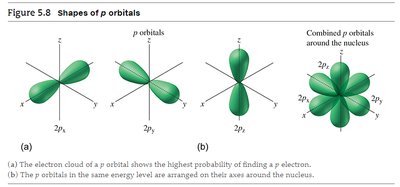
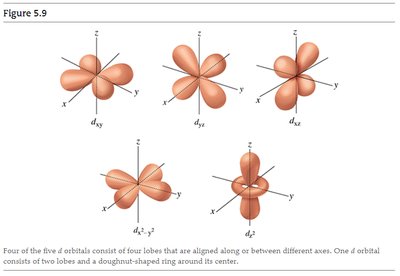
Each energy level contains sublevels designated as s, p, d, and f. These sublevels contain orbitals, which are regions of space where electrons are likely to be found. The maximum number of electrons in each energy level is determined by .
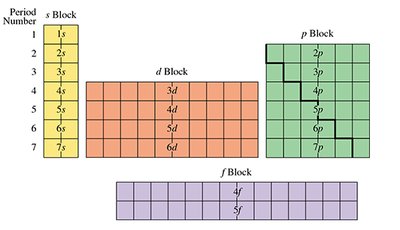
Sublevels: s, p, d, f; each energy level gains a new sublevel.
Orbitals: s (sphere), p (dumbbell), d (complex shapes), f (even more complex).
Electron Capacity: Each orbital holds 2 electrons (one with up spin, one with down spin).
Energy Level (n) | 1 | 2 | 3 | 4 |
|---|---|---|---|---|
2n2 | 2(1)2 | 2(2)2 | 2(3)2 | 2(4)2 |
Maximum Number of Electrons | 2 | 8 | 18 | 32 |

s orbital: 1 per energy level
p orbitals: 3 per energy level
d orbitals: 5 per energy level
f orbitals: 7 per energy level
Orbital Diagrams and Electron Configurations
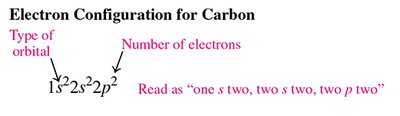
Electron configurations describe how electrons are distributed among orbitals. Orbital diagrams use boxes and arrows to show electron placement, while electron configuration notation lists the orbitals and the number of electrons in each. Lower energy orbitals fill first, and electrons occupy separate orbitals of the same energy before pairing (Hund's Rule).
Notation: Example for carbon:
Abbreviated Configuration: Uses noble gas core for simplification.
Filling Order: 4s fills before 3d due to lower energy.
Exceptions: Cr, Cu, Mo, Ag have unique electron arrangements for stability.
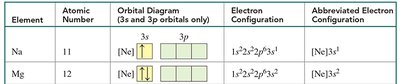
Element | Atomic Number | Orbital Diagram (3s and 3p only) | Electron Configuration | Abbreviated Electron Configuration |
|---|---|---|---|---|
Na | 11 | [Ne] 3s1 | 1s22s22p63s1 | [Ne]3s1 |
Mg | 12 | [Ne] 3s2 | 1s22s22p63s2 | [Ne]3s2 |
Periodic Properties of the Elements
Valence Electrons
Valence electrons are the electrons in the outermost energy level of an atom. The group number (1A, 2A, etc.) indicates the number of valence electrons. These electrons determine chemical reactivity and bonding.
Example: Ca has 2 valence electrons, I has 7, Pb has 4.
Atomic Size
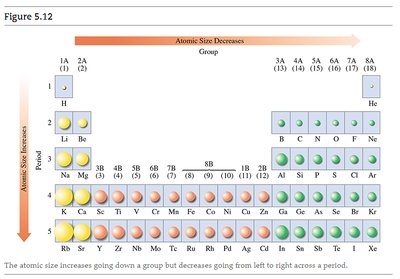
Atomic size is determined by the distance of valence electrons from the nucleus. Size increases down a group (more electron shells) and decreases across a period (greater nuclear charge pulls electrons closer).
Trend: Increases down a group, decreases across a period.
Transition Metals: Atomic size is relatively constant across transition metals.
Ionization Energy
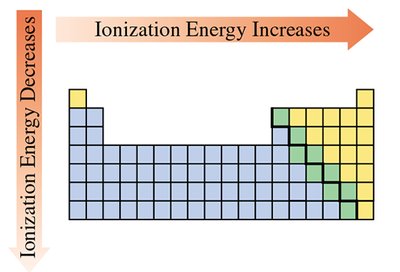
Ionization energy is the energy required to remove an electron from an atom. It decreases down a group (electrons are farther from the nucleus) and increases across a period (greater nuclear charge).
Trend: Decreases down a group, increases across a period.
Metallic Character
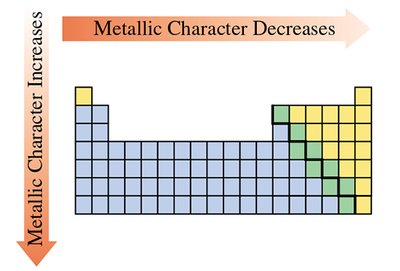
Metallic character refers to how easily an element loses valence electrons. Metals lose electrons easily, metalloids less so, and nonmetals rarely. Metallic character increases down a group and decreases across a period.
Trend: Increases down a group, decreases across a period.
Summary Table: Periodic Trends
Property | Trend Down a Group | Trend Across a Period |
|---|---|---|
Atomic Size | Increases | Decreases |
Ionization Energy | Decreases | Increases |
Metallic Character | Increases | Decreases |
Additional info: The notes cover quantum mechanics, atomic structure, electron configuration, and periodic properties, all of which are core topics in General Chemistry.
