 Indietro
Lec 4 notes chem
Guida di studio - Note intelligenti
 Appunti personalizzati basati sui tuoi materiali, ampliati con definizioni chiave, esempi e contesto.
Quantum Mechanics
Limitations of the Bohr Model and the Need for a New Theory
The Bohr model, while successful in explaining some atomic phenomena, could not account for all observed behaviors of electrons in atoms. This limitation led to the development of quantum mechanics, a new theoretical framework that describes the behavior of matter and energy at the atomic and subatomic levels.
Wave-Particle Duality: The distinction between matter and energy was removed, leading to the proposal that matter exhibits both particle-like and wave-like properties.
de Broglie Hypothesis: In 1924, Louis de Broglie suggested that particles such as electrons have an associated wavelength, given by the equation:
Where is the de Broglie wavelength, is Planck's constant, and is the momentum of the particle.
Example: The de Broglie wavelength of a baseball is extremely small compared to that of an electron, making wave-like properties observable only for very small particles.
Evidence for Wave-Particle Duality
Experimental evidence for the wave-like properties of matter comes from the observation of diffraction patterns, such as those produced by electrons passing through a crystal lattice. These patterns are similar to those produced by X-rays, supporting the concept of wave-particle duality.
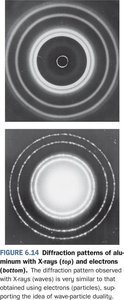
Key Point: The similarity in diffraction patterns for X-rays (waves) and electrons (particles) demonstrates that electrons exhibit wave-like behavior.
The Uncertainty Principle
Werner Heisenberg (1927) formulated the uncertainty principle, which states that it is impossible to simultaneously know both the exact position and momentum of a particle, such as an electron, with absolute precision.
Heisenberg Uncertainty Principle: The more precisely the position is known, the less precisely the momentum is known, and vice versa.
Instead of exact positions, quantum mechanics uses probability distributions to describe where an electron is likely to be found.
The probability is related to the square of the wavefunction, .
Wavefunctions and the Schrödinger Equation
Erwin Schrödinger developed quantum mechanics to describe particles as waves. The state of an electron is described by a wavefunction, , which depends on three spatial coordinates: .
Wavefunction (): A mathematical function describing the quantum state of a particle.
Probability Density (): The likelihood of finding an electron in a particular region of space.
The Schrödinger equation for the hydrogen atom is:
The solutions, called orbitals, are labeled by quantum numbers , , and .
The wavefunction can be separated into a radial part and an angular part :
Visualizing Orbitals and Probability Distributions
There are several ways to represent the probability of finding an electron in a hydrogen atom, including probability density plots, radial probability distributions, and boundary surfaces.
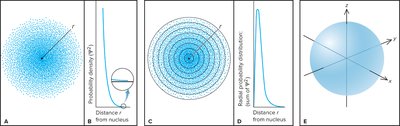
Probability Density Plot: Shows where the electron is most likely to be found.
Radial Probability Distribution: Plots the probability of finding the electron at a certain distance from the nucleus.
Boundary Surface: Encloses a region where the electron is likely to be found a certain percentage of the time.
Quantum Numbers and Atomic Orbitals
Quantum Numbers
The state of an electron in an atom is specified by four quantum numbers:
Quantum Number | Symbol | Allowed Values | Interpretation |
|---|---|---|---|
Principal | n | 1, 2, 3, ... | Energy level (shell) |
Angular Momentum | l | 0 to n-1 | Subshell (s, p, d, f...) |
Magnetic | m_l | -l to +l | Orbital orientation |
Spin | m_s | +1/2, -1/2 | Electron spin direction |
Energy of the hydrogen atom depends only on n:
Example: The designation n = 2, l = 3, m_l = -3 is impossible because l cannot be equal to or greater than n.
Notation for Orbitals
Orbitals are labeled using the notation , where:
n = principal quantum number (1, 2, 3, ...)
l = s (0), p (1), d (2), f (3), ...
m_l = orbital orientation
Shapes of Hydrogen Atom Orbitals
Visualizing s, p, and d Orbitals
Each type of orbital (s, p, d) has a characteristic shape and orientation in space. The shapes are determined by the quantum numbers and the solutions to the Schrödinger equation.
s orbitals (l = 0): Spherical symmetry, no angular nodes.
p orbitals (l = 1): Dumbbell-shaped, one angular node (plane).
d orbitals (l = 2): More complex shapes, two angular nodes.
Nodes are regions where the probability of finding an electron is zero. Radial nodes depend on n and l, while angular nodes depend on l.
It is important to learn the shapes, relative phases, and locations of nodes for all hydrogen s, p, and d orbitals. Visualizations and interactive applets can aid in understanding these concepts.
Additional info: For further exploration, students can use online applets such as Falstad Quantum Atom and ChemTube3D Orbitals to visualize orbital shapes and nodes.
