 Indietro
Reactions in Aqueous Solution: Acids, Bases, and Redox Chemistry
Guida di studio - Note intelligenti
 Appunti personalizzati basati sui tuoi materiali, ampliati con definizioni chiave, esempi e contesto.
Reactions in Aqueous Solution
Introduction to Aqueous Chemistry
Chemical reactions in aqueous solution are central to general chemistry. Many important classes of reactions—including acid-base, precipitation, and oxidation-reduction (redox) reactions—occur in water, which acts as a solvent to facilitate the movement and interaction of ions and molecules.
Solutions and Their Properties
Definitions and Types of Solutions
Solution: A homogeneous mixture of two or more pure substances.
Solvent: The component present in the greatest amount; in aqueous solutions, this is water.
Solute: The other substances present in lesser amounts.
Aqueous Solution: A solution where water is the solvent.
Dissolution of Substances in Water
Ionic Compounds: Dissolve by dissociation, where water molecules surround and separate the ions.
Molecular Compounds: Interact with water but generally do not dissociate into ions. Some may react with water upon dissolving.
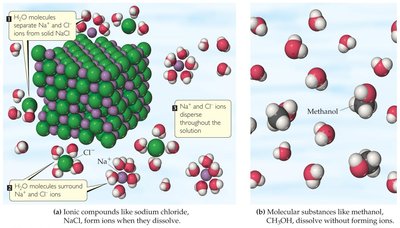
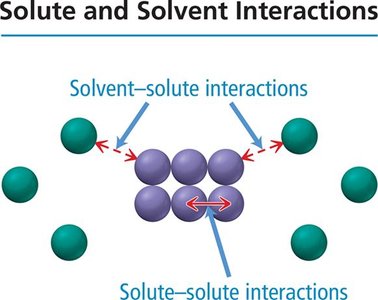
Solute-Solvent Interactions
For a solute to dissolve, the attractions between solute and solvent must be strong enough to overcome the attractions within the solute and within the solvent.
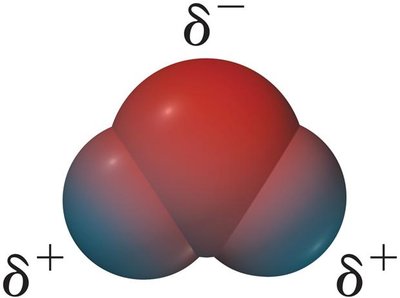
Polarity of Water
Water is a polar molecule, meaning it has an uneven distribution of electron density. The oxygen atom carries a partial negative charge (δ−), while the hydrogen atoms carry partial positive charges (δ+). This polarity enables water to dissolve many ionic compounds by stabilizing separated ions.
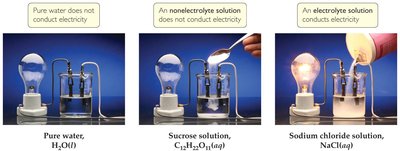
Electrolytes and Nonelectrolytes
Definitions
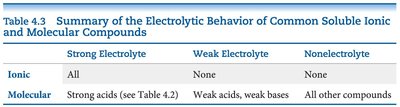
Electrolyte: A substance that dissociates into ions when dissolved in water, allowing the solution to conduct electricity.
Nonelectrolyte: A substance that may dissolve in water but does not produce ions, so the solution does not conduct electricity.
Types of Electrolytes
Strong Electrolyte: Completely dissociates into ions in water (e.g., most soluble ionic salts, strong acids, and strong bases).
Weak Electrolyte: Partially dissociates in water (e.g., weak acids and weak bases).
Nonelectrolyte: Does not dissociate into ions in water (e.g., most molecular compounds).
Strong Electrolyte | Weak Electrolyte | Nonelectrolyte | |
|---|---|---|---|
Ionic | All | None | None |
Molecular | Strong acids | Weak acids, weak bases | All other compounds |
Precipitation Reactions
Formation of Precipitates
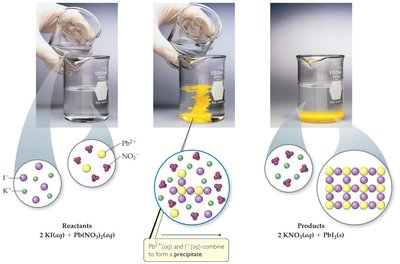
Precipitation reactions occur when two aqueous solutions of ionic compounds are mixed and an insoluble product (precipitate) forms. Solubility rules are used to predict whether a precipitate will form.
Solubility Rules (Summary Table)
Compounds Containing | Generally Soluble | Exceptions |
|---|---|---|
Li+, Na+, K+, Rb+, NH4+ | Yes | None |
NO3−, C2H3O2− | Yes | None |
Cl−, Br−, I− | Yes | Ag+, Hg22+, Pb2+ |
SO42− | Yes | Ca2+, Sr2+, Ba2+, Hg22+, Pb2+, Ag+ |
OH−, S2− | No | Li+, Na+, K+, Rb+, NH4+, Ca2+, Sr2+, Ba2+ |
CO32−, PO43− | No | Li+, Na+, K+, Rb+, NH4+ |
Predicting Precipitation
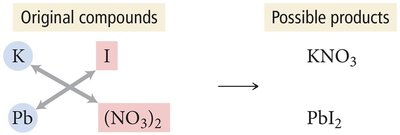
To predict whether a precipitation reaction will occur, write the possible products, check their solubility, and identify any insoluble product as the precipitate.
Metathesis (Exchange) Reactions
Types of Equations
Molecular Equation: Shows complete formulas for all reactants and products.
Complete Ionic Equation: Shows all strong electrolytes as ions.
Net Ionic Equation: Shows only the species that actually change during the reaction (spectator ions are omitted).
Example: Silver Nitrate and Potassium Chloride
Molecular:
Complete Ionic:
Net Ionic:
Acid–Base Reactions
Definitions of Acids and Bases
Arrhenius Acid: Increases H+ concentration in water.
Arrhenius Base: Increases OH− concentration in water.
Brønsted–Lowry Acid: Proton donor.
Brønsted–Lowry Base: Proton acceptor.
Properties of Acids and Bases
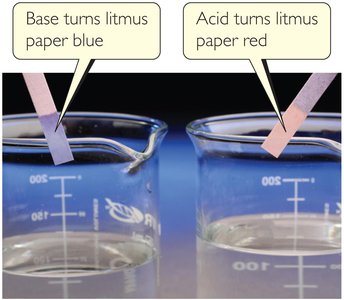
Acids: Taste sour, dissolve metals, low pH, turn litmus paper red.
Bases: Taste bitter, dissolve fats and oils, high pH, turn litmus paper blue.
Strong and Weak Acids/Bases
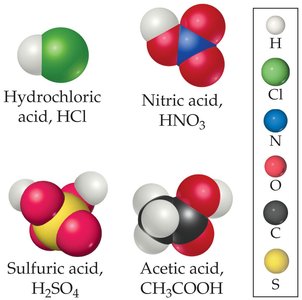
Strong Acids/Bases: Completely dissociate in water.
Weak Acids/Bases: Partially dissociate in water.
Neutralization Reactions
When an acid reacts with a base, water and a salt are produced. The net ionic equation for a strong acid and strong base is:
Gas-Forming Reactions
Some double displacement reactions produce a gas, such as CO2, SO2, H2S, or NH3, either directly or by decomposition of an unstable intermediate.
Oxidation–Reduction (Redox) Reactions
Introduction to Redox Reactions
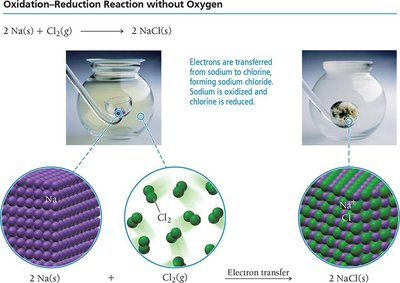
Redox reactions involve the transfer of electrons between substances. Oxidation is the loss of electrons, while reduction is the gain of electrons. These reactions are essential for processes such as combustion, corrosion, and metabolism.

Oxidation Numbers
Oxidation numbers (states) are assigned to atoms to keep track of electron transfer in reactions.
Rules for assigning oxidation numbers:
Free elements: 0
Monatomic ions: equal to their charge
Fluorine: always −1
Oxygen: usually −2 (except peroxides: −1, with F: +2)
Hydrogen: +1 (with nonmetals), −1 (with metals)
Sum of oxidation numbers equals the total charge
Redox Agents
Reducing Agent: Causes reduction in another substance and is itself oxidized.
Oxidizing Agent: Causes oxidation in another substance and is itself reduced.
Activity Series of Metals
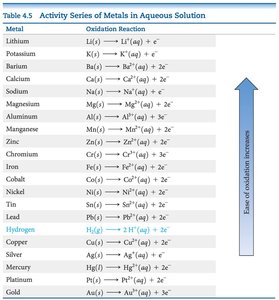
The activity series ranks metals by their tendency to lose electrons (be oxidized). Metals higher in the series are more easily oxidized and can reduce ions of metals lower in the series.
Metal | Oxidation Reaction |
|---|---|
Lithium | Li(s) → Li+(aq) + e− |
Potassium | K(s) → K+(aq) + e− |
... | ... |
Gold | Au(s) → Au3+(aq) + 3e− |
Laboratory Safety with Acids and Bases
Hazards and Precautions
Acids are corrosive and can cause severe injuries; some have specific hazards (e.g., sulfuric acid is dehydrating, nitric acid is a strong oxidizer, hydrofluoric acid attacks bones).
Bases are caustic and can cause chemical burns; metal hydroxides can saponify fats.
Personal protective equipment (PPE), careful handling, dilution, and neutralization are essential for safety.
