Indietro
Reactions in Aqueous Solution: Electrolytes, Precipitation, Acid-Base, and Redox Reactions
Guida di studio - Note intelligenti
 Appunti personalizzati basati sui tuoi materiali, ampliati con definizioni chiave, esempi e contesto.
Reactions in Aqueous Solution
Aqueous Solutions and Dissociation
Aqueous solutions are central to many chemical reactions, especially in general chemistry. A solution is a homogeneous mixture of two or more pure substances. The solvent is the substance present in the greatest quantity, while solutes are all other substances. When water is the solvent, the solution is termed an aqueous solution.
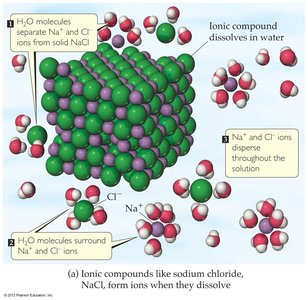
Dissociation: When an ionic substance dissolves in water, the solvent pulls individual ions from the crystal and solvates them. This process is called dissociation.
Electrolytes: Substances that dissociate into ions when dissolved in water, conducting electricity.
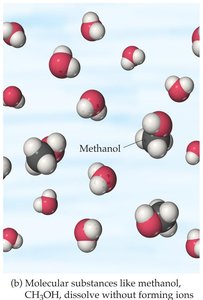
Nonelectrolytes: Substances that dissolve in water but do not dissociate into ions, thus do not conduct electricity.
Soluble ionic compounds tend to be electrolytes, while most molecular compounds are nonelectrolytes except for acids and bases.
Electrolytes and Nonelectrolytes
Electrolytes are classified based on their ability to dissociate in water:
Strong Electrolytes: Dissociate completely in water (e.g., NaCl, HCl).
Weak Electrolytes: Dissociate partially in water (e.g., acetic acid).
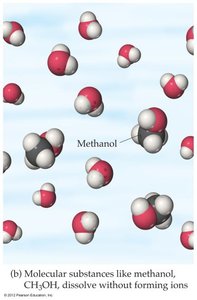
Nonelectrolytes: Do not dissociate in water (e.g., sucrose).
Strong and Weak Acids and Bases
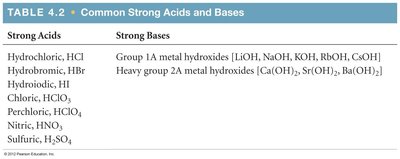
Acids and bases are important classes of electrolytes. Strong acids and bases ionize completely in solution, while weak acids and bases ionize only partially.
Strong Acids: Hydrochloric acid (HCl), Hydrobromic acid (HBr), Hydroiodic acid (HI), Nitric acid (HNO3), Sulfuric acid (H2SO4), Chloric acid (HClO3), Perchloric acid (HClO4).
Strong Bases: Group 1A metal hydroxides (LiOH, NaOH, KOH, etc.), heavy group 2A metal hydroxides (Ca(OH)2, Sr(OH)2, Ba(OH)2).
Precipitation Reactions
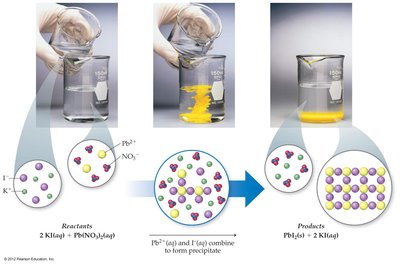
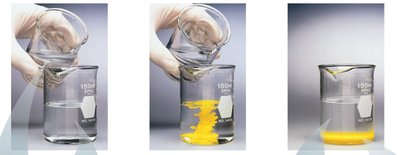
Precipitation reactions result in the formation of an insoluble product, called a precipitate. These reactions occur when two solutions containing soluble salts are mixed and an insoluble salt is formed.
Example:
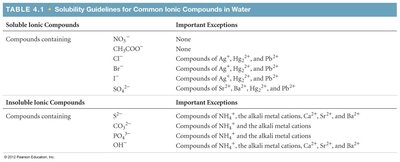
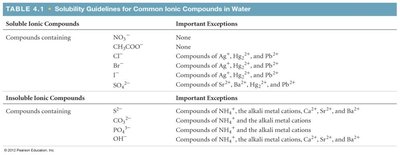
Solubility Guidelines: Used to predict whether a compound will be soluble or insoluble in water.
Exchange (Metathesis) Reactions
Metathesis reactions involve the exchange of ions between two reactants to form new products. The general form is:
Check solubility of products to determine if a precipitate forms.
Ionic and Net Ionic Equations
Chemical equations can be written in three forms:
Molecular Equation: Shows reactants and products in their molecular form.
Complete Ionic Equation: Shows all strong electrolytes as ions.
Net Ionic Equation: Shows only the species that change during the reaction, omitting spectator ions.
Acid-Base Reactions and Neutralization
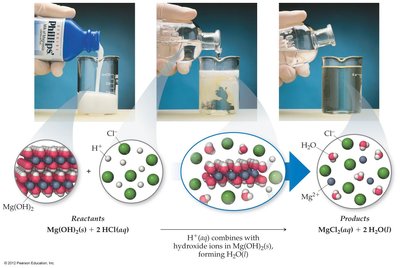
Acid-base reactions involve the transfer of a proton (H+) from the acid to the base. Neutralization occurs when an acid and a base react to form water and a salt.
Net Ionic Equation for Strong Acid-Base Neutralization:
Gas Forming Reactions
Some metathesis reactions produce a gas as a product, such as CO2, SO2, or H2S. These reactions often involve the decomposition of an unstable intermediate.
Example:
Oxidation-Reduction (Redox) Reactions
Redox reactions involve the transfer of electrons between atoms. Oxidation is the loss of electrons, while reduction is the gain of electrons. These reactions are fundamental to many processes, including combustion and metal reactivity.
Example:
Oxidation Numbers: Assigned to atoms to track electron transfer. Rules include: free elements have oxidation number 0, monatomic ions equal their charge, sum in a compound is zero, and specific values for groups and nonmetals.
Displacement Reactions and Activity Series
Displacement reactions occur when a metal is oxidized by an acid or salt. The activity series ranks metals by their tendency to be oxidized, predicting which metals will react with acids or salts.
Molarity and Solution Concentration
Molarity (M) is a measure of concentration, defined as moles of solute per liter of solution:
Preparation of solutions involves dissolving a known mass of solute in a volumetric flask and adding solvent to a specified volume.
Calculating Molarity and Ion Concentrations
To calculate molarity, convert grams of solute to moles and volume to liters. For ionic compounds, use the formula to determine ion concentrations.
Example: 1.0 M Na2SO4 yields 2.0 M Na+ and 1.0 M SO42–.
Dilution of Solutions
To dilute a solution, use the equation:
Where and are the molarity and volume of the concentrated solution, and and are those of the diluted solution.
Stoichiometry in Solution Reactions
Stoichiometry relates the quantities of reactants and products in chemical reactions. In solution reactions, use molarity and volume to determine moles, then use balanced equations to relate moles of different substances.
Titration
Titration is an analytical technique used to determine the concentration of a solute in a solution by reacting it with a standard solution of known concentration.
Calculate moles of standard solution used, relate to moles of unknown, and determine concentration.
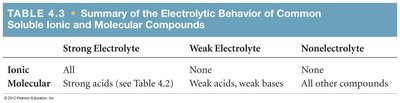
Summary Table: Electrolytic Behavior of Compounds
Strong Electrolyte | Weak Electrolyte | Nonelectrolyte | |
|---|---|---|---|
Ionic | All | None | None |
Molecular | Strong acids | Weak acids, weak bases | All other compounds |
Summary Table: Solubility Guidelines for Common Ionic Compounds
Soluble Ionic Compounds | Important Exceptions |
|---|---|
NO3–, CH3COO–, NH4+ | None |
Cl–, Br–, I– | Compounds of Ag+, Hg22+, Pb2+ |
SO42– | Compounds of Sr2+, Ba2+, Hg22+, Pb2+ |
Insoluble Ionic Compounds | Important Exceptions |
S2–, CO32–, PO43–, OH– | Compounds of NH4+, alkali metal cations, Ca2+, Sr2+, Ba2+ |