 Indietro
Reactions in Aqueous Solution, Solution Concentration, and Titration: Study Guide
Guida di studio - Note intelligenti
 Appunti personalizzati basati sui tuoi materiali, ampliati con definizioni chiave, esempi e contesto.
Reactions in Aqueous Solution
Acids and Bases
Acids and bases are fundamental classes of substances in chemistry, each with characteristic reactions in aqueous solution.
Acids: Substances that increase the concentration of hydrogen ions (H+) in solution. They are proton donors.
Bases: Substances that increase the concentration of hydroxide ions (OH-) in solution. They are proton acceptors or metal hydroxides.
Acids and bases can be monoprotic (donate/accept one proton, e.g., HCl, NaOH) or diprotic (donate/accept two protons, e.g., H2SO4, Ba(OH)2).
Acids are often highly corrosive and hazardous; bases are caustic and can cause saponification of fats.
Proper PPE and handling procedures are essential for safety.
Oxidation and Reduction (Redox Reactions)
Redox reactions involve the transfer of electrons between substances, and are classified based on changes in oxidation state.
Oxidation: Loss of electrons; increase in oxidation state.
Reduction: Gain of electrons; decrease in oxidation state.
Oxidation and reduction always occur simultaneously.
The reducing agent is oxidized, and the oxidizing agent is reduced.
Example: Na is oxidized (reducing agent), Cl2 is reduced (oxidizing agent).
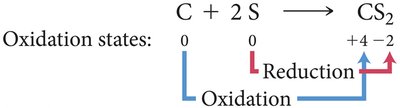
Identifying Redox Reactions
Redox reactions can be identified by changes in oxidation states of elements.
Increase in oxidation state: Oxidation
Decrease in oxidation state: Reduction
Example: In the reaction C + 2S → CS2, carbon is oxidized from 0 to +4, sulfur is reduced from 0 to -2.
Displacement Reactions
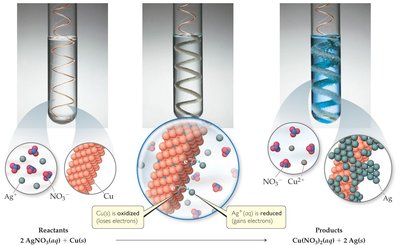
Displacement reactions involve ions oxidizing an element, often resulting in the exchange of electrons and formation of new products.
Example: Silver ions oxidize copper metal; the reverse reaction does not occur due to the activity series.
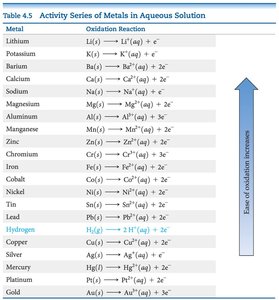
Activity Series of Metals
The activity series ranks metals by their tendency to lose electrons (undergo oxidation).
Metals at the top are most easily oxidized and are strong reducing agents.
Metals at the bottom are least reactive and are weak reducing agents.
The activity series helps predict the spontaneity of redox reactions.
Metal | Oxidation Reaction |
|---|---|
Lithium | Li(s) → Li+(aq) + e- |
Potassium | K(s) → K+(aq) + e- |
Gold | Au(s) → Au3+(aq) + 3e- |
... | ... |
Oxidation Numbers & Inorganic Nomenclature
Oxidation Numbers
Oxidation numbers are used to keep track of electron transfer in redox reactions and to name inorganic compounds.
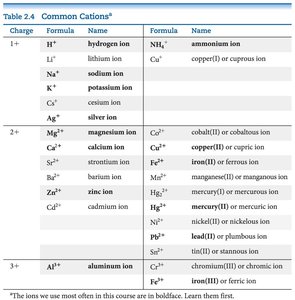
Metal cations with multiple oxidation states are named with Roman numerals (e.g., iron(II), iron(III)).
Example: Cu2S is copper(I) sulfide; CuS is copper(II) sulfide.
Common Cations and Anions
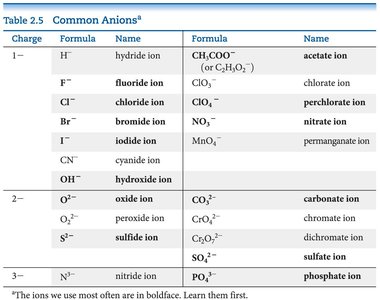
Understanding the names and formulas of common ions is essential for writing and naming compounds.
Charge | Formula | Name |
|---|---|---|
1+ | Na+ | sodium ion |
2+ | Mg2+ | magnesium ion |
3+ | Al3+ | aluminum ion |
1- | Cl- | chloride ion |
2- | SO42- | sulfate ion |
3- | PO43- | phosphate ion |
Solution Concentration and Molarity
Definitions and Concepts
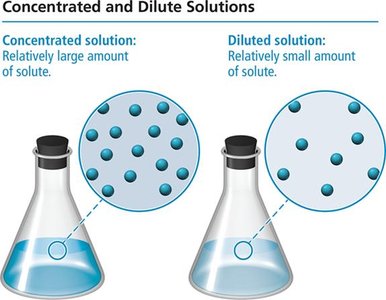
Solutions are homogeneous mixtures consisting of a solvent (majority component) and solute (minority component). The concentration of a solution quantifies the amount of solute relative to the solvent.
Aqueous solution: Water is the solvent.
Molarity (M): The most common unit of concentration, defined as moles of solute per liter of solution.
Formula:
Equipment for Measuring Volume
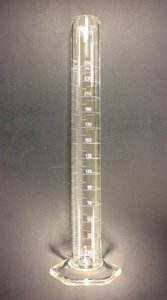
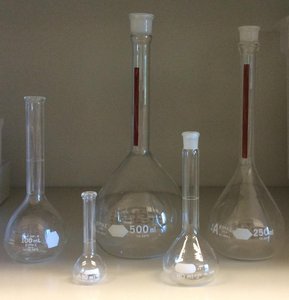
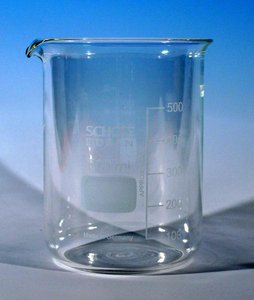
Accurate measurement of solution volumes is essential for preparing solutions of known concentration. Common laboratory glassware includes volumetric flasks, graduated cylinders, and beakers.
Volumetric flask: Used for precise preparation of solutions.
Graduated cylinder: Used for measuring various volumes.
Beaker: Used for mixing and holding solutions, not for precise measurements.
Preparing a Solution of Known Molarity
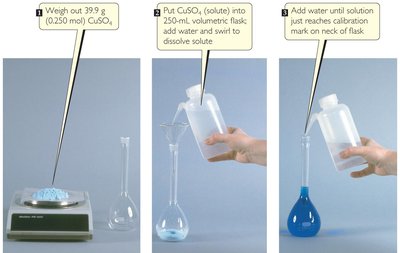
To prepare a solution of known molarity, weigh a known mass of solute, dissolve it in a volumetric flask, and add solvent to the calibration mark.
Weigh the solute accurately.
Add solute to the flask and partially fill with solvent.
Dissolve the solute completely, then add solvent to the calibration mark.
Dilution of Solutions
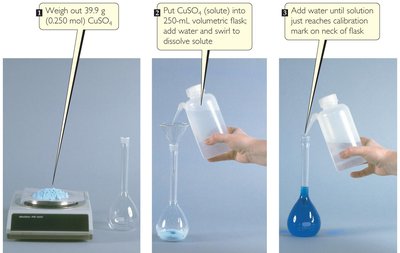
Stock solutions can be diluted to prepare solutions of lower concentration. The relationship between concentrations and volumes is given by:
= molarity of concentrated solution
= volume of concentrated solution
= molarity of dilute solution
= volume of dilute solution
Delivering Volumes
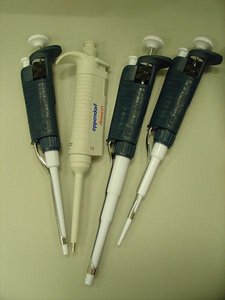
Precise delivery of volumes is achieved using pipettes and other volumetric tools.
Pipettes: Used for transferring exact volumes.
Stoichiometry and Gravimetric Analysis
Using Molarities in Stoichiometric Calculations
Molarity is used in stoichiometric calculations to relate volumes of solutions to moles of reactants and products.
Convert between grams, moles, liters, and number of particles using molar mass, molarity, and Avogadro's number.
Gravimetric Analysis
Gravimetric analysis involves precipitating a compound and measuring its mass to determine the concentration of an ion in solution.
Example: Adding excess AgNO3 to a Cl- solution yields AgCl precipitate. The mass of AgCl is used to calculate the original Cl- concentration.
Titration and Acid-Base Reactions
Titration Process
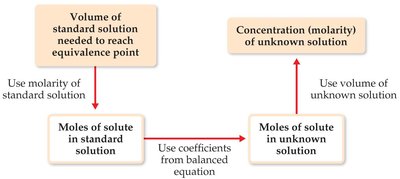
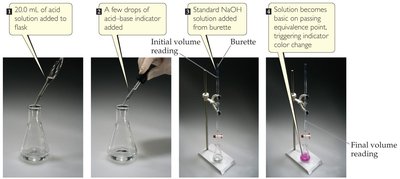
Titration is a quantitative technique used to determine the concentration of an unknown solution by reacting it with a solution of known concentration (titrant).
The reaction is complete at the equivalence point, where stoichiometric amounts of reactants have reacted.
An indicator is used to signal the end point, which should be close to the equivalence point.
Acid-Base Titrations
Acid-base titrations involve neutralization reactions between acids and bases. The equivalence point is reached when the number of moles of H+ equals the number of moles of OH- according to the balanced equation.
Indicators are chosen to change color near the equivalence point.
Example: Phenolphthalein turns pink at the equivalence point in NaOH-HCl titration.
Stoichiometry in Titration Calculations
Balanced chemical equations are essential for titration calculations, as they determine the mole ratio between reactants.
Example: Ba(OH)2 + 2HCl → BaCl2 + 2H2O
Use the titration formula to calculate unknown concentrations:
(for 1:1 reactions; adjust for other stoichiometries)
Example Calculations
Calculate the molarity of NaOH if 45.2 mL is neutralized by 19.0 mL of 0.340 M H2SO4:
Calculate the molarity of RbOH if 48.0 mL of 0.220 M H2SO4 neutralizes 25.0 mL of RbOH solution.
Additional info: For all titration calculations, always write the balanced equation and use the correct mole ratio.
