 Indietro
Reactions in Aqueous Solutions: Electrolytes, Precipitation, and Acid-Base Chemistry
Guida di studio - Note intelligenti
 Appunti personalizzati basati sui tuoi materiali, ampliati con definizioni chiave, esempi e contesto.
Reactions in Aqueous Solutions
Introduction to Aqueous Solutions
An aqueous solution is a homogeneous mixture in which water acts as the solvent. The substance being dissolved is called the solute, and the substance doing the dissolving is the solvent. In aqueous solutions, water is always the solvent.
Electrolytes and Non-electrolytes
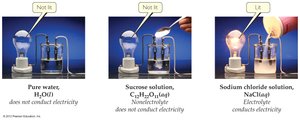
Substances dissolved in water can be classified based on their ability to conduct electricity:
Electrolytes: Substances that produce ions in solution and conduct electricity. Example:
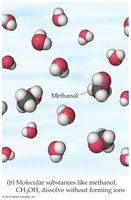
Non-electrolytes: Substances that dissolve without forming ions and do not conduct electricity. Example:
Dissociation vs. Ionization
Dissociation refers to the separation of ionic compounds into their constituent ions when dissolved in water. For example, . Ionization is the process by which molecular compounds form ions in solution, such as or . Pure water is a non-electrolyte and does not conduct electricity.
Classification of Electrolytes
Strong Electrolytes: Completely dissociate in water, producing a high concentration of ions and conducting electricity well. Examples include all water-soluble ionic compounds, strong acids (e.g., HCl, HNO3, H2SO4), and strong bases (e.g., NaOH, KOH).
Weak Electrolytes: Partially ionize in solution, resulting in poor conductivity. Examples include weak acids (e.g., CH3COOH, H2CO3) and weak bases (e.g., NH4OH).
Nonelectrolytes: Do not form ions in solution and do not conduct electricity. Most molecular compounds (except acids and bases) are nonelectrolytes, such as CH3OH and CCl4.
Precipitation Reactions
Formation and Prediction of Precipitates
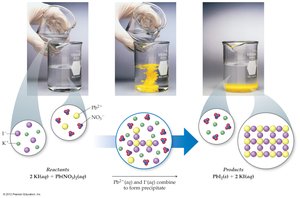
Precipitation reactions occur when two aqueous solutions are mixed and an insoluble ionic compound (precipitate) forms. The solubility of a compound is the maximum amount that can dissolve in a given amount of solvent at a specific temperature. Solubility rules help predict whether a precipitate will form.
Solubility Rules
The following tables summarize the main solubility rules for common ionic compounds:
Soluble Compounds | Exceptions |
|---|---|
Alkali metals (Group 1), NH4+, NO3-, C2H3O2- | None |
Cl-, Br-, I- | Ag+, Pb2+, Hg22+, Cu2+ |
SO42- | Sr2+, Ba2+, Hg22+, Pb2+, Ca2+, Ag+ |
Insoluble Compounds | Exceptions |
|---|---|
S2-, CO32-, PO43- | Alkali metals, NH4+ |
OH- | Alkali metals, Ca2+, Sr2+, Ba2+ |
Writing Molecular, Ionic, and Net Ionic Equations
To describe precipitation reactions, three types of equations are used:
Molecular Equation: Shows all reactants and products as compounds.
Ionic Equation: Shows all strong electrolytes as ions.
Net Ionic Equation: Shows only the ions and molecules directly involved in the reaction (spectator ions are omitted).
Steps to Write a Net Ionic Equation:
Write the balanced molecular equation.
Predict products by exchanging cations and anions.
Separate strong electrolytes into ions.
Cancel spectator ions.
Write the net ionic equation with the remaining species.
Example: Mixing aqueous silver nitrate and sodium sulfate:
Molecular:
Ionic:
Net Ionic:
Acids, Bases, and Neutralization Reactions
Definitions of Acids and Bases
Arrhenius Acid: Produces H+ ions in water.
Arrhenius Base: Produces OH- ions in water.
Brønsted-Lowry Acid: Proton donor.
Brønsted-Lowry Base: Proton acceptor.
Strong and Weak Acids and Bases
Strong Acids: HCl, HNO3, H2SO4, HI, HBr, HClO3, HClO4
Strong Bases: LiOH, NaOH, KOH, RbOH, CsOH, Ca(OH)2, Ba(OH)2, Sr(OH)2
Weak Acids: CH3COOH, H2CO3, H3PO4, etc.
Weak Bases: NH3, CH3NH2, Al(OH)3, etc.
Neutralization Reactions
A neutralization reaction occurs when an acid reacts with a base to produce a salt and water.
Molecular:
Ionic:
Net Ionic:
Example: Mixing acetic acid and lithium hydroxide:
Molecular:
Net Ionic:
Summary Table: Strong and Weak Electrolytes
Type | Examples | Degree of Ionization |
|---|---|---|
Strong Electrolyte | NaCl, HCl, NaOH | 100% |
Weak Electrolyte | CH3COOH, NH3 | Partial |
Nonelectrolyte | C12H22O11, CH3OH | None |
