 Indietro
SI Units, Conversions, Density, and Measurement Practice – General Chemistry Study Guide
Guida di studio - Note intelligenti
 Appunti personalizzati basati sui tuoi materiali, ampliati con definizioni chiave, esempi e contesto.
Q1. The Golden Gate Bridge is 8980 feet long. How many meters is the Golden Gate Bridge?
Background
Topic: Unit Conversion (English to SI Units)
This question tests your ability to convert measurements from feet (English units) to meters (SI units), a fundamental skill in chemistry for expressing quantities in standard units.
Key Terms and Formulas:
Conversion factor:
Goal unit: meters (m)
Step-by-Step Guidance
Identify the starting quantity: .
Determine the goal unit: meters (m).
Write the conversion factor: .
Set up the calculation so that feet cancel and meters remain.
Try solving on your own before revealing the answer!
Final Answer: 2737 m
The length of the Golden Gate Bridge in meters is approximately 2737 m.
Q2. If you cube both sides of the equality 1 yard = 3 ft, is it still equal? How many cubic feet (ft³) are in 2.5 yd³?
Background
Topic: Volume Conversion (Cubing Linear Units)
This question tests your understanding of how unit conversions work for volume, specifically when cubing linear measurements.
Key Terms and Formulas:
Equality:
Cubed equality:
Volume conversion:
Step-by-Step Guidance
Cube both sides: .
Calculate to find the conversion factor for cubic yards to cubic feet.
Set up the calculation: .
Try solving on your own before revealing the answer!
Final Answer: 67.5 ft³
There are 67.5 cubic feet in 2.5 cubic yards.
Q3. Ford used to make a 7.0 liter engine. Calculate how many cubic inches would be the same size engine.
Background
Topic: Volume Conversion (Liters to Cubic Inches)
This question tests your ability to convert between metric and English volume units using multiple conversion factors.
Key Terms and Formulas:
Step-by-Step Guidance
Start with .
Convert liters to cubic centimeters: .
Convert cubic centimeters to cubic inches using .
Set up the calculation so that cm³ cancels and in³ remains.
Try solving on your own before revealing the answer!
Final Answer: 427 in³
The engine size is approximately 427 cubic inches.
Q4. Osmium has a density of 22.6 g/mL. What volume (in mL) would be occupied by a 21.8 g sample of osmium?
Background
Topic: Density and Volume Calculation
This question tests your ability to use the density formula to find the volume of a substance given its mass and density.
Key Terms and Formulas:
Density formula:
Rearranged:
Step-by-Step Guidance
Identify the mass: .
Identify the density: .
Rearrange the density formula to solve for volume.
Set up the calculation: .
Try solving on your own before revealing the answer!
Final Answer: 0.97 mL
The sample occupies approximately 0.97 mL.
Q5. Convert 1.0 mg/cm² to kg/m².
Background
Topic: Unit Conversion (Mass and Area)
This question tests your ability to convert between different units of mass and area, including metric prefixes.
Key Terms and Formulas:
Step-by-Step Guidance
Start with .
Convert mg to kg using metric prefixes.
Convert cm² to m² using metric prefixes.
Set up the calculation so that the units cancel appropriately.
Try solving on your own before revealing the answer!
Final Answer: 0.01 kg/m²
The converted value is 0.01 kg/m².
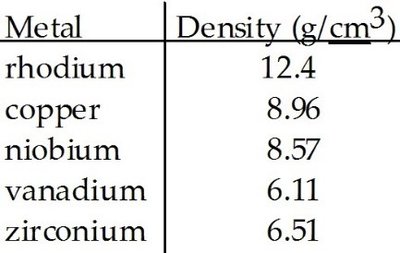
Q6. A cube of an unknown metal measures 1.250 inch on one side. The mass of the cube is 0.395 kg. Which of the following is most likely the unknown metal?
Background
Topic: Density Calculation and Identification
This question tests your ability to calculate the density of a metal cube and compare it to known values to identify the metal.
Key Terms and Formulas:
Density formula:
Volume of a cube:
Conversion:
Step-by-Step Guidance
Convert the side length from inches to centimeters: .
Calculate the volume of the cube in cm³: .
Convert the mass from kg to g: .
Calculate the density: .
Compare your calculated density to the values in the table to identify the metal.
Try solving on your own before revealing the answer!
Final Answer: Copper
The calculated density is closest to copper (8.96 g/cm³) based on the table provided.
To find the value of the cube, look up the spot price of copper per gram and multiply by the mass in grams.
Q7. If an object weighs 28.245 lbs, what would be the mass in grams? (2.20 lbs = 1 kg)
Background
Topic: Mass Conversion (English to Metric)
This question tests your ability to convert mass from pounds to kilograms and then to grams.
Key Terms and Formulas:
Step-by-Step Guidance
Start with .
Convert lbs to kg using the conversion factor.
Convert kg to g using metric conversion.
Set up the calculation so that lbs cancel and grams remain.
Try solving on your own before revealing the answer!
Final Answer: 12,840 g
The mass in grams is approximately 12,840 g.
Q8. A baseball is thrown at a velocity of 96.4 miles per hour. What is the speed in m/s?
Background
Topic: Speed Conversion (English to SI Units)
This question tests your ability to convert velocity from miles per hour to meters per second.
Key Terms and Formulas:
Step-by-Step Guidance
Start with .
Convert miles to meters using the conversion factor.
Convert hours to seconds using the conversion factor.
Set up the calculation so that mi/hr cancels and m/s remains.
Try solving on your own before revealing the answer!
Final Answer: 43.1 m/s
The speed is approximately 43.1 m/s.
Q9. A patient's cholesterol level in blood measures 198 mg/dL. What is the patient's cholesterol level in g/L?
Background
Topic: Concentration Conversion (Metric Units)
This question tests your ability to convert concentration units from mg/dL to g/L.
Key Terms and Formulas:
Step-by-Step Guidance
Start with .
Convert mg to g using metric prefixes.
Convert dL to L using metric prefixes.
Set up the calculation so that mg/dL cancels and g/L remains.
Try solving on your own before revealing the answer!
Final Answer: 1.98 g/L
The cholesterol level is 1.98 g/L.
Q10. A doctor’s order prescribed a dosage of 0.200 mg. If tablets in stock contain 25 μg of Synthroid, how many tablets are required?
Background
Topic: Dosage Calculation (Metric Prefixes)
This question tests your ability to convert between metric units and calculate the number of tablets needed for a prescribed dose.
Key Terms and Formulas:
Number of tablets =
Step-by-Step Guidance
Convert the prescribed dose from mg to μg.
Divide the total dose by the dose per tablet to find the number of tablets needed.
Set up the calculation so that units cancel appropriately.
Try solving on your own before revealing the answer!
Final Answer: 8 tablets
Eight tablets are required to provide the prescribed medication.
Q11. A person who exercises regularly has 14% body fat. If this person weighs 174 lb, what is the mass, in kilograms, of body fat?
Background
Topic: Percentage and Mass Conversion
This question tests your ability to calculate the mass of a component (body fat) from a percentage and convert from pounds to kilograms.
Key Terms and Formulas:
Percentage formula:
Step-by-Step Guidance
Calculate the mass of body fat: .
Convert the mass of body fat from lb to kg using the conversion factor.
Set up the calculation so that lb cancels and kg remains.
Try solving on your own before revealing the answer!
Final Answer: 11.1 kg
The mass of body fat is approximately 11.1 kg.
Q12. The density of octane is 0.703 g/mL. The generator requires 995 mL of gasoline. What is the mass, in kg, of 995 mL of octane?
Background
Topic: Density and Mass Calculation
This question tests your ability to use density to calculate mass and convert from grams to kilograms.
Key Terms and Formulas:
Density formula:
Rearranged:
Step-by-Step Guidance
Identify the volume: .
Identify the density: .
Calculate the mass in grams: .
Convert the mass from grams to kilograms.
Try solving on your own before revealing the answer!
Final Answer: 0.699 kg
The mass of octane is approximately 0.699 kg.
Q13. A square piece of aluminum foil has a mass of 2.400 g and sides of 15.25 cm. Find the thickness of the aluminum foil.
Background
Topic: Density, Volume, and Thickness Calculation
This question tests your ability to use mass, density, and area to find the thickness of a material.
Key Terms and Formulas:
Density formula:
Volume of foil: (where is thickness)
Area: (for a square, )
Density of aluminum: (look up value)
Step-by-Step Guidance
Calculate the area of the foil: .
Use the density formula to solve for volume: .
Set up the equation for thickness: .
Rearrange to solve for thickness: .
Try solving on your own before revealing the answer!
Final Answer: 0.058 cm
Area =
Volume =
Thickness =
The thickness of the foil is approximately 0.0038 cm.
