 Indietro
Significant Figures and Measurement Reliability in Chemistry
Guida di studio - Note intelligenti
 Appunti personalizzati basati sui tuoi materiali, ampliati con definizioni chiave, esempi e contesto.
Chapter One: Matter, Measurement, and Problem Solving
The Reliability of a Measurement: Significant Figures
In scientific measurement, reliability is ensured by reporting all certain digits and one estimated digit. The precision of a measurement depends on the quality of the instrument, the measurement technique, environmental conditions, and the observer’s skill. Preserving this precision during calculations and reporting is accomplished by using significant figures.
Significant Figures: Digits in a measurement that are known with certainty plus one digit that is estimated.
Precision: The degree to which repeated measurements under unchanged conditions show the same results.
Accuracy: How close a measured value is to the true or accepted value.
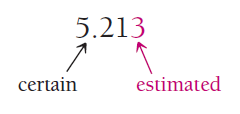
Example: In the measurement 5.213, the digits 5, 2, and 1 are certain, while 3 is estimated.
Reading Measurements: The Meniscus
When measuring liquids, the correct reading is taken at the bottom of the meniscus. This ensures accuracy and consistency in volume measurements.
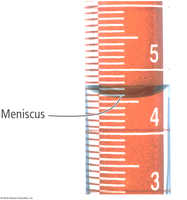
Example: The meniscus in the image is at 4.58 mL.
Counting Significant Figures
Rules for determining which digits in a number are significant:
Rule 1: All nonzero digits are significant.
Rule 2: Interior zeroes (zeroes between nonzero digits) are significant.
Rule 3: Leading zeroes (zeroes to the left of the first nonzero digit) are not significant; they only serve to locate the decimal point.
Rule 4: Trailing zeroes after a decimal point are always significant. Trailing zeroes before a decimal point (and after a nonzero number) are always significant. Trailing zeroes before an implied decimal point are ambiguous and should be avoided by using scientific notation or placing decimal points.
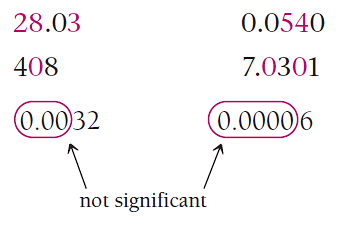
Example: In 0.0032, the leading zeroes are not significant; in 0.00006, only the 6 is significant.
Examples: Determining Significant Figures
(a) 1002.7 → 5 significant figures
(b) 1.00000 → 6 significant figures
(c) 0.0000000009 → 1 significant figure
(d) 0.00090 → 2 significant figures
(e) 5000 → ambiguous (1, 2, 3, or 4 significant figures depending on context)
(f) 5000.0 → 5 significant figures
Significant Figures in Calculations
When performing calculations with measured quantities, the result must reflect the precision of the input values. There are specific rules for multiplication/division and addition/subtraction:
Multiplication and Division: The result carries the same number of significant figures as the factor with the fewest significant figures.
Addition and Subtraction: The result carries the same number of decimal places as the quantity with the fewest decimal places.
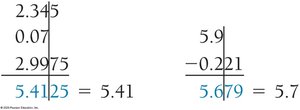
Example: Adding 2.345, 0.07, and 2.9975 gives 5.4125, which is rounded to 5.41 (two decimal places). Subtracting 0.221 from 5.9 gives 5.679, rounded to 5.7 (one decimal place).
Rounding Significant Figures
When rounding to the correct number of significant figures:
Round down if the last digit being dropped is four or less.
Round up if the last digit being dropped is five or more.
Only the last (or leftmost) digit being dropped determines the direction of rounding; ignore all digits to the right of it.
Examples:
5.37 rounds to 5.4 (rounded up)
5.34 rounds to 5.3 (rounded down)
5.35 rounds to 5.4 (rounded up)
5.349 rounds to 5.3 (rounded down)
Rounding in Multistep Calculations
To avoid rounding errors in multistep calculations, round only the final answer. If intermediate answers are written down, underline the least significant digit to keep track of significant figures.
Additional info: Follow the BODMAS/PEMDAS rule for the order of operations in calculations.
Precision and Accuracy
Understanding the difference between precision and accuracy is essential in evaluating measurement quality:
Precision: Consistency among repeated measurements.
Accuracy: Closeness to the true value.
Measurements can be precise but not accurate, accurate but not precise, or both.
Random error causes inconsistency (affects precision), while systematic error causes inaccuracy (affects accuracy).
Example: Three students weigh a lead block known to have a true mass of 10.00 g. Student A's results are both inaccurate and imprecise; Student B's results are precise but inaccurate; Student C's results are both accurate and precise.
Summary Table: Types of Errors
Error Type | Effect | Source |
|---|---|---|
Random Error | Inconsistency (affects precision) | Unpredictable fluctuations |
Systematic Error | Consistent deviation (affects accuracy) | Faulty equipment or bias |
