 Indietro
Significant Figures and Measurement Reliability in Chemistry
Guida di studio - Note intelligenti
 Appunti personalizzati basati sui tuoi materiali, ampliati con definizioni chiave, esempi e contesto.
Chapter One: Matter, Measurement, and Problem Solving
The Reliability of a Measurement: Significant Figures
In scientific measurement, the reliability and precision of reported values are crucial. Every digit in a measurement is certain except the last, which is estimated. The precision depends on the instrument, technique, environment, and observer skill. Preserving this precision during calculations is achieved by using significant figures.
Significant Figures: Digits in a measurement that are known with certainty plus one digit that is estimated.
Precision: The degree to which repeated measurements under unchanged conditions show the same results.
Accuracy: How close a measured value is to the true value.
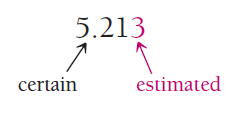
Example: In the measurement 5.213, the digits 5, 2, and 1 are certain, while 3 is estimated.
Reading Measurements: The Meniscus
When measuring liquids, the meniscus is the curve seen at the liquid's surface. The correct measurement is taken at the bottom of the meniscus, ensuring accuracy and consistency.
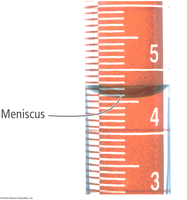
Example: The meniscus in a graduated cylinder is read at the lowest point, here at 4.58 mL.
Counting Significant Figures
Rules for Identifying Significant Figures
Understanding which digits are significant is essential for reporting and calculating measurements correctly. The following rules apply:
Rule 1: All nonzero digits are significant.
Rule 2: Interior zeroes (between nonzero digits) are significant.
Rule 3: Leading zeroes (to the left of the first nonzero digit) are not significant; they only locate the decimal point.
Rule 4: Trailing zeroes after a decimal point are always significant. Trailing zeroes before a decimal point (and after a nonzero number) are always significant. Trailing zeroes before an implied decimal point are ambiguous and should be clarified with scientific notation or a decimal point.
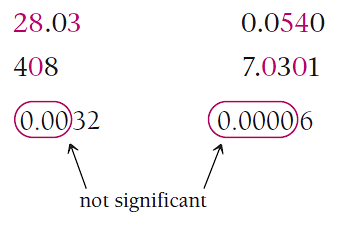
Example: In 0.0032, the leading zeroes are not significant; in 0.00006, only the 6 is significant.
Examples: Determining Significant Figures
(a) 1002.7 → 5 significant figures
(b) 1.00000 → 6 significant figures
(c) 0.0000000009 → 1 significant figure
(d) 0.00090 → 2 significant figures
(e) 5000 → ambiguous (1, 2, 3, or 4 significant figures depending on context)
(f) 5000.0 → 5 significant figures
Significant Figures in Calculations
Rules for Mathematical Operations
When performing calculations with measured quantities, the result must reflect the precision of the input values. The rules for significant figures in calculations are:
Multiplication and Division: The result has the same number of significant figures as the factor with the fewest significant figures.
Addition and Subtraction: The result has the same number of decimal places as the quantity with the fewest decimal places.
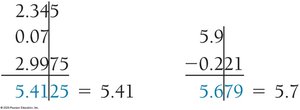
Example: Adding 2.345, 0.07, and 2.9975 gives 5.4125, which is rounded to 5.41 (two decimal places). Subtracting 0.221 from 5.9 gives 5.679, rounded to 5.7 (one decimal place).
Rounding Rules
When rounding to the correct number of significant figures:
Round down if the last digit being dropped is four or less.
Round up if the last digit being dropped is five or more.
Only the leftmost digit being dropped determines the direction of rounding; ignore all digits to the right.
Examples:
5.37 rounds to 5.4 (rounded up)
5.34 rounds to 5.3 (rounded down)
5.35 rounds to 5.4 (rounded up)
5.349 rounds to 5.3 (rounded down)
Rounding in Multistep Calculations
To avoid rounding errors in multistep calculations, round only the final answer. If intermediate answers are written, underline the least significant digit to keep track of significant figures.
Precision and Accuracy
Definitions and Differences
Precision and accuracy are fundamental concepts in measurement:
Precision: Consistency among repeated measurements.
Accuracy: Closeness to the true value.
Measurements are precise if they are consistent, and accurate if they are close to the actual value.
Example: Student A's results are both inaccurate and imprecise; Student B's results are precise but inaccurate; Student C's results are both accurate and precise.
Types of Error
Random Error: Has equal probability of being too high or too low; causes inconsistency.
Systematic Error: Tends to be consistently too high or too low; causes inaccuracy.
Practice Problems
Apply the rules of significant figures, rounding, and measurement reliability to solve practice problems and reinforce understanding.
