 Indietro
Solution Concentration and Colligative Properties
Guida di studio - Note intelligenti
 Appunti personalizzati basati sui tuoi materiali, ampliati con definizioni chiave, esempi e contesto.
Expressing Solution Concentration
Overview of Concentration Units
Concentration describes the amount of solute present in a given quantity of solvent or solution. Several units are commonly used in chemistry to express concentration, each with specific applications and calculation methods.
Mass Percent (%): The mass of solute divided by the total mass of solution, multiplied by 100.
Parts Per Million (ppm): The mass of solute per million parts of solution mass.
Parts Per Billion (ppb): The mass of solute per billion parts of solution mass.
Molarity (M): Moles of solute per liter of solution.
Molality (m): Moles of solute per kilogram of solvent.
Mole Fraction (X): Moles of a component divided by the total moles of all components.
Key Equations:
Mass Percent:
ppm:
ppb:
Molarity:
Molality:
Mole Fraction:
Example: Lead in Drinking Water
The Environmental Protection Agency (EPA) sets a limit for lead (Pb2+) in water at 15 ppb. To find the maximum mass of lead in 1.00 L of water (density = 1.00 g/cm3):
1.00 L water = 1000 g
Maximum mass of lead:

Example: Concentration Calculations for Ethanol in Gin
Given a gin solution labeled as 44% alcohol by volume, with the remainder water, and densities provided, the following concentrations can be calculated for ethanol:
Mass Percent:
Mole Fraction:
Molarity:
Molality:

Colligative Properties
Definition and Overview
Colligative properties are physical properties of solutions that depend only on the number of solute particles, not their identity. These properties arise from the entropy-driven stabilization of the solution and are especially important for ideal solutions, where solute-solvent interactions are similar to solute-solute and solvent-solvent interactions.
Vapor Pressure Lowering
Boiling Point Elevation
Freezing Point Depression
Osmotic Pressure
Vapor Pressure Lowering (Raoult’s Law)
Adding a nonvolatile solute to a solvent lowers the solvent’s vapor pressure. Raoult’s Law quantifies this effect:
Where is the mole fraction of the solvent and is the vapor pressure of the pure solvent.
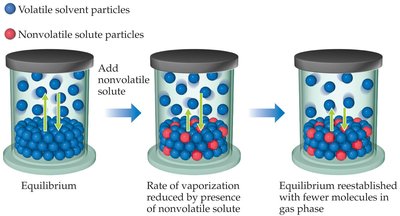
Example: Adding 22.5 g lactose to 100.0 g water at 25°C (vapor pressure of pure water = 23.8 torr):
Mole fraction H2O:
Vapor pressure: torr
Ideal Solutions with Two Volatile Components
For solutions with two volatile components, each contributes to the total vapor pressure according to Raoult’s Law. The total pressure is the sum of the partial pressures (Dalton’s Law):
Example: For gin (44% ethanol by volume), at 20°C, torr, torr:
Partial pressure H2O: torr
Partial pressure ethanol: torr
Total pressure: torr
Mole fraction ethanol in gas phase:
Boiling Point Elevation and Freezing Point Depression
Phase Diagram and Effects of Solute
Adding a solute to a solvent stabilizes the liquid phase, resulting in a lower freezing point and a higher boiling point for the solution compared to the pure solvent.
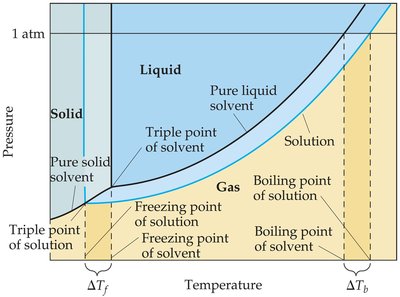
Key Equations:
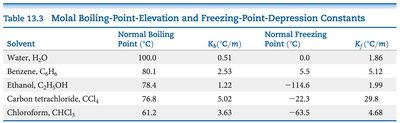
Boiling Point Elevation:
Freezing Point Depression:
Where is the van’t Hoff factor (number of particles per formula unit), and are solvent-specific constants, and is molality.
Dependence on Solute Particles (van’t Hoff Factor)
The magnitude of boiling point elevation and freezing point depression depends on the number of solute particles. The van’t Hoff factor () accounts for dissociation in ionic compounds:
For nonelectrolytes (e.g., glycerin):
For NaCl: (Na+ and Cl−)
For Zn(NO3)2: (Zn2+ and 2 NO3−)
Example: Of three 0.15 m solutions (glycerin, NaCl, Zn(NO3)2), Zn(NO3)2 will have the lowest freezing point due to the highest value.
Deviations in the van’t Hoff Factor
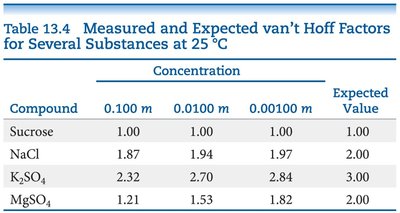
In practice, the van’t Hoff factor may be lower than expected due to ion pairing or incomplete dissociation, especially at higher concentrations.
Compound | 0.100 m | 0.0100 m | 0.00100 m | Expected Value |
|---|---|---|---|---|
Sucrose | 1.00 | 1.00 | 1.00 | 1.00 |
NaCl | 1.87 | 1.94 | 1.97 | 2.00 |
K2SO4 | 2.32 | 2.70 | 2.84 | 3.00 |
MgSO4 | 1.21 | 1.53 | 1.82 | 2.00 |
Summary Table: Colligative Property Equations
Property | Equation | Concentration Unit |
|---|---|---|
Vapor Pressure Lowering | Mole Fraction | |
Boiling Point Elevation | Molality | |
Freezing Point Depression | Molality | |
Osmotic Pressure | Molarity |
Additional info: The van’t Hoff factor () is crucial for ionic solutes, as it reflects the number of particles produced in solution. Deviations from ideality are more pronounced at higher concentrations due to ion pairing.
