 Indietro
Solutions and Their Properties: Structure, Solubility, and Colligative Effects
Guida di studio - Note intelligenti
 Appunti personalizzati basati sui tuoi materiali, ampliati con definizioni chiave, esempi e contesto.
Solutions and Their Properties
Types of Solutions
Solutions are homogeneous mixtures composed of a solute and a solvent. The physical state of a solution is typically the same as that of the solvent, and the components are dispersed on a molecular scale. The dissolved solute does not settle out, and the composition can be varied continuously depending on solubility.
Solute: The substance present in a lesser amount, dissolved in the solvent.
Solvent: The substance present in a greater amount, which dissolves the solute.
Homogeneous: Uniform composition throughout.
Examples:
Air: O2(g) in N2(g)
Soft drinks: CO2(g) in H2O(l)
Saltwater: NaCl(s) in H2O(l)
Brass: Zn(s) in Cu(s)
Intermolecular Forces (IMF) in Solutions
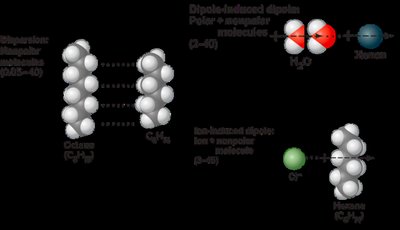
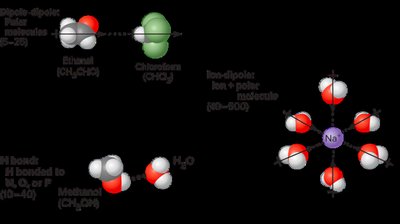
The formation and properties of solutions are governed by intermolecular forces between solute and solvent particles. These include dispersion forces, dipole-dipole interactions, hydrogen bonding, and ion-dipole forces.
Dispersion Forces: Present in all molecules, especially nonpolar ones.
Dipole-Dipole Interactions: Occur between polar molecules.
Hydrogen Bonding: Special dipole-dipole interaction involving H bonded to N, O, or F.
Ion-Dipole Forces: Occur between ions and polar molecules, crucial for dissolving ionic compounds in water.
Formation of Solutions
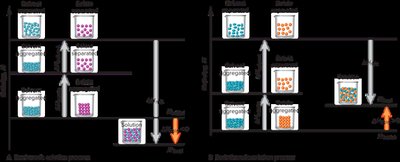
Solution formation is driven by two main factors:
Decrease in Internal Energy: An exothermic process favors solution formation. If there is no energy change, the solution is considered ideal.
Increase in Entropy: Greater dispersal of matter (higher entropy) also favors solution formation.
Solubility
Solubility of Gases in Liquids
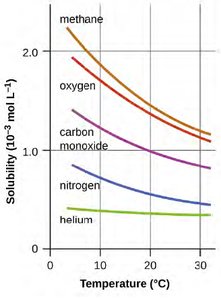
The solubility of a gas in a liquid depends on the nature of the gas and solvent, temperature, and pressure. There are no solute-solute attractions to overcome for gases, so solute-solvent interactions are the main energetic factor. Generally, solubility of gases decreases as temperature increases.
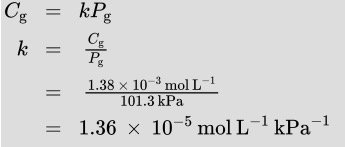
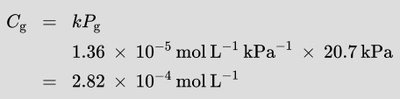
Henry's Law: The concentration of a dissolved gas is directly proportional to its partial pressure above the solution.
Henry's Law equation:
Where is the concentration of the gas, is the Henry's law constant, and is the partial pressure of the gas.
Solubility of Liquids in Liquids
Liquids can be miscible, immiscible, or partially miscible:
Miscible: Mix in all proportions (e.g., ethanol and water).
Immiscible: Do not mix appreciably (e.g., oil and water).
Partially Miscible: Mix to a limited extent, forming two layers (e.g., bromine and water).
Solubility of Solids in Liquids
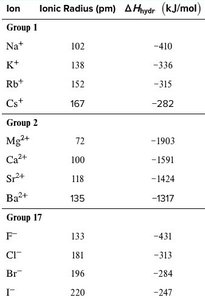
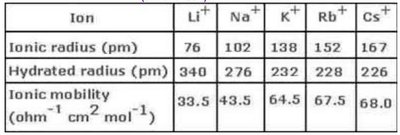
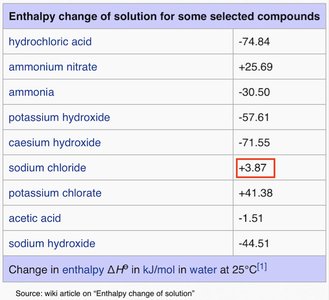
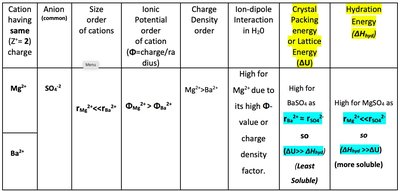
The solubility of ionic solids in water depends on the balance between lattice energy and hydration energy. Smaller ions and higher charges generally lead to higher lattice energies, while higher hydration energies favor dissolution.
Electrolytes
Types of Electrolytes
Electrolytes are substances that produce ions in solution and conduct electricity. They are classified as strong, weak, or nonelectrolytes based on their degree of ionization.
Strong Electrolytes: Completely ionize in solution (e.g., NaCl, HCl).
Weak Electrolytes: Partially ionize (e.g., acetic acid).
Nonelectrolytes: Do not produce ions (e.g., ethanol).
Colligative Properties
Definition and Importance
Colligative properties depend only on the number of solute particles in solution, not their identity. These include vapor pressure lowering, boiling point elevation, freezing point depression, and osmotic pressure.
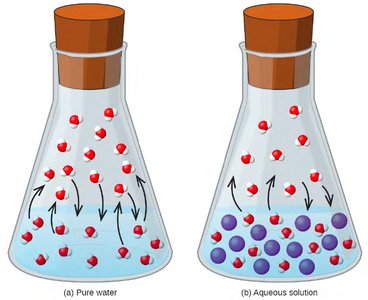
Vapor Pressure Lowering: Addition of a nonvolatile solute lowers the vapor pressure of the solvent.
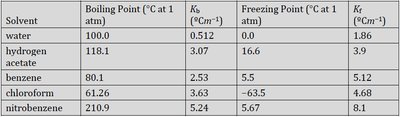
Boiling Point Elevation: The boiling point of a solution is higher than that of the pure solvent.
Freezing Point Depression: The freezing point of a solution is lower than that of the pure solvent.
Osmotic Pressure: The pressure required to stop the net flow of solvent through a semipermeable membrane into the solution.
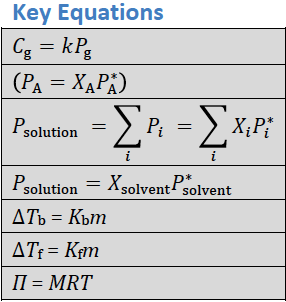
Key Equations for Colligative Properties
Vapor Pressure Lowering (Raoult's Law):
Boiling Point Elevation:
Freezing Point Depression:
Osmotic Pressure:
Concentration Units
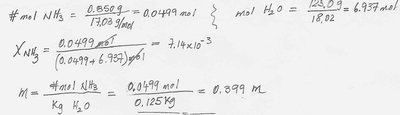
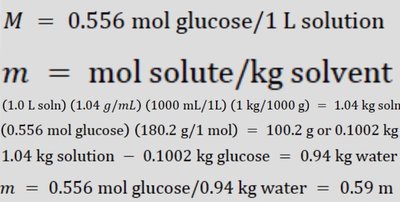
Molarity (M):
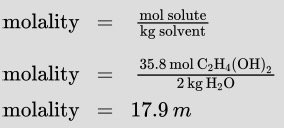
Molality (m):
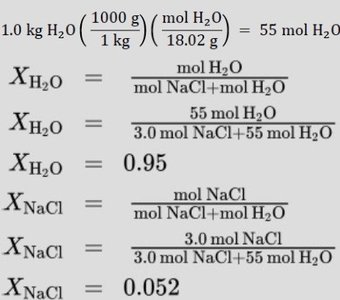
Mole Fraction (X):
Osmosis and Osmotic Pressure
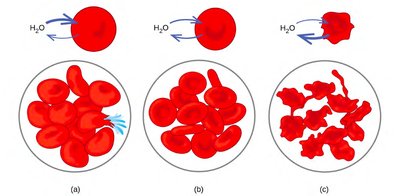
Osmosis is the movement of solvent molecules through a semipermeable membrane from a region of lower solute concentration to higher solute concentration. Osmotic pressure is the pressure required to stop this flow.
Isotonic Solution: Equal osmotic pressure; no net movement of water.
Hypotonic Solution: Lower osmotic pressure; water enters the cell, causing swelling.
Hypertonic Solution: Higher osmotic pressure; water leaves the cell, causing shrinkage.
Colloids
Definition and Properties
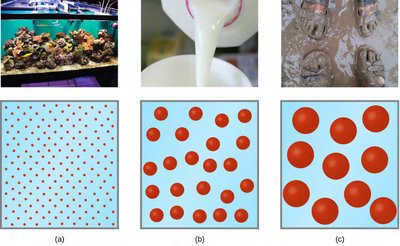
Colloids are mixtures where the dispersed particles are larger than those in true solutions but do not settle out. They exhibit the Tyndall effect (scattering of light).
Dispersed Phase: The particles distributed throughout the medium.
Dispersion Medium: The substance in which the particles are dispersed.
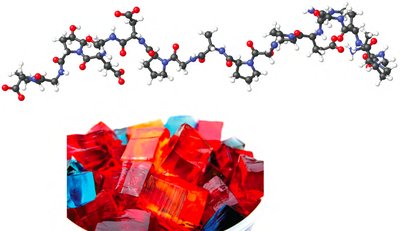
Examples: Milk (liquid in liquid), gelatin (solid in liquid), fog (liquid in gas).
Key Terms
Alloy: Solid mixture of a metallic element and one or more additional elements.
Amphiphilic: Molecules possessing both hydrophobic (nonpolar) and hydrophilic (polar) parts.
Boiling Point Elevation: Elevation of the boiling point of a liquid by addition of a solute.
Colligative Property: Property of a solution that depends only on the concentration of solute species.
Colloid: Mixture in which relatively large solid or liquid particles are dispersed uniformly throughout a gas, liquid, or solid.
Electrolyte: Substance that produces ions when dissolved in water.
Henry’s Law: The proportional relationship between the concentration of dissolved gas in a solution and the partial pressure of the gas in contact with the solution.
Miscible: Mutually soluble in all proportions; typically refers to liquid substances.
Molality (m): A concentration unit defined as the ratio of the numbers of moles of solute to the mass of the solvent in kilograms.
Osmosis: Diffusion of solvent molecules through a semipermeable membrane.
Raoult’s Law: The relationship between a solution’s vapor pressure and the vapor pressures and concentrations of its components.
Solubility: Extent to which a solute may be dissolved in water, or any solvent.
Van’t Hoff Factor (i): The ratio of the number of moles of particles in a solution to the number of moles of formula units dissolved in the solution.
