 Indietro
Standard Enthalpy, Hess's Law, and Enthalpy Calculations
Guida di studio - Note intelligenti
 Appunti personalizzati basati sui tuoi materiali, ampliati con definizioni chiave, esempi e contesto.
Standard Enthalpy and Enthalpy of Formation
Definition and Concepts
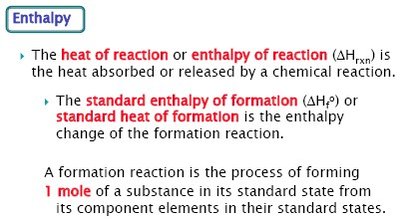
The heat of reaction or enthalpy of reaction (ΔHrxn) is the heat absorbed or released during a chemical reaction. The standard enthalpy of formation (ΔHof) is the enthalpy change when one mole of a substance is formed from its elements in their standard states.
Standard state: The most stable form of a substance at 1 atm pressure and 25°C.
Formation reaction: The process of forming 1 mole of a compound from its elements in their standard states.
ΔHof for elements in their standard state is zero.

Calculating Enthalpy Changes
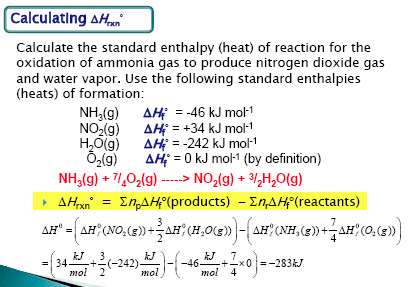
The standard enthalpy change of a reaction can be calculated using the enthalpies of formation:
Formula:
Enthalpy is a state function, meaning its value depends only on the initial and final states, not the path taken.

Example Calculation
For the reaction: NH3(g) + 7/4 O2(g) → NO2(g) + 3/2 H2O(g), using standard enthalpies of formation:
ΔHof[NH3] = -46 kJ/mol
ΔHof[NO2] = +34 kJ/mol
ΔHof[H2O] = -242 kJ/mol
ΔHof[O2] = 0 kJ/mol
Calculation:
kJ
Hess's Law
Principle and Explanation
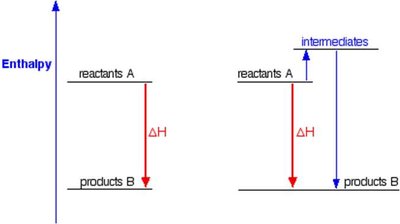
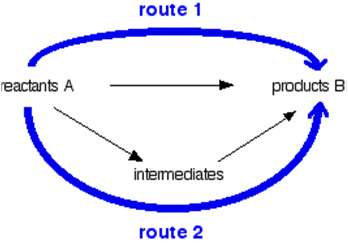
Hess's Law states that the overall enthalpy change for a chemical process is independent of the path taken. This means that the enthalpy change for a reaction is the same whether it occurs in one step or multiple steps.
The enthalpy change for a reaction can be determined by summing the enthalpy changes of individual steps.
Enthalpy is a state function, so only the initial and final states matter.


Operational Details
If you reverse a reaction, the sign of ΔH changes.
If you multiply the coefficients in a reaction by a constant, multiply ΔH by the same constant.
When combining reactions, work backwards from the target reaction.

Example: Combining Reactions
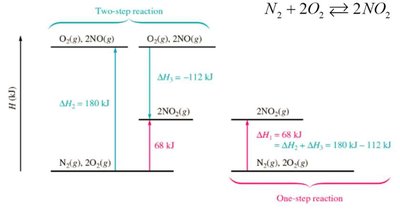
Consider the reaction: N2(g) + 2O2(g) → 2NO2(g), ΔH = 68 kJ. This can be carried out in two steps:
N2(g) + O2(g) → 2NO(g), ΔH1 = 180 kJ
2NO(g) + O2(g) → 2NO2(g), ΔH2 = -112 kJ
Adding the two steps: ΔH = ΔH1 + ΔH2 = 68 kJ

Generalized Hess's Law Formula
For a process from A to B via intermediates X and Y:

Worked Examples Using Hess's Law
Example: Methane Combustion
CH4(g) + 2O2(g) → CO2(g) + 2H2O(g), ΔH = -802 kJ
2H2O(g) → 2H2O(l), ΔH = -88 kJ
Combined: CH4(g) + 2O2(g) → CO2(g) + 2H2O(l), ΔH = -890 kJ
Example: Formation of Acetaldehyde
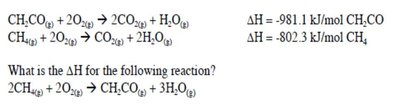
CH3CO(g) + 2O2(g) → 2CO2(g) + H2O(g), ΔH = -981.1 kJ/mol
CH4(g) + 2O2(g) → CO2(g) + 2H2O(g), ΔH = -802.3 kJ/mol
Target: 2CH4(g) + 2O2(g) → CH3CO(g) + 3H2O(g)

Example: Formation of HCl
H2(g) + Cl2(g) → 2HCl(g), ΔH = -185 kJ
Given reactions and their enthalpy changes, combine and manipulate equations to obtain the target reaction.
Standard Enthalpies of Combustion
Tabulated Values
Standard enthalpies of combustion are important for understanding the energy content of fuels.
Substance | ΔHocomb (kJ/mol) |
|---|---|
CO(g) | -283.0 |
C5H12(l), pentane | -3535 |
C9H20(l), avg. gasoline compound | -6160 |
C14H30(l), avg. diesel compound | -7940 |
Summary of Key Points
Enthalpy is a state function and can be calculated using standard enthalpies of formation.
Hess's Law allows calculation of enthalpy changes for complex reactions by combining known reactions.
Manipulation of equations (reversing, multiplying) affects the sign and magnitude of ΔH.
Standard enthalpies of combustion are used to compare fuel values.
Additional info:
Some images and diagrams were omitted as they were not directly relevant to the explanation of the paragraph.
All equations are provided in LaTeX format for clarity and academic rigor.
