 Indietro
Step-by-Step Guidance for General Chemistry I Practice Exam 2
Guida di studio - Note intelligenti
 Appunti personalizzati basati sui tuoi materiali, ampliati con definizioni chiave, esempi e contesto.
Q1. When filling degenerate orbitals, electrons fill them singly first, with parallel spins. What is this way of filling orbitals called?
Background
Topic: Electron Configuration and Quantum Principles
This question tests your understanding of the rules governing how electrons occupy orbitals, especially when orbitals have the same energy (degenerate).
Key Terms:
Degenerate orbitals: Orbitals with the same energy level.
Hund's Rule: Electrons fill degenerate orbitals singly with parallel spins before pairing up.
Pauli Exclusion Principle: No two electrons in an atom can have the same set of quantum numbers.
Aufbau Principle: Electrons fill the lowest energy orbitals first.
Step-by-Step Guidance
Recall the three main rules for electron filling: Hund's rule, Pauli exclusion principle, and Aufbau principle.
Focus on the behavior of electrons in orbitals of equal energy (degenerate orbitals).
Think about which rule specifically states that electrons fill these orbitals singly and with parallel spins before pairing.
Try solving on your own before revealing the answer!
Final Answer: Hund's Rule
Hund's rule states that electrons fill degenerate orbitals singly first, with parallel spins, to maximize total spin.
Q2. Choose the orbital diagram that represents the ground state of N.
Background
Topic: Orbital Diagrams and Electron Configuration
This question tests your ability to represent the electron configuration of nitrogen using orbital diagrams.
Key Terms:
Ground state: The lowest energy state of an atom.
Orbital diagram: Visual representation of electron arrangement in orbitals.
Nitrogen (N): Atomic number 7.
Step-by-Step Guidance
Determine the electron configuration for nitrogen: $1s^2 2s^2 2p^3$.
Draw the orbital diagram for the 2p orbitals, remembering Hund's rule.
Check that each 2p orbital contains one electron with parallel spins before any pairing occurs.
Try solving on your own before revealing the answer!
Final Answer: The diagram with three unpaired electrons in the 2p orbitals
Each 2p orbital should have one electron, all with parallel spins, according to Hund's rule.
Q3. Give the ground state electron configuration for As.
Background
Topic: Electron Configuration
This question tests your ability to write the electron configuration for arsenic (As), using noble gas notation.
Key Terms:
Ground state: Lowest energy configuration.
Noble gas notation: Uses the previous noble gas to simplify electron configuration.
Arsenic (As): Atomic number 33.
Step-by-Step Guidance
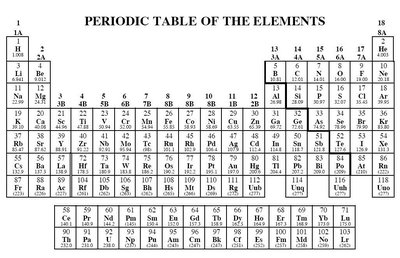
Find the atomic number of As (33) and locate it on the periodic table.
Write the electron configuration up to the previous noble gas (Ar).
Continue filling orbitals according to the Aufbau principle until you reach As.
Try solving on your own before revealing the answer!
Final Answer: [Ar]4s^2 3d^{10} 4p^3
Arsenic's electron configuration is [Ar]4s^2 3d^{10} 4p^3, following the order of orbital filling.
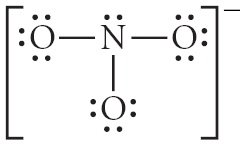
Q30. Choose the best Lewis structure for NO3-.
Background
Topic: Lewis Structures and Resonance
This question tests your ability to identify the correct Lewis structure for the nitrate ion, including resonance and formal charges.
Key Terms:
Lewis structure: Diagram showing bonds and lone pairs.
Resonance: Multiple valid structures for a molecule or ion.
Formal charge: Charge assigned to atoms in a molecule based on electron distribution.
Nitrate ion (NO3-): Polyatomic ion with one negative charge.
Step-by-Step Guidance
Count the total number of valence electrons for NO3- (5 from N, 6 from each O, plus 1 for the negative charge).
Draw possible Lewis structures, ensuring all atoms have full octets and the correct number of electrons.
Check for resonance structures: nitrate has three equivalent resonance forms.
Assign formal charges to each atom and select the structure(s) with the lowest formal charges.
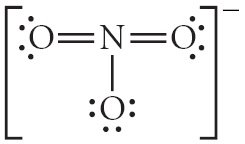
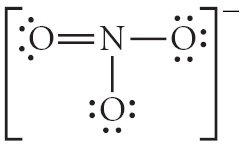
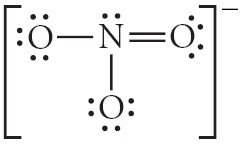
Try solving on your own before revealing the answer!
Final Answer: The best Lewis structure for NO3- is any of the resonance forms with one double bond and two single bonds, with formal charges distributed appropriately.
NO3- has three resonance structures, each with one double bond and two single bonds, and the negative charge is delocalized over the oxygens.
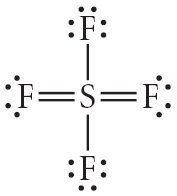
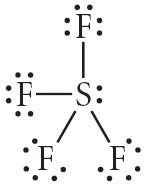
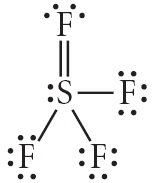
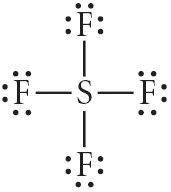
Q32. Choose the best Lewis structure for SF4.
Background
Topic: Lewis Structures and Molecular Geometry
This question tests your ability to draw the Lewis structure for sulfur tetrafluoride (SF4), including lone pairs and bonding arrangement.
Key Terms:
Lewis structure: Shows bonds and lone pairs.
SF4: Sulfur tetrafluoride, central atom S bonded to four F atoms.
Lone pair: Non-bonding pair of electrons on the central atom.
Step-by-Step Guidance
Count the total number of valence electrons (S: 6, F: 7 each).
Draw the skeleton structure with S in the center and four F atoms attached.
Distribute remaining electrons to satisfy octets and place any lone pairs on S.
Check for the correct number of bonds and lone pairs.
Try solving on your own before revealing the answer!
Final Answer: The best Lewis structure for SF4 has four single bonds to F and one lone pair on S.
This structure gives S a total of five electron domains (four bonds, one lone pair), matching the expected geometry for SF4.
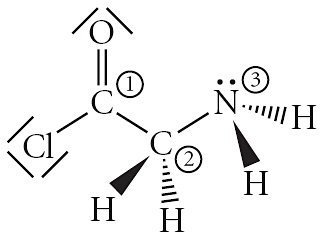
Q37. Consider the molecule below. Determine the molecular geometry at each of the 3 labeled atoms.
Background
Topic: Molecular Geometry (VSEPR Theory)
This question tests your ability to use VSEPR theory to determine the geometry at specific atoms in a molecule.
Key Terms:
Molecular geometry: The shape of a molecule as determined by the arrangement of atoms.
VSEPR theory: Valence Shell Electron Pair Repulsion theory, used to predict geometry.
Electron domain: Region around a central atom where electrons are found (bonds or lone pairs).
Step-by-Step Guidance
Identify the number of electron domains (bonds and lone pairs) around each labeled atom.
Use VSEPR theory to determine the geometry based on the number of domains.
Assign the correct geometry for each atom: tetrahedral, trigonal planar, trigonal pyramidal, etc.
Try solving on your own before revealing the answer!
Final Answer: 1 = trigonal planar, 2 = tetrahedral, 3 = trigonal pyramidal
Each geometry is determined by the number of electron domains and the presence of lone pairs at each labeled atom.
