 Indietro
Stoichiometry: Calculations with Chemical Formulas and Equations
Guida di studio - Note intelligenti
 Appunti personalizzati basati sui tuoi materiali, ampliati con definizioni chiave, esempi e contesto.
Stoichiometry: Calculations with Chemical Formulas and Equations
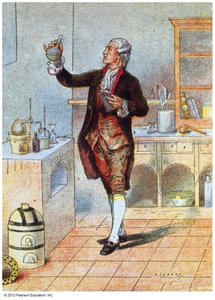
Law of Conservation of Mass
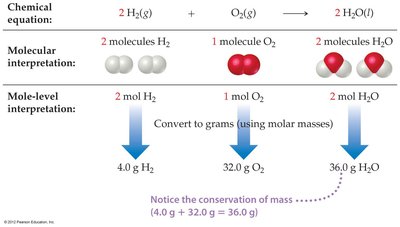
The Law of Conservation of Mass states that in any chemical reaction, the total mass of substances present after the reaction is the same as the total mass of substances before the reaction. This means that during a chemical reaction, there is no gain or loss of mass; atoms are simply rearranged.
Chemical Equations
Chemical reactions are represented using chemical equations, which show the reactants (on the left) and products (on the right) separated by an arrow. Coefficients are used to balance the equation, ensuring the same number of each type of atom on both sides. The physical state of each substance is indicated by (s) for solid, (l) for liquid, (g) for gas, and (aq) for aqueous solution.
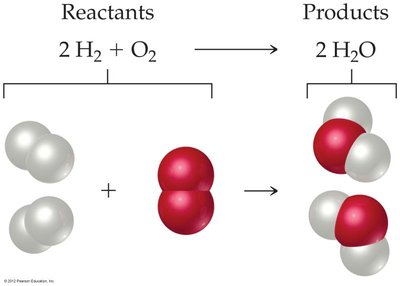
Balancing Chemical Equations
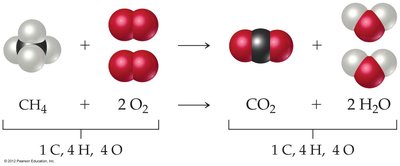
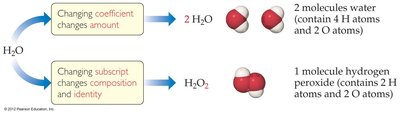
Balancing a chemical equation involves adjusting coefficients to ensure the same number of atoms of each element on both sides. Subscripts indicate the number of atoms in a molecule, while coefficients indicate the number of molecules. Changing a coefficient changes the amount, but changing a subscript changes the identity of the compound.
Sample Exercise: Balancing Equations
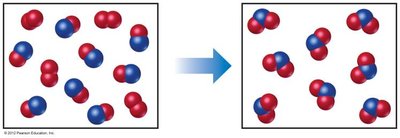
Consider the reaction between nitrogen monoxide and oxygen to form nitrogen dioxide:
Unbalanced: O2 + NO → NO2
Balanced: O2 + 2 NO → 2 NO2

Types of Chemical Reactions
Chemical reactions can be classified into several types:
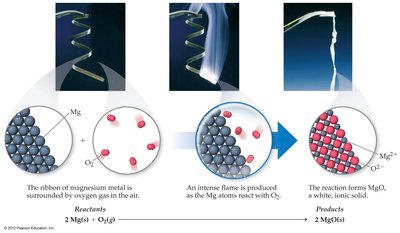
Combination (Synthesis) Reactions: Two or more substances combine to form one product. Example: 2Mg(s) + O2(g) → 2MgO(s)
Decomposition Reactions: One substance breaks down into two or more substances. Example: 2KClO3(s) → 2KCl(s) + 3O2(g)
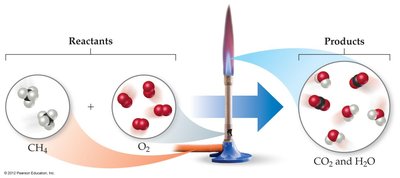
Combustion Reactions: A substance reacts rapidly with oxygen, often producing a flame. Hydrocarbons typically yield CO2 and H2O. Example: CH4(g) + 2O2(g) → CO2(g) + 2H2O(g)

Formula Weight and Molecular Weight
The formula weight (FW) is the sum of the atomic weights of all atoms in a chemical formula, typically used for ionic compounds. The molecular weight (MW) is the sum of atomic weights in a molecule, used for molecular compounds.
Example: FW of CaCl2 = 40.08 + 2(35.45) = 110.98 amu
Example: MW of C2H6 = 2(12.01) + 6(1.008) = 30.07 amu
Percent Composition
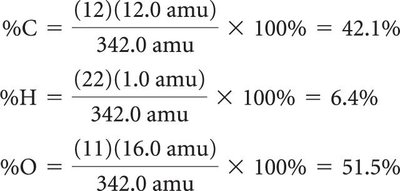
The percent composition of an element in a compound is the percentage of the compound's mass contributed by that element:
The Mole and Avogadro's Number
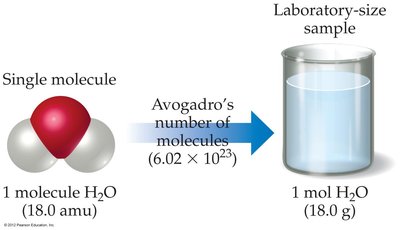
A mole (mol) is the amount of substance containing as many entities (atoms, molecules, ions) as there are atoms in exactly 12 g of carbon-12. This number is Avogadro's number, .
Molar Mass
The molar mass of a substance is the mass of one mole of that substance, expressed in grams per mole (g/mol). The molar mass (in g/mol) is numerically equal to the formula weight (in amu).
Converting Between Mass, Moles, and Number of Particles
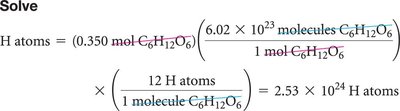
To convert between mass, moles, and number of particles, use the following relationships:
Mass (g) ↔ Moles (mol): Use molar mass
Moles (mol) ↔ Number of particles: Use Avogadro's number

Empirical and Molecular Formulas
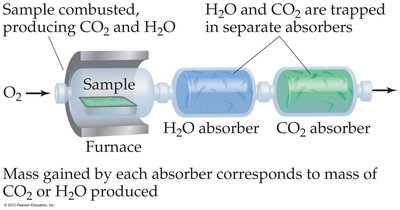
The empirical formula gives the simplest whole-number ratio of atoms in a compound. The molecular formula gives the actual number of atoms of each element in a molecule. The empirical formula can be determined from percent composition or combustion analysis.

Stoichiometric Calculations
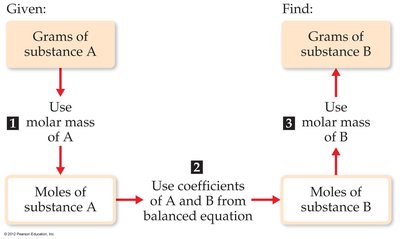
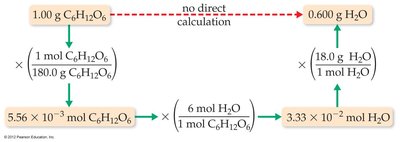
Stoichiometry involves using balanced chemical equations to calculate the amounts of reactants and products. The coefficients in the equation give the mole ratios needed for these calculations.
Limiting Reactant and Theoretical Yield
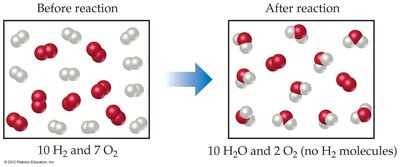
The limiting reactant is the reactant that is completely consumed first, limiting the amount of product formed. The theoretical yield is the maximum amount of product that can be formed from the limiting reactant. The percent yield is the ratio of actual yield to theoretical yield, expressed as a percentage:

Summary Table: Types of Reactions
Type | General Form | Example |
|---|---|---|
Combination | A + B → C | 2Mg(s) + O2(g) → 2MgO(s) |
Decomposition | C → A + B | 2KClO3(s) → 2KCl(s) + 3O2(g) |
Combustion | CxHy + O2 → CO2 + H2O | CH4(g) + 2O2(g) → CO2(g) + 2H2O(g) |
Additional info: These notes expand on the provided material with definitions, examples, and stepwise procedures for calculations, ensuring a comprehensive and self-contained study guide for General Chemistry students.
