 Indietro
Stoichiometry: Calculations with Chemical Formulas and Equations
Guida di studio - Note intelligenti
 Appunti personalizzati basati sui tuoi materiali, ampliati con definizioni chiave, esempi e contesto.
Chemical Equations and Stoichiometry
Representing Chemical Reactions
Chemical reactions are represented by chemical equations, which show the reactants and products involved. The numbers in front of the formulas are called coefficients and indicate the relative number of molecules or moles of each substance.
Balanced chemical equations have equal numbers of each type of atom on both sides, reflecting the law of conservation of mass.
Coefficients change the amount of a substance, not its identity; subscripts change the identity and should never be altered when balancing equations.
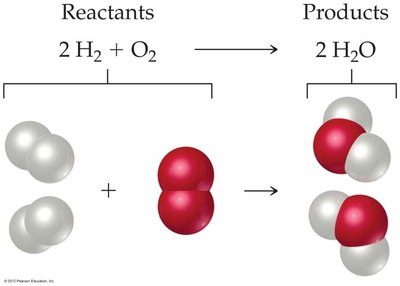
Example: The reaction of hydrogen and oxygen to form water is written as:
Balancing Chemical Equations
Balancing equations ensures the same number of each atom on both sides. Only coefficients are adjusted, never subscripts.
Start by balancing atoms that appear in only one reactant and one product.
Balance hydrogen and oxygen atoms last, as they often appear in multiple compounds.
Example: Balancing the combustion of methane:
Unbalanced:
Balanced:
Types of Chemical Reactions
Combination (Synthesis) Reactions
Two or more reactants combine to form a single product.
General form:
Example:
Decomposition Reactions
A single reactant breaks down into two or more products, often upon heating.
General form:
Example:
Single Replacement (Displacement) Reactions
One element replaces another in a compound.
General form:
Example:
Double Replacement (Metathesis) Reactions
Two compounds exchange ions to form two new compounds.
General form:
Example:
Combustion Reactions
Rapid reactions with oxygen that produce a flame, typically forming CO2 and H2O from hydrocarbons.
Example:
Formula Weights, Moles, and Avogadro’s Number
Formula Weight and Molar Mass
The formula weight (FW) is the sum of atomic weights of all atoms in a chemical formula (in amu). The molar mass (MM) is the mass in grams of one mole of a substance and numerically equals the formula weight in amu.
Example: FW of HNO3 = amu
MM of HNO3 = 62.99 g/mol
Avogadro’s Number and the Mole
The mole (mol) is the SI unit for amount of substance. One mole contains Avogadro’s number () of particles (atoms, molecules, or ions).
1 mol H2O = molecules H2O
1 mol NaCl = formula units NaCl
Percentage Composition
Calculating Percentage Composition
The percentage composition of a compound is the percent by mass of each element in the compound.
Formula:
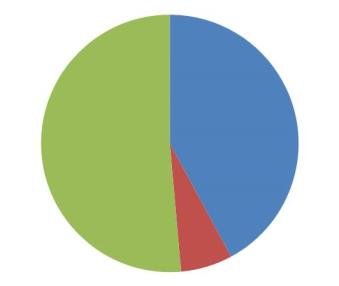
Example: For C12H22O11 (sucrose):
%C = 42.1%
%H = 6.5%
%O = 51.4%
Empirical and Molecular Formulas
Empirical Formulas from Percent Composition
The empirical formula gives the simplest whole-number ratio of atoms in a compound. It can be determined from percent composition by converting percentages to grams, then to moles, and finding the simplest ratio.
Example: A compound with 2.06% H, 32.71% S, and 65.23% O by mass has the empirical formula H2SO4.
Molecular Formulas from Empirical Formulas
The molecular formula is a whole-number multiple of the empirical formula. It is determined by dividing the molecular weight by the empirical formula weight.
Formula:
Example: If empirical formula is CH2O and molecular weight is 180.12 g/mol, molecular formula is C6H12O6.
Stoichiometric Calculations
Quantitative Information from Balanced Equations
The coefficients in a balanced equation indicate the relative numbers of moles (or molecules) of reactants and products. These ratios are used to convert between amounts of substances in a reaction.
Example:
2 mol H2 react with 1 mol O2 to produce 2 mol H2O
Limiting Reactants and Theoretical Yield
The limiting reactant is the reactant that is completely consumed first, limiting the amount of product formed. The theoretical yield is the maximum amount of product that can be formed from the limiting reactant. The percent yield compares the actual yield to the theoretical yield.
Percent yield =
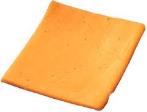
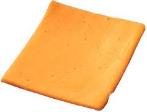
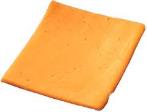
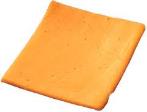
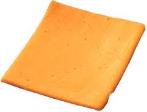
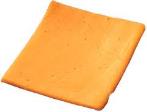
Example: If you have 14 slices of bread and 6 slices of cheese, you can make only 6 cheese sandwiches. Cheese is the limiting reactant.
In chemical reactions, the limiting reactant determines the maximum amount of product that can be formed, and any excess reactant is left over.
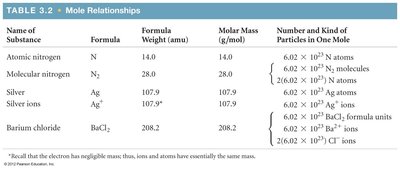
Summary Table: Mole Relationships
Name of Substance | Formula | Formula Weight (amu) | Molar Mass (g/mol) | Number and Kind of Particles in One Mole |
|---|---|---|---|---|
Atomic nitrogen | N | 14.0 | 14.0 | 6.02 × 10²³ N atoms |
Molecular nitrogen | N2 | 28.0 | 28.0 | 6.02 × 10²³ N2 molecules |
Silver | Ag | 107.9 | 107.9 | 6.02 × 10²³ Ag atoms |
Silver ions | Ag+ | 107.9 | 107.9 | 6.02 × 10²³ Ag+ ions |
Barium chloride | BaCl2 | 208.2 | 208.2 | 6.02 × 10²³ BaCl2 formula units 6.02 × 10²³ Ba2+ ions 2 × 6.02 × 1023 Cl- ions |
