 Indietro
Stoichiometry, Limiting Reactants, and Reaction Yield in General Chemistry
Guida di studio - Note intelligenti
 Appunti personalizzati basati sui tuoi materiali, ampliati con definizioni chiave, esempi e contesto.
Stoichiometric Calculations
Introduction to Stoichiometry
Stoichiometry is the quantitative study of reactants and products in a chemical reaction. It allows chemists to predict the amounts of substances consumed and produced in a reaction using the mole ratio from the balanced chemical equation.
Stoichiometry comes from the Greek words for "element" and "measure," meaning the measurement of elements.
It is essential for making quantitative predictions in chemical reactions.
The mole ratio from the balanced equation is the key to relating different substances.
The Mole Bridge and Conversion Factors
Stoichiometric calculations often require converting between mass, moles, volume, and number of particles. The following relationships are fundamental:
Molar Mass: Converts between grams and moles.
Avogadro’s Number (NA): Converts between moles and number of molecules or atoms.
Molarity: Converts between moles and volume for solutions.
These conversions are often visualized as a "mole bridge" connecting different units.
Guidelines for Reaction Stoichiometry
To solve stoichiometry problems, follow these steps:
Write the balanced chemical equation.
Calculate the number of moles of the given species (reactant or product).
Use the coefficients from the balanced equation to convert moles of the given species to moles of the desired species.
Convert the moles of the desired species to mass, if required.
Example: Stoichiometric Calculation
Consider the reaction of hydrochloric acid with manganese dioxide:
Unbalanced: HCl(aq) + MnO2(s) → H2O(l) + MnCl2(aq) + Cl2(g)
Balanced: 4 HCl(aq) + MnO2(s) → 2 H2O(l) + MnCl2(aq) + Cl2(g)
Problem: How many grams of HCl are required to completely convert 5.00 g of MnO2? Answer: 8.40 g HCl
Test Your Understanding
Example: 2 ZnS(s) + 3 O2(g) → 2 ZnO(s) + 2 SO2(g) How many kilograms of O2 are needed to react with 5.00 × 10³ g of ZnS? Answer: 2.46 kg O2
Limiting Reactants
Definition and Importance
The limiting reactant is the reactant that is completely consumed first in a chemical reaction, thus determining the maximum amount of product that can be formed. Any other reactants are considered to be in excess.
The limiting reactant controls the extent of the reaction.
Identifying the limiting reactant is essential for accurate stoichiometric calculations.
Analogy: Making a Pizza
The concept of limiting reactants can be illustrated by making pizzas. If you have 10 cups of cheese, dough for 6 crusts, and 50 oz of sauce, the number of pizzas you can make is limited by the ingredient you have in the smallest stoichiometric amount (in this case, the crusts).
Molecular and Molar Representation
Consider the reaction: 2 H2 + O2 → 2 H2O
If you start with 10 molecules (or moles) of H2 and 7 molecules (or moles) of O2, H2 is the limiting reactant.
After the reaction, all H2 is consumed, and some O2 remains.
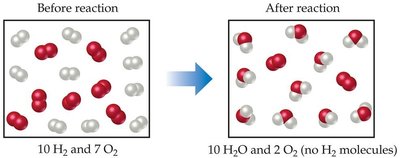
Limiting Reactants in Stoichiometry
All stoichiometric calculations involving multiple reactants must consider the limiting reactant to determine the amount of products formed and the amount of excess reactants remaining.
Example: Limiting Reactant Calculation
CS2(g) + 3 O2(g) → CO2(g) + 2 SO2(g)
Given: 15.0 g CS2 and 35.0 g O2
Find: Grams of SO2 produced, which reactant is in excess, and how much remains.
Answer: 25.2 g SO2 produced, 16 g O2 remains
Test Your Understanding
Zn(s) + 2 HCl(aq) → ZnCl2(aq) + H2(g) If 0.30 mol Zn is added to 0.52 mol HCl, how many moles of H2 are produced? Answer: 0.26 mol H2
Theoretical Yield and Percent Yield
Theoretical Yield
The theoretical yield is the maximum amount of product that can be formed from the limiting reactant, as calculated from the balanced chemical equation. It assumes perfect reaction conditions and complete conversion of the limiting reactant.
Actual Yield and Percent Yield
The actual yield is the amount of product actually obtained from a reaction. The percent yield compares the actual yield to the theoretical yield:
Example: Percent Yield Calculation
C7H6O3(s) + CH3OH(l) → C8H8O3(l) + H2O(l)
Given: 1.50 g salicylic acid, 11.20 g methanol, 1.31 g methyl salicylate produced
Find: Percent yield
Answer: About 79.2%
Test Your Understanding
Excess HCl is reacted with 0.800 g NaHCO3 to make NaCl, CO2, and H2O. If 0.420 g NaCl is obtained, what is the percent yield?
Theoretical yield: ~0.556 g NaCl
Percent yield: ~75.5%
Applications: Flue Gas Desulfurization
Environmental Chemistry Application
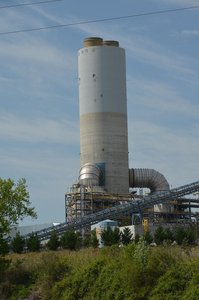
Flue gas desulfurization is a process used to remove sulfur dioxide (SO2) from the exhaust gases of coal-fired power plants, reducing acid rain formation. The reaction is:
Nomenclature: Sulfur dioxide + calcium carbonate + water + oxygen → calcium sulfate hydrate (gypsum) + carbon dioxide
Stoichiometry is used to calculate how much limestone (CaCO3) is needed to capture a given amount of SO2.
Appendix: Course Schedule Reference
Date | Topic | Chapter | HW |
|---|---|---|---|
8/18 | Introduction, Classification of Matter, Properties of Matter | 1.1-1.7 | HW 1: Sun. 8/24 |
8/20 | Properties of Matter, Nature of Energy, Units, Sig Figs, Dimensional Analysis | 1.8-1.9 | |
8/25 | Atoms and Measurements | 2.1-2.5 | HW 2: Mon. 8/31 |
8/27 | Atomic Structure, Periodic Table | 2.6-2.7 | |
9/1 | Molecules, Compounds, Nomenclature, Chemical Reactions | 2.8-3.5 | |
9/3 | Formula Weights, Avogadro's Number and the Mole, Empirical Formula, Balanced Equations, Limiting Reactant | 3.2-3.7 | |
9/7 | Labor Day, no recitation | ||
9/8 | Aqueous Solutions, Precipitation, Acid and Bases | 4.1-4.3 | HW 4: Mon. 9/14 |
9/10 | Oxidation and Reduction, Concentration of Solutions | 4.4-4.8 | |
9/17 | EXAM 1: Chapters 1-4 |
