 Indietro
Study Guide: Atomic and Ionic Radii, Bond Lengths, Ionization Energies, and Periodic Trends
Guida di studio - Note intelligenti
 Appunti personalizzati basati sui tuoi materiali, ampliati con definizioni chiave, esempi e contesto.
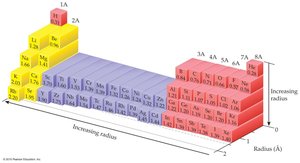
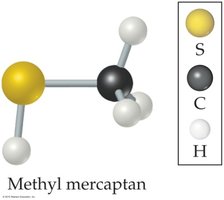
Q1. Use Figure 7.7 to predict the lengths of the C—S, C—H, and S—H bonds in methyl mercaptan (CH3SH).
Background
Topic: Bond Lengths and Atomic Radii
This question tests your ability to estimate bond lengths in a molecule by using the bonding atomic radii of the constituent atoms.
Key Terms and Formulas:
Bond length: The distance between the nuclei of two bonded atoms.
Bonding atomic radius: The radius assigned to an atom for the purpose of estimating bond lengths.
Formula:
Step-by-Step Guidance
Identify the atoms involved in each bond: C—S, C—H, and S—H.
Refer to Figure 7.7 to find the bonding atomic radii for C, S, and H.
Set up the calculation for each bond length by adding the atomic radii of the two atoms involved.
Write out the expressions for each bond length, but do not compute the final values yet.
Try solving on your own before revealing the answer!
Final Answer:
C—S bond length = 0.76 Å + 1.05 Å = 1.81 Å
C—H bond length = 0.76 Å + 0.31 Å = 1.07 Å
S—H bond length = 1.05 Å + 0.31 Å = 1.36 Å
These values are close to experimentally determined bond lengths, but bonds involving hydrogen often show larger deviations from predicted values.
Q2. Hypothetical elements X and Y form a molecule XY2. The X—X distance in elemental X is 2.04 Å, and the Y—Y distance in elemental Y is 1.68 Å. What would you predict for the X—Y distance in the XY2 molecule?
Background
Topic: Estimating Bond Lengths Using Atomic Radii
This question tests your ability to estimate the bond length between two different atoms using their atomic radii derived from their elemental bond distances.
Key Terms and Formulas:
Bonding atomic radius: Half the bond distance in the elemental form.
Bond length: Sum of the bonding atomic radii of the two atoms.
Formulas:
Step-by-Step Guidance
Calculate the bonding atomic radius for X by dividing the X—X distance by 2.
Calculate the bonding atomic radius for Y by dividing the Y—Y distance by 2.
Set up the expression for the X—Y bond length by adding the two radii.
Match your result to the closest value among the answer choices, but do not compute the final value yet.
Try solving on your own before revealing the answer!
Final Answer:
X—Y bond length = (2.04 Å / 2) + (1.68 Å / 2) = 1.02 Å + 0.84 Å = 1.86 Å
The predicted X—Y bond length is 1.86 Å, which matches answer choice (c).
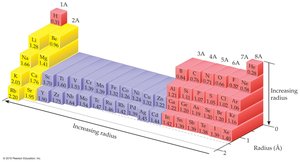
Q3. Using Figure 7.7, predict which is longer: the P—Br bond in PBr3 or the As—Cl bond in AsCl3.
Background
Topic: Comparing Bond Lengths Using Atomic Radii
This question tests your ability to use atomic radii to compare the lengths of two different bonds in molecules.
Key Terms and Formulas:
Bond length: Sum of the bonding atomic radii of the two atoms involved.
Formula:
Step-by-Step Guidance
Find the atomic radii for P, Br, As, and Cl using Figure 7.7.
Set up the calculation for the P—Br bond length and the As—Cl bond length.
Compare the two sums to determine which bond is longer, but do not compute the final values yet.
Try solving on your own before revealing the answer!
Final Answer:
P—Br bond length = P (1.06 Å) + Br (1.14 Å) = 2.20 Å
As—Cl bond length = As (1.21 Å) + Cl (0.99 Å) = 2.20 Å
Both bonds are predicted to have the same length, but small differences in experimental values may exist.
Q4. By referring to the periodic table, but not to Figure 7.7, place the following atoms in order of increasing bonding atomic radius: N, O, P, Ge.
Background
Topic: Periodic Trends in Atomic Radii
This question tests your understanding of how atomic radius changes across periods and down groups in the periodic table.
Key Terms and Formulas:
Atomic radius: The size of an atom, typically increases down a group and decreases across a period.
Periodic trend: Atomic radius increases as you move down a group and decreases as you move left to right across a period.
Step-by-Step Guidance
Locate N, O, P, and Ge in the periodic table.
Recall that atomic radius increases down a group and decreases across a period.
Arrange the atoms based on their positions, starting with the smallest and ending with the largest, but do not finalize the order yet.
Try solving on your own before revealing the answer!
Final Answer:
Order of increasing atomic radius: O < N < P < Ge
This order follows the periodic trends: O and N are in the same period, P is below N, and Ge is further down and to the right.
Q5. Arrange Be, C, K, and Ca in order of increasing atomic radius.
Background
Topic: Periodic Trends in Atomic Radii
This question tests your ability to apply periodic trends to arrange elements by atomic radius.
Key Terms and Formulas:
Atomic radius: Increases down a group, decreases across a period.
Step-by-Step Guidance
Locate Be, C, K, and Ca in the periodic table.
Compare their positions to determine relative atomic radii.
Arrange the elements from smallest to largest atomic radius, but do not finalize the order yet.
Try solving on your own before revealing the answer!
Final Answer:
Order of increasing atomic radius: C < Be < Ca < K
K is the largest because it is further down and to the left; C is the smallest because it is up and to the right.
