 Indietro
Study Guide: Electronic Structure of Atoms (CHEM 1251)
Guida di studio - Note intelligenti
 Appunti personalizzati basati sui tuoi materiali, ampliati con definizioni chiave, esempi e contesto.
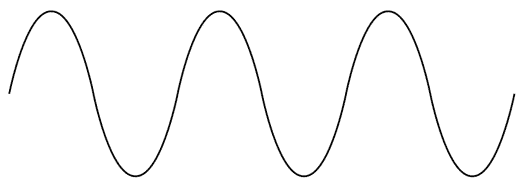
Q1. On the wave below, label the wavelength, frequency, and amplitude.
Background
Topic: Properties of Waves
This question tests your understanding of the basic characteristics of waves, which are essential for describing the behavior of electrons and light in quantum mechanics.
Key Terms:
Wavelength (\lambda): The distance between two consecutive peaks (or troughs) of the wave.
Frequency (\nu): The number of wave cycles that pass a given point per second.
Amplitude: The height of the wave from the center line to the peak (or trough).
Step-by-Step Guidance
Identify the repeating pattern in the wave. The wavelength (\lambda) is the horizontal distance between two adjacent peaks.
The amplitude is the vertical distance from the center of the wave to a peak (or trough).
Frequency (\nu) is not directly shown in the diagram, but it relates to how many wavelengths pass a point per second.
Label these features on the diagram, using arrows or lines to indicate each property.
Try labeling the diagram before revealing the answer!
Final Answer:
The wavelength (\lambda) is the distance between two peaks. The amplitude is the height from the center line to a peak. Frequency (\nu) is the number of wavelengths passing a point per second, which is not directly shown but is related to the spacing of the waves.
These properties are fundamental for understanding how electrons behave as waves in quantum mechanics.
Q2. The energy of the light wave above can be determined using what two equations? These equations provide you an energy in what units?
Background
Topic: Energy of Light Waves
This question tests your knowledge of how to calculate the energy of light using its frequency or wavelength.
Key Formulas:
Where:
= energy (in joules, J)
= Planck's constant ( J·s)
= frequency (in Hz)
= speed of light ( m/s)
= wavelength (in meters)
Step-by-Step Guidance
Recall that energy can be calculated using frequency: .
Alternatively, energy can be calculated using wavelength: .
Both equations give energy in units of joules (J).
Think about which equation to use based on whether you are given frequency or wavelength.
Try writing out the equations and units before revealing the answer!
Final Answer:
The two equations are and . Both provide energy in joules (J).
These equations are fundamental for calculating the energy of photons in quantum chemistry.
Q3. 1 mole = __________ photons
Background
Topic: Avogadro's Number and Photons
This question tests your understanding of the relationship between moles and the number of particles (photons, in this case).
Key Term:
Avogadro's Number (): particles per mole
Step-by-Step Guidance
Recall that 1 mole of any substance contains Avogadro's number of particles.
For photons, 1 mole means photons.
Write this value in the blank.
Try filling in the blank before revealing the answer!
Final Answer:
1 mole = photons
This is Avogadro's number, which applies to any type of particle, including photons.
Q4. Without performing any calculations, arrange the lights on a traffic signal from lowest to highest energy.
Background
Topic: Relationship Between Wavelength and Energy
This question tests your understanding of how the energy of light relates to its wavelength.

Key Concept:
Energy is inversely proportional to wavelength:
Step-by-Step Guidance
List the wavelengths: Red (750 nm), Yellow (580 nm), Green (500 nm).
Recall that shorter wavelength means higher energy.
Arrange the colors from longest to shortest wavelength.
Now, arrange them from lowest to highest energy based on their wavelengths.
Try arranging the colors before revealing the answer!
Final Answer:
Lowest to highest energy: Red (750 nm) < Yellow (580 nm) < Green (500 nm)
Energy increases as wavelength decreases.
Q5. A nitrogen gas laser pulse with a wavelength of 337 nm contains 3.83 mJ of energy. How many photons does it contain?
Background
Topic: Calculating Number of Photons
This question tests your ability to use energy and wavelength to determine the number of photons in a sample.
Key Formulas:
Where:
= Planck's constant ( J·s)
= speed of light ( m/s)
= wavelength (in meters)
Total energy = 3.83 mJ = J
Step-by-Step Guidance
Convert the wavelength from nm to meters: m.
Calculate the energy of one photon using .
Divide the total energy by the energy per photon to find the number of photons.
Set up the calculation, but stop before computing the final value.
Try setting up the calculation before revealing the answer!
Final Answer:
Number of photons =
Where J
Number of photons
This calculation shows how to relate total energy to the number of photons using wavelength.
Q6. An AM radio station broadcasts at 960 kHz.
Background
Topic: Electromagnetic Radiation Calculations
This question tests your ability to convert frequency to wavelength and calculate photon energy.
Key Formulas:
Where:
= frequency (960 kHz = Hz)
= speed of light ( m/s)
= Planck's constant ( J·s)
= Avogadro's number ()
Step-by-Step Guidance
Convert the frequency to Hz: Hz.
Calculate the wavelength using .
Calculate the energy of one photon using .
Calculate the energy of one mole of photons using .
Set up each calculation, but stop before computing the final values.
Try setting up the calculations before revealing the answer!
Final Answer:
a. Wavelength: m
b. Energy of one photon: J
c. Energy of one mole: J
These calculations show how to relate frequency, wavelength, and energy for electromagnetic radiation.
Q7. What experiment taught us that light (and matter) behaves as a wave? Draw a diagram of this experiment.
Background
Topic: Wave-Particle Duality
This question tests your knowledge of the experiment that demonstrated the wave nature of light and matter.
Key Concept:
The double-slit experiment shows interference patterns, indicating wave behavior.
Step-by-Step Guidance
Recall the double-slit experiment, where light passes through two slits and creates an interference pattern.
Draw a diagram showing the setup: a light source, two slits, and a screen with alternating bright and dark bands.
Explain how the pattern demonstrates wave behavior.
Try drawing the diagram and explaining before revealing the answer!
Final Answer:
The double-slit experiment taught us that light (and matter) behaves as a wave. The interference pattern on the screen is evidence of wave behavior.
When light passes through two slits, it creates alternating bright and dark bands due to constructive and destructive interference.
Q8. What effect taught us that light (and matter) behaves as a particle?
Background
Topic: Photoelectric Effect
This question tests your knowledge of the experiment that demonstrated the particle nature of light.
Key Concept:
The photoelectric effect shows that light can eject electrons from a metal surface, behaving as particles (photons).
Step-by-Step Guidance
Recall the photoelectric effect experiment, where light shines on a metal and electrons are ejected.
Draw a diagram showing a light source, metal surface, and ejected electrons.
Explain how the effect demonstrates particle behavior.
Try drawing the diagram and explaining before revealing the answer!
Final Answer:
The photoelectric effect taught us that light behaves as a particle. When light of sufficient energy shines on a metal, electrons are ejected, showing that light consists of discrete packets (photons).
Q9. Let’s say I shine light with an energy of 625 kJ/mol on a sodium surface with a threshold wavelength of 182 nm. Will an electron be ejected? Justify your answer.
Background
Topic: Photoelectric Effect and Threshold Energy
This question tests your ability to compare the energy of incident light to the threshold energy required to eject electrons.
Key Formulas:
Compare to
Step-by-Step Guidance
Convert the threshold wavelength to energy using .
Compare the energy of the incident light (625 kJ/mol) to the threshold energy.
If , electrons will be ejected.
Set up the comparison, but stop before making the final conclusion.
Try setting up the comparison before revealing the answer!
Final Answer:
Calculate for 182 nm: J per photon.
Convert to kJ/mol: kJ/mol.
Since 625 kJ/mol < 656 kJ/mol, the incident light does not have enough energy to eject electrons.
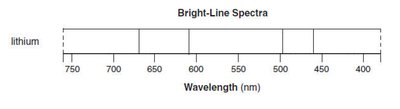
Q10. When an atom, such as lithium, is heated in a flame, it emits a line spectrum:
Background
Topic: Atomic Spectra
This question tests your understanding of the difference between line and continuous spectra, and why atoms emit line spectra.
Key Terms:
Line Spectrum: Discrete wavelengths emitted by atoms.
Continuous Spectrum: All wavelengths emitted, as in a rainbow.
Step-by-Step Guidance
Recall that a line spectrum consists of specific wavelengths, while a continuous spectrum includes all wavelengths.
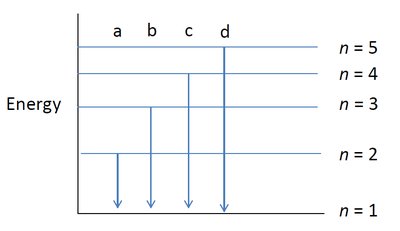
Atoms emit line spectra because electrons transition between discrete energy levels.
Explain the process inside the atom: electrons absorb energy, move to higher levels, then emit photons as they return to lower levels.
Match each wavelength in the emission spectrum to the correct transition using the provided diagrams.
Try matching the transitions before revealing the answer!
Final Answer:
a. Line spectrum shows discrete lines; continuous spectrum shows all colors. Atoms emit line spectra because electrons transition between specific energy levels.
b. Inside the atom, electrons absorb energy and move to higher levels, then emit photons as they return to lower levels.
c. Each wavelength in the emission spectrum corresponds to a specific transition between energy levels, as shown in the diagrams.
Q11. The basics of what we know about electrons were developed using the hydrogen atom as a model. When we have multielectron atoms, we must use Schrodinger’s equation to provide us with information about the electrons. When you solve this monstrosity, three values (called quantum numbers) result:
Background
Topic: Quantum Numbers
This question tests your understanding of the quantum numbers that describe electron orbitals.
Key Terms:
Principal quantum number (n): Energy level
Angular momentum quantum number (l): Shape of orbital
Magnetic quantum number (m_l): Orientation of orbital
Step-by-Step Guidance
Recall the three quantum numbers: n, l, m_l.
Each quantum number has allowed values depending on the orbital.
Think about how these numbers describe the location and shape of electrons in atoms.
Try listing the quantum numbers before revealing the answer!
Final Answer:
The three quantum numbers are: n (principal), l (angular momentum), and m_l (magnetic). They describe the energy, shape, and orientation of electron orbitals.
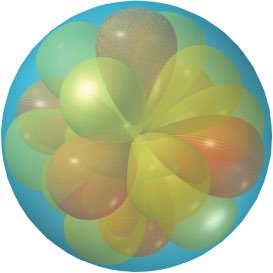
Q12. Consider a 3d orbital. Provide three quantum numbers for this orbital and draw what it would look like.
Background
Topic: Quantum Numbers and Orbital Shapes
This question tests your ability to assign quantum numbers and visualize orbital shapes.
Key Terms:
For a 3d orbital: n = 3, l = 2, m_l = -2, -1, 0, 1, or 2
Step-by-Step Guidance
Assign n = 3 (third energy level).
Assign l = 2 (d orbital).
Choose one value for m_l (e.g., 0).
Draw or visualize the shape of a d orbital (complex, often cloverleaf).
Try assigning the quantum numbers and visualizing the shape before revealing the answer!
Final Answer:
For a 3d orbital: n = 3, l = 2, m_l = 0 (or any value from -2 to 2). The shape is complex, often resembling a cloverleaf.
Q13. Consider a 2p orbital. Provide three quantum numbers for this orbital and draw what it would look like.
Background
Topic: Quantum Numbers and Orbital Shapes
This question tests your ability to assign quantum numbers and visualize orbital shapes.
Key Terms:
For a 2p orbital: n = 2, l = 1, m_l = -1, 0, or 1
Step-by-Step Guidance
Assign n = 2 (second energy level).
Assign l = 1 (p orbital).
Choose one value for m_l (e.g., 0).
Draw or visualize the shape of a p orbital (dumbbell-shaped).
Try assigning the quantum numbers and visualizing the shape before revealing the answer!
Final Answer:
For a 2p orbital: n = 2, l = 1, m_l = 0 (or any value from -1 to 1). The shape is dumbbell-shaped.
Q14. Consider a 2s and a 4s orbital. Provide three quantum numbers for each orbital and draw what they would look like.
Background
Topic: Quantum Numbers and Orbital Shapes
This question tests your ability to assign quantum numbers and visualize s orbital shapes.
Key Terms:
For a 2s orbital: n = 2, l = 0, m_l = 0
For a 4s orbital: n = 4, l = 0, m_l = 0
Step-by-Step Guidance
Assign n = 2, l = 0, m_l = 0 for 2s.
Assign n = 4, l = 0, m_l = 0 for 4s.
Draw or visualize the shape of s orbitals (spherical).
Try assigning the quantum numbers and visualizing the shapes before revealing the answer!
Final Answer:
For a 2s orbital: n = 2, l = 0, m_l = 0. For a 4s orbital: n = 4, l = 0, m_l = 0. Both are spherical, but the 4s orbital is larger.
