 Indietro
Study Guide: Mass, Moles, and Atoms in General Chemistry
Guida di studio - Note intelligenti
 Appunti personalizzati basati sui tuoi materiali, ampliati con definizioni chiave, esempi e contesto.
Q1. How many gold atoms are there in 9.67 g of gold?
Background
Topic: The Mole Concept & Dimensional Analysis
This question tests your ability to convert between mass, moles, and the number of atoms using the molar mass and Avogadro's number.
Key Terms and Formulas:
Molar mass: The mass (in grams) of one mole of a substance. For gold (Au), it is 196.967 g/mol.
Avogadro's number: atoms/mol
Dimensional analysis: A method to convert units stepwise.
Key formula:
Step-by-Step Guidance
Identify the mass of gold given: .
Find the molar mass of gold: .
Set up the conversion from grams to moles: .
Use Avogadro's number to convert moles to atoms: .
Multiply the values to find the number of atoms, keeping track of significant figures.
Try solving on your own before revealing the answer!
Final Answer: atoms
First, convert grams to moles: mol Au. Then, multiply by Avogadro's number: atoms.
This calculation uses dimensional analysis to ensure units cancel properly, leaving atoms as the final unit.
Q2. What is the mass of lead (Pb) atoms?
Background
Topic: The Mole Concept & Mass-Atom Conversions
This question tests your ability to convert from the number of atoms to mass using Avogadro's number and the molar mass of lead.
Key Terms and Formulas:
Avogadro's number: atoms/mol
Molar mass of lead (Pb):
Key formula:
Step-by-Step Guidance
Start with the number of lead atoms: atoms.
Convert atoms to moles: .
Multiply the number of moles by the molar mass of lead: g/mol.
Set up the calculation so that atoms cancel, leaving grams as the final unit.
Try solving on your own before revealing the answer!
Final Answer: g
First, convert atoms to moles: mol Pb. Then, multiply by the molar mass: g.
This approach uses two conversion factors to ensure the correct units and significant figures.
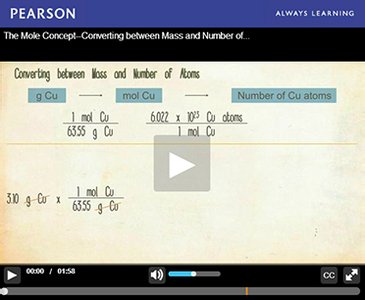
Q3. Calculate the mass, in grams, of a single iodine atom ( g/mol).
Background
Topic: Atomic Mass and Single Atom Calculations
This question tests your ability to use the atomic mass and Avogadro's number to find the mass of a single atom.
Key Terms and Formulas:
Atomic mass of iodine: g/mol
Avogadro's number: atoms/mol
Key formula:
Step-by-Step Guidance
Start with the atomic mass of iodine: g/mol.
Recognize that 1 mole contains atoms.
Set up the calculation: .
Ensure the units are correct: grams per atom.
Try solving on your own before revealing the answer!
Final Answer: g
Divide the atomic mass by Avogadro's number: g.
This calculation gives the mass of a single iodine atom in grams.
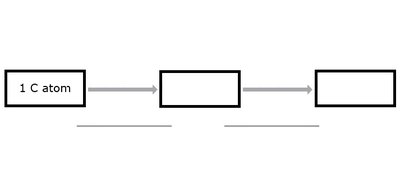
Q4. Which of the following would you expect to be a molecule and which would you expect to be part of an ionic solid?
Background
Topic: Ionic vs. Covalent Bonding
This question tests your understanding of the difference between molecular (covalent) and ionic compounds, based on the types of elements involved.
Key Terms:
Covalent bond: A bond formed by sharing electrons between two nonmetals.
Ionic bond: A bond formed by transferring electrons from a metal to a nonmetal, resulting in oppositely charged ions.
Molecule: A cluster of atoms held together by covalent bonds.
Ionic solid: A lattice of ions held together by ionic bonds.
Step-by-Step Guidance
Identify whether the compound is made of metals, nonmetals, or both.
Recall that covalent bonds form between two nonmetals, resulting in molecules.
Recall that ionic bonds form between a metal and a nonmetal, resulting in ionic solids.
Classify each compound based on the elements present.
Try solving on your own before revealing the answer!
Final Answer:
Compounds made of two nonmetals are molecules (covalent), while those made of a metal and a nonmetal are ionic solids.
For example, is a molecule, while is an ionic solid.
