 Indietro
Study Guide: Reactions in Aqueous Solution (General Chemistry)
Guida di studio - Note intelligenti
 Appunti personalizzati basati sui tuoi materiali, ampliati con definizioni chiave, esempi e contesto.
Reactions in Aqueous Solution
Concept of Solutions
Solutions are homogeneous mixtures composed of two or more substances, where the composition is uniform throughout. The main components are the solute (the substance dissolved) and the solvent (the substance in greater quantity that dissolves the solute).
Solute: The substance dissolved in the solvent.
Solvent: The substance present in the largest amount, which dissolves the solute.
Concentration: A measure of the amount of solute in a given volume of solution.
Types of Mixtures: Solutions, Suspensions, and Colloids
Mixtures can be classified based on the size of the solute particles and their behavior in the solvent.
Solutions: Homogeneous mixtures with solute particles smaller than 1 nm; particles do not settle.
Suspensions: Heterogeneous mixtures with large solute particles (>500 nm); particles settle over time.
Colloids: Mixtures with intermediate particle sizes (1–500 nm); particles do not settle but may scatter light.
Example: Salad dressing is a suspension, while milk is a colloid.
Molarity (M): Calculating Concentration
Molarity is the most common unit of concentration in chemistry, defined as the number of moles of solute per liter of solution.
Formula:
Example: Dissolving 23.7 g NaOH in 2.50 L of solution: Calculate moles of NaOH, then divide by volume.
Osmolarity: Ionic Concentration
Osmolarity measures the total concentration of ions in solution, important for solutions containing electrolytes.
Formula:
For compounds that dissociate, multiply the molarity by the number of ions produced per formula unit.
Dilutions
Dilution involves adding solvent to a solution to decrease its concentration. The relationship is given by:
Formula:
and are the initial molarity and volume; and are after dilution.
Example: To prepare 3.5 L of 2.7 M HBr from 5.2 M stock, solve for the volume needed.
Solubility Rules
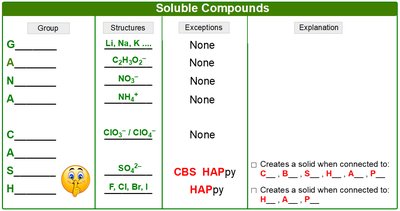
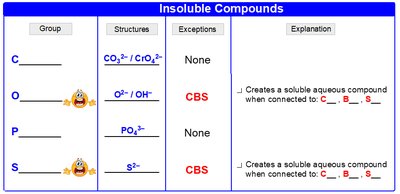
Solubility rules help predict whether an ionic compound will dissolve in water. Mnemonics like "GANA CASH" and "COPS" are used for soluble and insoluble compounds, respectively.
Soluble: Most compounds containing Group 1 metals, ammonium, nitrates, acetates, and halides (except with Ag, Pb, Hg).
Insoluble: Most carbonates, phosphates, sulfides, and hydroxides (except with Group 1 metals and ammonium).

Electrolytes
Electrolytes are substances that conduct electricity when dissolved in water, due to the formation of ions.
Strong Electrolytes: Completely dissociate (strong acids, strong bases, soluble ionic compounds).
Weak Electrolytes: Partially dissociate (weak acids, weak bases).
Non-Electrolytes: Do not dissociate (sugars, alcohols, most covalent compounds).
Molecular, Complete Ionic, and Net Ionic Equations
Chemical reactions in solution can be represented in three ways:
Molecular Equation: Shows compounds as intact molecules.
Complete Ionic Equation: Shows all soluble compounds as dissociated ions.
Net Ionic Equation: Shows only the ions and molecules directly involved in the reaction, omitting spectator ions.
Redox Reactions and Oxidation Numbers
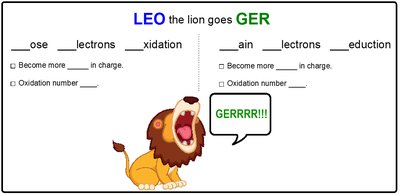
Redox (oxidation-reduction) reactions involve the transfer of electrons between substances. Oxidation numbers help track electron transfer.
Oxidation: Loss of electrons; increase in oxidation number.
Reduction: Gain of electrons; decrease in oxidation number.
Balancing Redox Reactions
Redox reactions must be balanced for both mass and charge. The process differs for acidic and basic solutions.
Acidic Solution: Balance atoms, then add H2O for oxygen, H+ for hydrogen, and electrons for charge.
Basic Solution: After balancing as in acid, add OH- to neutralize H+ and form water.
Activity Series
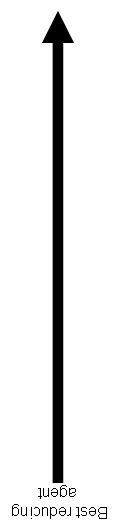
The activity series ranks elements by their ability to displace others in single displacement reactions. An element higher in the series can displace one below it.
Example: Magnesium can displace hydrogen from hydrochloric acid.
Solution Stoichiometry
Stoichiometry in solution involves calculations using molarity and volume to determine the amounts of reactants and products.
Convert volume to moles using molarity.
Use balanced equations for mole-to-mole conversions.
Convert moles to desired units (grams, volume, etc.).
Practice and Application
Throughout the chapter, practice problems reinforce concepts such as calculating molarity, osmolarity, predicting solubility, classifying electrolytes, writing equations, and balancing redox reactions.
Additional info: The notes include memory tools and charts to aid in learning solubility rules and redox concepts, as well as stepwise methods for balancing equations and performing stoichiometric calculations.
