 Indietro
The Electromagnetic Spectrum and the Bohr Model in General Chemistry
Guida di studio - Note intelligenti
 Appunti personalizzati basati sui tuoi materiali, ampliati con definizioni chiave, esempi e contesto.
The Electromagnetic Spectrum
Overview of the Electromagnetic Spectrum
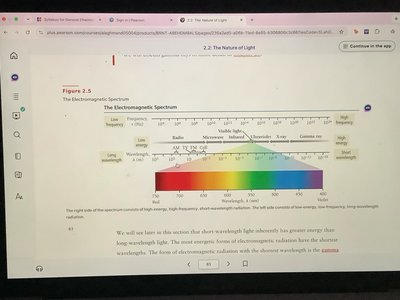
The electromagnetic spectrum encompasses all types of electromagnetic radiation, which differ in wavelength, frequency, and energy. Understanding the spectrum is fundamental in chemistry, as it relates to atomic and molecular interactions with light.
Electromagnetic radiation includes radio waves, microwaves, infrared, visible light, ultraviolet, X-rays, and gamma rays.
Wavelength (\lambda) is the distance between two consecutive peaks of a wave, typically measured in meters (m), nanometers (nm), or angstroms (Å).
Frequency (\nu) is the number of wave cycles that pass a given point per second, measured in hertz (Hz).
Energy (E) of electromagnetic radiation is related to its frequency and wavelength by the equation: where h is Planck's constant and c is the speed of light.
The visible region of the spectrum ranges from approximately 400 nm (violet) to 700 nm (red).
Key Properties and Applications
Shorter wavelengths (e.g., gamma rays, X-rays) have higher energy and frequency.
Longer wavelengths (e.g., radio waves) have lower energy and frequency.
Visible light is crucial for spectroscopy and understanding atomic structure.
Different regions of the spectrum are used in various scientific and medical applications.
The Bohr Model and Emission Spectra
Bohr Model of the Hydrogen Atom
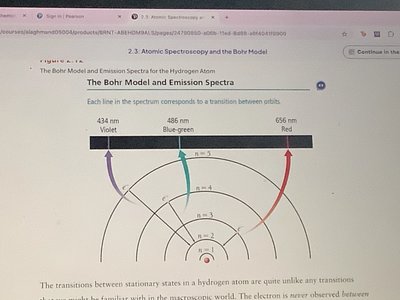
The Bohr model describes electrons in hydrogen atoms as occupying discrete energy levels, or orbits, around the nucleus. Transitions between these levels result in the emission or absorption of specific wavelengths of light.
Energy levels are denoted by quantum numbers (n = 1, 2, 3, ...).
When an electron transitions from a higher energy level to a lower one, it emits a photon with energy equal to the difference between the two levels.
The energy difference is given by: where R_H is the Rydberg constant, n_i is the initial energy level, and n_f is the final energy level.
Emission Spectra of Hydrogen
Each line in the hydrogen emission spectrum corresponds to a transition between specific energy levels. The visible lines are known as the Balmer series.
Violet line (434 nm): Transition from n = 5 to n = 2.
Blue-green line (486 nm): Transition from n = 4 to n = 2.
Red line (656 nm): Transition from n = 3 to n = 2.
These transitions produce distinct colors in the visible spectrum.
Significance in Chemistry
The Bohr model explains the quantized nature of atomic energy levels.
Emission spectra are used to identify elements and study atomic structure.
Understanding these concepts is foundational for quantum mechanics and spectroscopy.
Additional info: The Bohr model is a precursor to the more advanced quantum-mechanical model, but it provides a useful introduction to atomic structure and spectral lines.
