 Indietro
The Periodic Law and the Periodic Table: Structure, Classification, and Trends
Guida di studio - Note intelligenti
 Appunti personalizzati basati sui tuoi materiali, ampliati con definizioni chiave, esempi e contesto.
Finding Patterns: The Periodic Law and the Periodic Table
Introduction to the Periodic Law
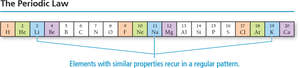
The periodic law is a foundational concept in chemistry that explains the recurring trends in the properties of elements. Dmitri Mendeleev first observed that when elements are arranged in order of increasing mass, certain sets of properties recur periodically. This observation led to the development of the periodic table, which organizes elements to highlight these repeating patterns.
Periodic: Exhibiting a repeating pattern.
Mendeleev's Periodic Law: When elements are arranged in order of increasing mass, certain sets of properties recur periodically.
Modern Periodic Law: Elements are arranged by increasing atomic number, which resolves inconsistencies found in Mendeleev's arrangement by mass.
Mendeleev’s Periodic Table
Development and Predictions
Mendeleev organized the known elements into a table, arranging the rows so that elements with similar properties fell into the same vertical columns. He left gaps for undiscovered elements and predicted their properties with remarkable accuracy. For example, he predicted the existence and properties of elements such as germanium (eka-silicon) and gallium (eka-aluminum) before their actual discovery.
Rows (Periods): Arranged so that elements with similar properties are in the same column.
Predictions: Mendeleev left spaces for elements not yet discovered and accurately predicted their properties.
Historical Discoveries: Germanium and gallium were discovered after Mendeleev’s predictions, confirming the validity of his table.
The Modern Periodic Table
Structure and Organization
The modern periodic table arranges elements by increasing atomic number rather than atomic mass. This arrangement corrects earlier inaccuracies and accommodates the discovery of new elements. The table is structured into vertical columns called groups and horizontal rows called periods.
Groups: 18 vertical columns, elements in the same group have similar chemical properties.
Periods: 7 horizontal rows, properties change progressively across a period.
Main-group elements: Groups 1, 2, and 13–18; properties are predictable based on position.
Transition elements (metals): Groups 3–12; properties are less predictable.
Classification of Elements
Metals, Nonmetals, and Metalloids
Elements are broadly classified based on their physical and chemical properties into metals, nonmetals, and metalloids.
Metals: Located on the lower-left side and middle of the table. Good conductors, malleable, ductile, shiny, tend to lose electrons (e.g., chromium, copper, strontium, lead).
Nonmetals: Upper-right side. Poor conductors, not ductile or malleable, varied states, tend to gain electrons (e.g., oxygen, carbon, sulfur, bromine, iodine).
Metalloids (Semimetals): Along the zigzag line. Exhibit properties of both metals and nonmetals, often used as semiconductors (e.g., silicon, germanium).
Element Groups and Families
Elements are also classified by their groups, each with characteristic properties and reactivity.
Group Name | Group Number | Key Properties | Examples |
|---|---|---|---|
Alkali Metals | IA (1) | Highly reactive, form basic substances | Lithium, Sodium, Potassium |
Alkaline Earth Metals | IIA (2) | Reactive, form basic substances, found as minerals | Magnesium, Calcium, Strontium |
Chalcogens | VIA (16) | Reactive nonmetals, found in ores as oxides/sulfides | Oxygen, Sulfur |
Halogens | VIIA (17) | Very reactive nonmetals, form salts | Fluorine, Chlorine, Bromine, Iodine |
Noble Gases | VIIIA (18) | Unreactive, chemically stable | Helium, Neon, Argon |
Ions and the Periodic Table
Formation of Ions by Main-Group Elements
Main-group metals and nonmetals tend to form ions that achieve the same number of electrons as the nearest noble gas. Metals lose electrons to form cations, while nonmetals gain electrons to form anions.
Alkali metals (Group IA): Lose one electron to form 1+ ions.
Alkaline earth metals (Group IIA): Lose two electrons to form 2+ ions.
Halogens (Group VIIA): Gain one electron to form 1- ions.
Chalcogens (Group VIA): Gain two electrons to form 2- ions.
Cations: Positive ions formed by losing electrons. Anions: Negative ions formed by gaining electrons.
Summary Table: Ion Formation by Group
Group | Ion Type | Typical Charge | Example |
|---|---|---|---|
IA (Alkali Metals) | Cation | +1 | Na+ |
IIA (Alkaline Earth Metals) | Cation | +2 | Mg2+ |
VIA (Chalcogens) | Anion | -2 | O2- |
VIIA (Halogens) | Anion | -1 | Cl- |
Key Equations and Concepts
Periodic Law (Modern):
Ion Formation:
