 Indietro
The Periodic Table of the Elements: Structure, Properties, and Classification
Guida di studio - Note intelligenti
 Appunti personalizzati basati sui tuoi materiali, ampliati con definizioni chiave, esempi e contesto.
The Periodic Table of the Elements
Overview and Structure
The Periodic Table is a systematic arrangement of all known chemical elements, organized by increasing atomic number and grouped according to similar chemical properties. It is a foundational tool in General Chemistry, providing insight into element classification, periodic trends, and chemical behavior.
Rows (Periods): Horizontal rows represent elements with increasing atomic number. Each period corresponds to the filling of a principal energy level.
Columns (Groups/Families): Vertical columns group elements with similar valence electron configurations and chemical properties.
Group Numbering: Groups are labeled IA-VIIIA (or 1-18 in modern notation), with special names for certain groups (e.g., Alkali Metals, Halogens, Noble Gases).
Element Information: Each cell contains the element symbol, atomic number, and atomic mass (with mass numbers in parentheses for unstable or most common isotopes).
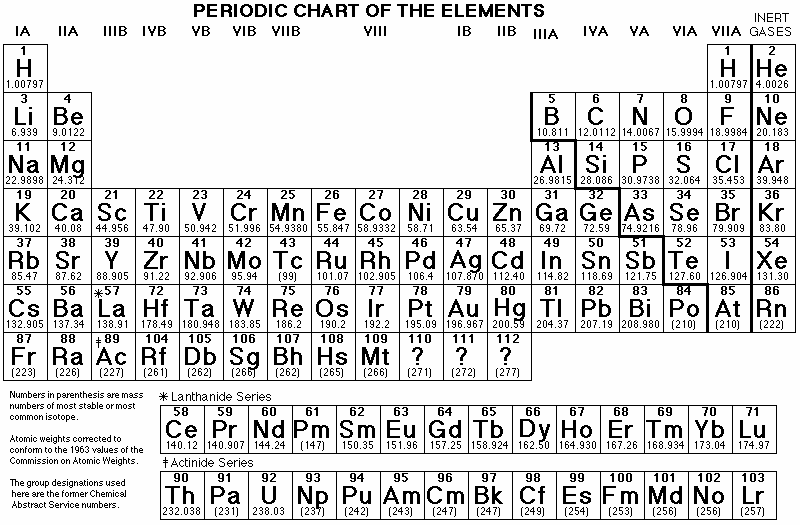
Classification of Elements
Elements are classified based on their position in the table and their chemical properties:
Metals: Located on the left and center; typically shiny, conductive, and malleable.
Nonmetals: Found on the right; generally poor conductors, often gases or brittle solids.
Metalloids: Elements with properties intermediate between metals and nonmetals, found along the staircase line.
Transition Metals: Groups IIIB to IIB (3-12); characterized by variable oxidation states and colored compounds.
Lanthanides and Actinides: Two rows below the main table, representing elements with f-orbital electrons.
Periodic Trends
The arrangement of elements reveals important periodic trends:
Atomic Radius: Decreases across a period, increases down a group.
Ionization Energy: Increases across a period, decreases down a group.
Electronegativity: Increases across a period, decreases down a group.
Reactivity: Varies by group; alkali metals and halogens are highly reactive.
Key Terms and Definitions
Atomic Number (Z): Number of protons in the nucleus of an atom.
Atomic Mass: Weighted average mass of an element's isotopes.
Isotope: Atoms of the same element with different numbers of neutrons.
Valence Electrons: Electrons in the outermost shell, responsible for chemical bonding.
Example: Group and Period Identification
For example, Sodium (Na) is in Group IA (1) and Period 3. It is an alkali metal, highly reactive, and has one valence electron.
Table: Element Classification
Group | Example Elements | Properties |
|---|---|---|
Alkali Metals (IA) | Li, Na, K | Highly reactive, soft, low density |
Alkaline Earth Metals (IIA) | Be, Mg, Ca | Reactive, harder than alkali metals |
Halogens (VIIA) | F, Cl, Br | Very reactive, form salts |
Noble Gases (VIIIA) | He, Ne, Ar | Inert, colorless gases |
Transition Metals | Fe, Cu, Zn | Variable oxidation states, colored compounds |
Equations and Notation
Atomic Number:
Atomic Mass:
Additional info:
The periodic table shown is a classic layout, with atomic weights corrected to 1963 values and group designations based on former Chemical Abstract Service numbers. Modern tables may use updated atomic weights and group numbers (1-18).
