 Indietro
The Quantum-Mechanical Model of the Atom: Structure, Light, and Electron Behavior
Guida di studio - Note intelligenti
 Appunti personalizzati basati sui tuoi materiali, ampliati con definizioni chiave, esempi e contesto.
The Quantum-Mechanical Model of the Atom
Introduction to Quantum Mechanics
The quantum-mechanical model explains the unique and sometimes counterintuitive behavior of electrons in atoms. Early twentieth-century scientists such as Einstein, Bohr, de Broglie, Planck, Heisenberg, Dirac, and Schrödinger contributed to the foundation of this model, which is essential for understanding atomic structure and chemical properties.
Subatomic particles: Electrons, protons, and neutrons are the fundamental components of atoms.
Wave–matter duality: Electrons exhibit both particle-like and wave-like properties, depending on experimental conditions.
Electron cloud: Electrons are best described as a cloud of probable positions rather than fixed orbits.
The Nature of Light
Wave Properties of Light
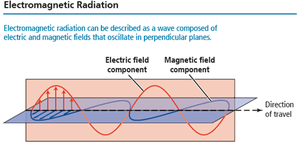
Light is a form of electromagnetic radiation, consisting of oscillating electric and magnetic fields that propagate through space. These fields are perpendicular to each other and to the direction of wave travel.
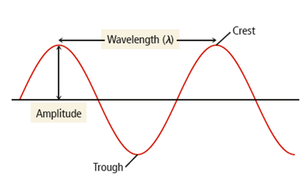
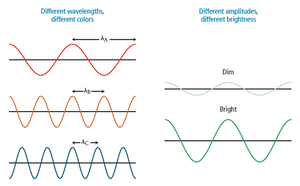
Amplitude: The height of the wave, related to the intensity (brightness) of light.
Wavelength (\( \lambda \)): The distance between successive crests or troughs, determining the color of light.
Frequency (\( \nu \)): The number of wave cycles passing a point per second, measured in hertz (Hz).
Speed of light (\( c \)): All electromagnetic waves travel at \( c = 3.00 \times 10^8 \) m/s in a vacuum.
Color and the Electromagnetic Spectrum
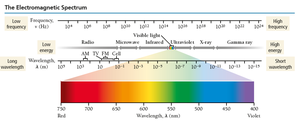
The color of visible light is determined by its wavelength or frequency. White light contains all visible wavelengths, and objects appear colored based on which wavelengths they reflect or absorb.
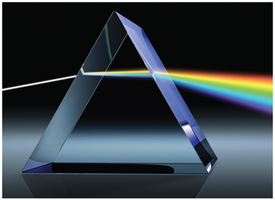
Electromagnetic spectrum: Visible light is only a small part of the full spectrum, which includes radio waves, microwaves, infrared, ultraviolet, X-rays, and gamma rays.
Shorter wavelengths correspond to higher energy and frequency (e.g., gamma rays), while longer wavelengths have lower energy (e.g., radio waves).
Wave Behavior: Interference and Diffraction
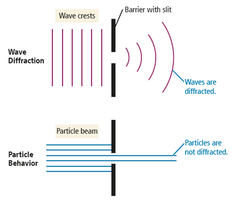
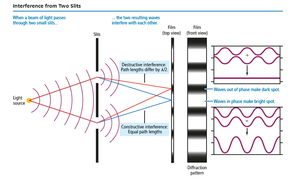
Waves can interact through interference and can bend around obstacles through diffraction. These properties distinguish waves from particles.
Constructive interference: Waves in phase add to make a larger wave.
Destructive interference: Waves out of phase cancel each other.
Diffraction: Waves bend around barriers or slits, producing characteristic patterns.
The Photoelectric Effect and Quantization of Light
Photoelectric Effect
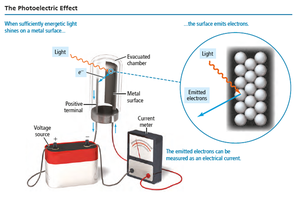
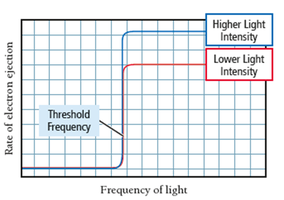
When light of sufficient frequency strikes a metal surface, electrons are emitted. This phenomenon, called the photoelectric effect, could not be explained by classical wave theory.
Threshold frequency: Electrons are only emitted if the light's frequency exceeds a certain minimum, regardless of intensity.
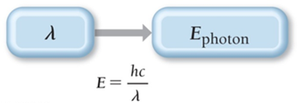
Photon: Einstein proposed that light energy is quantized in packets called photons. The energy of a photon is proportional to its frequency and inversely proportional to its wavelength.
Energy of a photon: where is Planck's constant ( J·s), is the speed of light, is frequency, and is wavelength.
Atomic Spectra and the Bohr Model
Emission Spectra
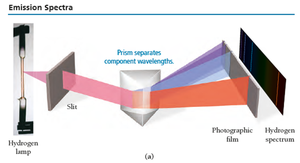
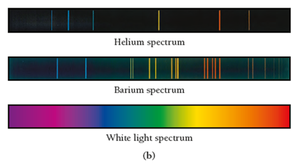
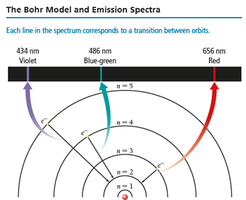
When atoms absorb energy, electrons are excited to higher energy levels. As they return to lower levels, they emit light at specific wavelengths, producing a line spectrum unique to each element.
Emission spectrum: A pattern of discrete lines corresponding to specific electron transitions.
Identification: Each element has a unique emission spectrum, useful for identification.

The Bohr Model of the Atom
Bohr proposed that electrons travel in fixed orbits around the nucleus, with quantized energy levels. Electrons emit or absorb photons when transitioning between these levels.
Quantized energy: Only specific energy values are allowed for electrons in an atom.
Photon emission: The energy of emitted or absorbed light corresponds to the difference between energy levels.
Wave-Particle Duality and Electron Behavior
De Broglie Hypothesis
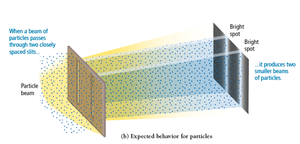
De Broglie proposed that particles such as electrons have wave-like properties, with a wavelength inversely proportional to their momentum.
De Broglie relation: where is mass and is velocity.
Electron diffraction experiments confirmed the wave nature of electrons.
Heisenberg's Uncertainty Principle
Uncertainty and Complementarity
Heisenberg's uncertainty principle states that it is impossible to simultaneously know both the exact position and velocity of a particle such as an electron. The more precisely one property is known, the less precisely the other can be known.
Uncertainty principle: where is the uncertainty in position, is mass, and is the uncertainty in velocity.
This principle leads to the concept of electron probability distributions rather than definite orbits.
Quantum Numbers and Atomic Orbitals
Quantum Numbers
The quantum-mechanical model uses quantum numbers to describe the properties of atomic orbitals and the electrons within them.
Principal quantum number (n): Indicates the energy level and size of the orbital (n = 1, 2, 3, ...).
Angular momentum quantum number (l): Describes the shape of the orbital (l = 0, 1, ..., n-1).
Magnetic quantum number (ml): Specifies the orientation of the orbital (-l to +l).
Spin quantum number (ms): Specifies the spin orientation of the electron (+1/2 or -1/2).
Atomic Orbitals and Their Shapes
Each set of quantum numbers describes a unique atomic orbital. The principal energy level contains one or more sublevels (s, p, d, f), each with a characteristic shape and number of orbitals.
s-orbitals (l = 0): Spherical shape, one per energy level.
p-orbitals (l = 1): Dumbbell shape, three per energy level (n ≥ 2).
d-orbitals (l = 2): Cloverleaf shape, five per energy level (n ≥ 3).
f-orbitals (l = 3): Complex shapes, seven per energy level (n ≥ 4).
Probability and Radial Distribution Functions
The probability density function describes the likelihood of finding an electron at a particular point in space. The radial distribution function shows the probability of finding an electron at a certain distance from the nucleus, with maxima corresponding to the most probable distances.
Summary Table: Quantum Numbers and Orbitals
Quantum Number | Symbol | Allowed Values | Physical Meaning |
|---|---|---|---|
Principal | n | 1, 2, 3, ... | Energy level, size of orbital |
Angular Momentum | l | 0 to n-1 | Shape of orbital (s, p, d, f) |
Magnetic | ml | -l to +l | Orientation of orbital |
Spin | ms | +1/2, -1/2 | Spin direction of electron |
Additional info: This summary covers the foundational quantum-mechanical concepts necessary for understanding atomic structure, electron configuration, and the periodic trends in chemistry. It integrates key experimental evidence, mathematical relationships, and the implications for chemical behavior.
