 Indietro
The Quantum-Mechanical Model of the Atom: Light, Electrons, and Atomic Structure
Guida di studio - Note intelligenti
 Appunti personalizzati basati sui tuoi materiali, ampliati con definizioni chiave, esempi e contesto.
The Quantum-Mechanical Model of the Atom
Introduction to Atomic Behavior and Light
The quantum-mechanical model explains how electrons behave inside atoms, accounting for phenomena such as atomic emission spectra and the unique colors produced by different elements. This chapter explores the wave and particle nature of light, the quantization of energy, and the structure of atomic orbitals.
Light as a Wave
Wavelength, Amplitude, and Frequency
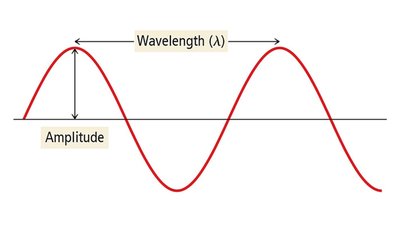
Wavelength (λ): The distance between two consecutive crests of a wave. Determines the color of visible light.
Amplitude: The vertical height from the center line to the crest (or trough). Relates to the intensity or brightness of light.
Frequency (ν): The number of wave cycles passing a point per second, measured in hertz (Hz).
Relationship: Wavelength and frequency are inversely related for light traveling at constant speed (c):
The Electromagnetic Spectrum
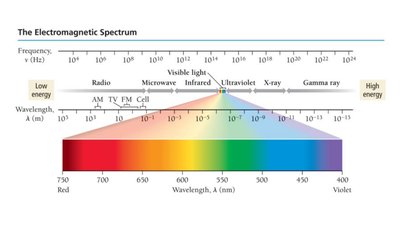
Visible light is a small portion of the electromagnetic spectrum, which ranges from low-energy radio waves to high-energy gamma rays. As wavelength decreases, frequency and energy increase.
Light as a Particle: Photons and Energy
Photon Energy and Planck's Equation
Photon: A packet (quantum) of light energy.
Energy of a photon (E): Proportional to its frequency and inversely proportional to its wavelength.
h: Planck's constant ( J·s)
Shorter wavelength → higher frequency → higher energy per photon.
Example Calculation
Find the energy of a photon with nm:
Atomic Emission and Spectroscopy
Flame Tests and Atomic Colors
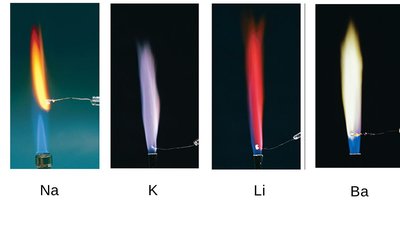
Different elements emit characteristic colors when heated in a flame due to the emission of light at specific wavelengths. This is the basis for flame tests and the colorful displays in fireworks.
Emission Spectra
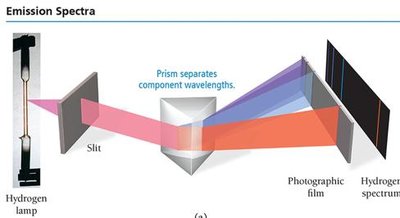
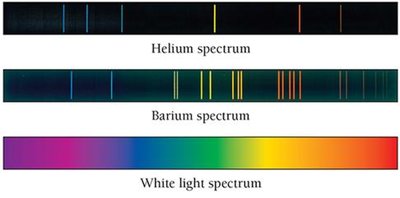
When atoms are excited (by heat or electricity), they emit light at specific wavelengths, producing a line spectrum unique to each element. White light produces a continuous spectrum, while excited atoms produce discrete lines.
The Bohr Model and Energy Levels
Bohr's Explanation of Atomic Spectra
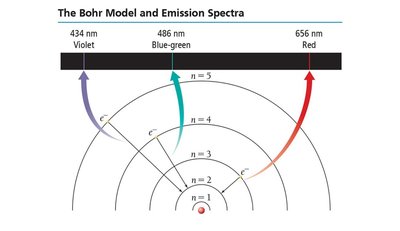
Electrons occupy specific energy levels (orbits) in the atom.
When an electron drops from a higher to a lower energy level, it emits a photon with energy equal to the difference between the two levels.
This explains the discrete lines in atomic emission spectra.
Energy of Electron Levels in Hydrogen
The energy of an electron in the nth energy level of hydrogen is given by:

Energy Change for Electron Transitions
The energy change when an electron moves from an initial level to a final level is:


The wavelength of the emitted photon is:

Wave-Particle Duality and Quantum Mechanics
de Broglie Hypothesis
Electrons, like light, exhibit both wave and particle properties. The wavelength of a particle is given by:
Where m is mass and v is velocity.
Double-Slit Experiment
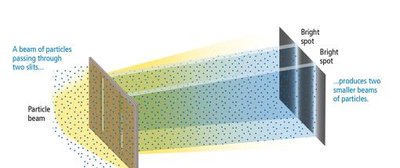
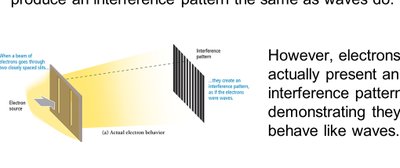
When electrons pass through two slits, they produce an interference pattern, demonstrating their wave-like behavior. This cannot be explained by treating electrons as classical particles.
Heisenberg Uncertainty Principle
It is fundamentally impossible to know both the exact position and momentum of an electron simultaneously:
This principle sets a limit on the precision of measurements at the quantum scale.
Quantum Mechanical Model: Orbitals and Quantum Numbers
Orbitals and Probability Density
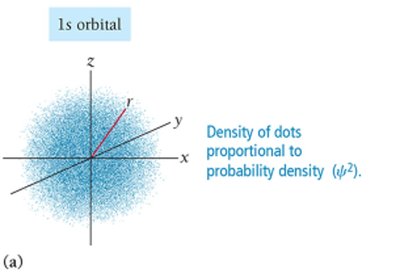
Unlike Bohr's fixed orbits, quantum mechanics describes the probability of finding an electron in a region of space called an orbital. The probability density is given by , where is the wave function.
Quantum Numbers
Principal quantum number (n): Specifies the energy level (n = 1, 2, 3, ...).
Angular momentum quantum number (l): Specifies the sublevel (l = 0 to n-1; s, p, d, f).
Magnetic quantum number (ml): Specifies the orientation (ml = -l to +l).
Spin quantum number (ms): Specifies the electron spin (+½ or -½).
Shapes of Atomic Orbitals
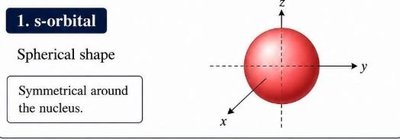
s orbitals (l = 0): Spherical shape, one per energy level.
p orbitals (l = 1): Dumbbell-shaped, three orientations (px, py, pz).
d orbitals (l = 2): Four-lobed shapes, five orientations.
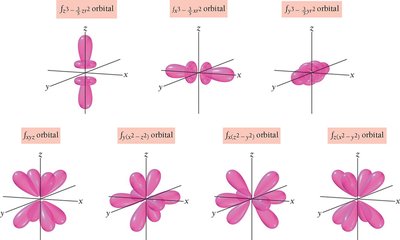
f orbitals (l = 3): Complex shapes, seven orientations.
Summary Table: Quantum Numbers and Orbitals
Quantum Number | Symbol | Possible Values | Physical Meaning |
|---|---|---|---|
Principal | n | 1, 2, 3, ... | Energy level, size of orbital |
Angular Momentum | l | 0 to n-1 | Shape (s, p, d, f) |
Magnetic | ml | -l to +l | Orientation in space |
Spin | ms | +½, -½ | Spin direction |
Electron Transitions and Spectral Lines
Energy Transitions in Hydrogen
When an electron transitions between energy levels, the energy difference determines the wavelength of the emitted or absorbed photon. Each line in the hydrogen spectrum corresponds to a specific transition.
Example Calculation: n = 4 to n = 2 Transition
The wavelength of the emitted photon is:
Practice Questions
For l = 2:
Possible values of ml: -2, -1, 0, +1, +2
Number of orbitals: 5
Sublevel: d
Which set of quantum numbers cannot describe an orbital?
A. n = 2, l = 1, ml = -1 (valid)
B. n = 3, l = 2, ml = 0 (valid)
C. n = 3, l = 3, ml = 0 (invalid, l cannot equal n)
D. n = 4, l = 0, ml = 0 (valid)
