 Indietro
Thermochemistry and Calorimetry: Enthalpy, Calorimetric Methods, and Hess’s Law
Guida di studio - Note intelligenti
 Appunti personalizzati basati sui tuoi materiali, ampliati con definizioni chiave, esempi e contesto.
Enthalpy and Thermochemistry
Definition of Enthalpy
Enthalpy (H) is a thermodynamic quantity defined as the sum of the internal energy of a system and the product of its pressure and volume. It is a state function, meaning its value depends only on the current state of the system, not on how it got there.
Formula:
Enthalpy Change (ΔH): The heat absorbed or released during a chemical reaction at constant pressure.
Relationship:
Key Point: ΔH is similar to ΔE (change in internal energy), but the difference is significant for reactions involving gases.
Enthalpy of Reaction
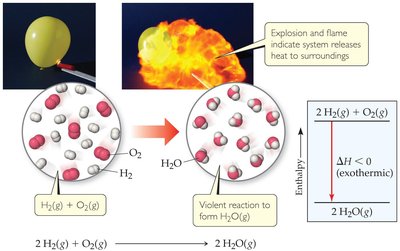
The enthalpy change when a chemical reaction occurs is called the enthalpy of reaction (or "heat of reaction").
Formula:
Enthalpy is an extensive property: it scales with the amount of substance.
ΔH for the reverse reaction is equal in magnitude but opposite in sign to the forward reaction.
ΔH depends on the physical states of reactants and products and is generally defined at the same temperature for both.
Calorimetry: Measuring Heat Flow
Principles of Calorimetry
Calorimetry is the experimental measurement of heat flow during chemical reactions or physical changes. Since the absolute enthalpy of substances cannot be measured directly, calorimetry allows us to determine ΔH by measuring temperature changes in a controlled environment.
Isothermal calorimeter: Used historically to demonstrate the equivalency of respiration and combustion.
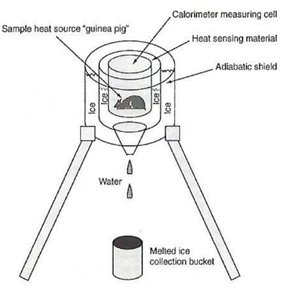
Types of Calorimeters
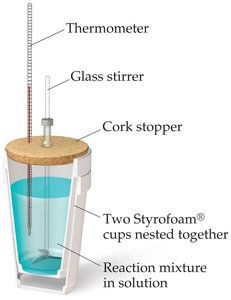
Coffee cup calorimeter: Measures heat at constant pressure, suitable for reactions in solution.
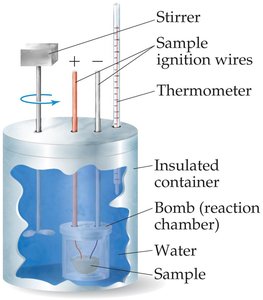
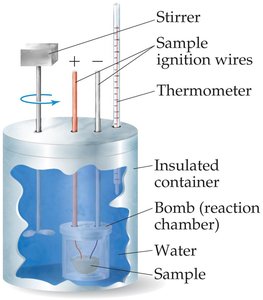
Bomb calorimeter: Measures heat at constant volume, suitable for combustion reactions.
Heat Capacity and Specific Heat
Definitions
Heat capacity is the amount of energy required to raise the temperature of a system by 1 K (or 1 °C). It is an extensive property, scaling with the size of the system.
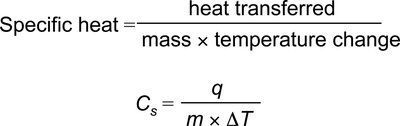
Specific heat capacity (Cs) is the amount of energy required to raise the temperature of 1 gram of a substance by 1 K (or 1 °C) at constant pressure.
Formula:
Examples and Tabulated Values
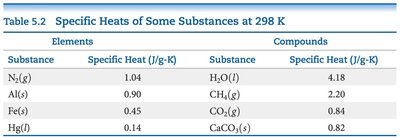
Specific heats and molar heat capacities are tabulated for pure substances. For example, the specific heat of water is 4.184 J/g·K.
Substance | Specific Heat (J/g·K) |
|---|---|
H2O(l) | 4.18 |
Al(s) | 0.90 |
Fe(s) | 0.45 |
CO2(g) | 0.84 |
CaCO3(s) | 0.82 |
CH4(g) | 2.20 |
N2(g) | 1.04 |
Hg(l) | 0.14 |
Thermal Energy Transfer and Equilibration
Heat Transfer Between Objects
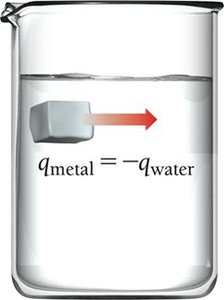
When two objects at different temperatures are placed in contact, heat flows from the hotter object to the cooler one until thermal equilibrium is reached. The heat lost by the hot object equals the heat gained by the cold object:
Formula:
Calculating Heat Transfer
The temperature change depends on the mass and specific heat capacities of the substances involved. For a metal and water in thermal contact:
Formula:
For a single substance:
Constant Volume Calorimetry (Bomb Calorimetry)
Principle
In a bomb calorimeter, reactions occur at constant volume. The measured heat corresponds to the change in internal energy (ΔE), but for most reactions, this is a good approximation for ΔH.
Formula:
Thermochemical Equations and Stoichiometry
Thermochemical Equations
A thermochemical equation is a balanced chemical equation that includes the enthalpy change (ΔH). The enthalpy change is proportional to the amount of substance reacting, so it must be scaled for different quantities.
Example:
Key Point: ΔH is a stoichiometric quantity and must be adjusted for the actual amounts used.
Hess’s Law
Statement and Application
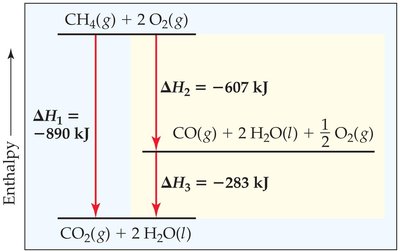
Hess’s Law states that the total enthalpy change for a reaction is the same, regardless of the number of steps or pathway taken, because enthalpy is a state function. This allows us to calculate ΔH for complex reactions by combining known enthalpy changes for related reactions.
Key Point:
Standard Enthalpies of Formation
Definition and Use
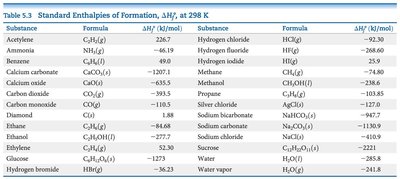
The standard enthalpy of formation (ΔHf°) is the enthalpy change when one mole of a compound is formed from its elements in their standard states (25°C, 1 atm). By convention, elements in their standard states have ΔHf° = 0.
Formula for reaction enthalpy:
Common Errors
Forgetting to multiply ΔHf° by the stoichiometric coefficient.
Not applying the negative sign for reactants when using the formula.
Isothermal Titration Calorimetry (ITC)
Principle and Application
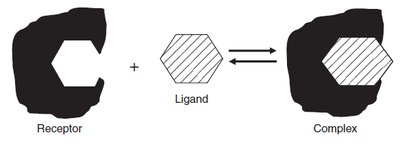
Isothermal titration calorimetry is used to study the thermodynamics of binding interactions, such as between a ligand and a macromolecule. The heat released or absorbed during binding is measured as a function of the amount of ligand added.
Thermogram: Shows heat flow as ligand is titrated into the solution.
Isotherm: Plots enthalpy change versus mole ratio, allowing determination of binding constants and enthalpy changes.
Additional info: ITC is widely used in biochemistry to study protein-ligand and nucleic acid-ligand interactions, providing both thermodynamic and kinetic information.
