 Indietro
Thermochemistry and Electronic Structure of Atoms: Study Notes
Guida di studio - Note intelligenti
 Appunti personalizzati basati sui tuoi materiali, ampliati con definizioni chiave, esempi e contesto.
Thermochemistry
Energy and Thermodynamics
Thermochemistry is the study of energy changes, particularly heat, that accompany chemical reactions. Energy is the ability to do work or transfer heat, and in chemistry, it is often discussed in terms of potential energy, especially electrostatic potential energy in molecules.
Electrostatic Potential Energy (Eel): The energy due to interactions between charged particles.
Joule (J): The SI unit of energy.
Energy Conversion: Energy can be converted from one form to another, but it cannot be created or destroyed (First Law of Thermodynamics).
Examples: Chemical energy converted to heat in homes, sunlight converted to chemical energy in plants.
System and Surroundings
In thermochemistry, the universe is divided into the system (the part under study) and the surroundings (everything else).
Open System: Exchanges both heat and mass with surroundings.
Closed System: Exchanges only heat, not mass.
Isolated System: Exchanges neither heat nor mass.
Internal Energy and Its Change
The internal energy (E) of a system is the sum of all kinetic and potential energies of its components. The change in internal energy, ΔE, is given by:
ΔE = Efinal − Einitial
If ΔE > 0: System absorbs energy.
If ΔE < 0: System releases energy.
Thermodynamic Quantities and Sign Conventions
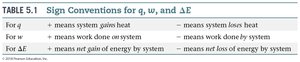
Thermodynamic quantities have three parts: a number, a unit, and a sign. The sign indicates the direction of energy flow.
ΔE = q + w (where q = heat, w = work)
Endothermic and Exothermic Processes
Heat can be absorbed or released during a reaction:
Endothermic: Heat absorbed by the system (ΔH > 0).
Exothermic: Heat released by the system (ΔH < 0).
State Functions
A state function depends only on the current state of the system, not the path taken to reach it. Internal energy (E) and enthalpy (H) are state functions, but heat (q) and work (w) are not.
ΔE depends only on Einitial and Efinal.
Work and Enthalpy
Work is often associated with changes in gas volume:
w = −PΔV (work done by the system is negative)
Enthalpy (H) is defined as:
At constant pressure, (heat gained or lost)
Calorimetry
Calorimetry is the measurement of heat flow. A calorimeter is used to measure the enthalpy change (ΔH) of a reaction.
Hess’s Law and Enthalpy of Formation
Hess’s Law allows calculation of ΔH for a reaction using known ΔH values. The enthalpy of formation (ΔHf) is the enthalpy change when a compound is formed from its elements.
Energy in Foods and Fuels
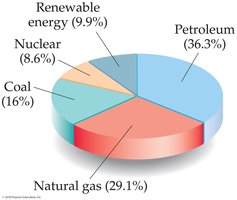
Energy in foods comes mainly from carbohydrates, fats, and proteins. The vast majority of energy consumed in the U.S. comes from fossil fuels, with smaller contributions from nuclear and renewable sources.
Carbohydrates: 17 kJ/g
Fats: 38 kJ/g
Proteins: 17 kJ/g
Electronic Structure of Atoms
Nature of Electromagnetic Radiation
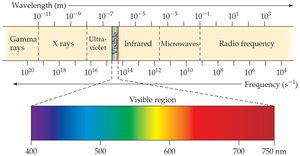
Electromagnetic radiation moves as waves through space at the speed of light (c = 3.00 × 10⁸ m/s). The wavelength (λ) is the distance between corresponding points on adjacent waves, and frequency (ν) is the number of waves passing a point per unit time.
Longer wavelength → lower frequency
Quantum Theory and Atomic Spectra
Some atomic phenomena cannot be explained by classical wave theory, such as blackbody radiation, the photoelectric effect, and atomic emission spectra. Max Planck introduced the concept of energy quanta, and Einstein used it to explain the photoelectric effect:
(h = Planck’s constant, 6.626 × 10⁻³⁴ J·s)
Bohr Model and Quantum Numbers
The Bohr model introduced discrete energy levels for electrons. Quantum mechanics, developed by Schrödinger, describes electrons in terms of wave functions and quantum numbers:
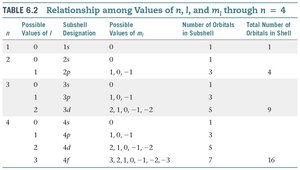
Principal quantum number (n): Energy level (n ≥ 1)
Angular momentum quantum number (l): Orbital shape (0 to n−1)
Magnetic quantum number (ml): Orbital orientation (−l to l)
Spin quantum number (ms): Electron spin (+½ or −½)
Relationship Among Quantum Numbers
The possible values of n, l, and ml determine the number and types of orbitals in each shell.
Orbital Types and Shapes
s orbitals: l = 0, spherical shape
p orbitals: l = 1, two lobes with a node
d orbitals: l = 2, four lobes or a doughnut shape
f orbitals: l = 3, complex shapes
Electron Spin and Pauli Exclusion Principle
Each orbital can hold two electrons with opposite spins. The Pauli Exclusion Principle states that no two electrons in the same atom can have the same set of four quantum numbers.
Electron Configurations and Orbital Diagrams
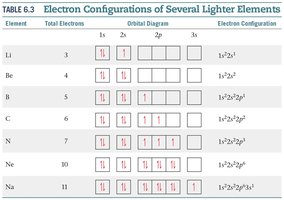
Electron configuration describes the arrangement of electrons in an atom. The most stable configuration is the ground state. Orbital diagrams visually represent electron placement and spin.
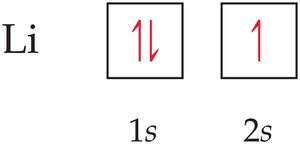
Electron Configurations of Lighter Elements
Electron configurations follow the order of filling orbitals based on increasing energy. Elements in the same group have the same number of valence electrons.
Valence electrons: Electrons in the outermost shell
Core electrons: Filled inner shell electrons
Condensed configuration: Uses noble gas notation for core electrons
Example: Argon (atomic number 18): 1s22s22p63s23p6
Example: Potassium (atomic number 19): [Ar]4s1
Additional info: Transition metals and inner transition elements (lanthanides and actinides) fill d and f orbitals, respectively. The periodic table blocks correspond to different orbital types: s, p, d, and f.
