Indietro
Thermochemistry and Energy in Chemical Reactions
Guida di studio - Note intelligenti
 Appunti personalizzati basati sui tuoi materiali, ampliati con definizioni chiave, esempi e contesto.
Thermochemistry: Energy Changes in Chemical Reactions
Introduction to Thermochemistry
Thermochemistry is the study of the absorption or release of heat in chemical reactions. Chemical reactions involve the making and breaking of chemical bonds, which results in energy transfer between the system and its surroundings. Understanding these energy changes is essential for predicting reaction behavior and designing chemical processes.
Energy is released when chemical bonds are formed.
Energy is consumed when chemical bonds are broken.
Energy exists in different forms (kinetic, potential, internal) and can be interconverted.
Forms of Energy
Kinetic energy (Ek): Energy of motion.
Potential energy: Energy due to position or chemical composition.
Internal energy (E): Sum of kinetic and potential energies of all particles in a substance.
First Law of Thermodynamics
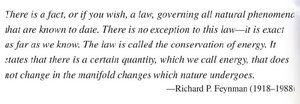
The first law of thermodynamics states that energy cannot be created or destroyed, only converted from one form to another. The energy of the universe is constant.
Mathematical expression:
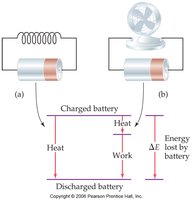
Energy exchange: (where q is heat and w is work)
System and Surroundings
The system is the substance(s) being studied, while the surroundings are everything else. Energy can flow as heat or work between the system and surroundings.
Heat (q): Energy transfer due to temperature difference.
Work (w): Energy transfer due to force acting over a distance.
Heat Flow and Sign Convention
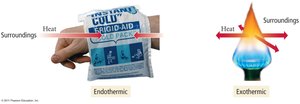
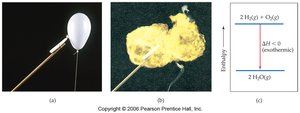
Heat flows from higher to lower temperature. The sign of q indicates the direction of heat flow:
Exothermic: System releases heat,
Endothermic: System absorbs heat,
Work in Chemical Systems
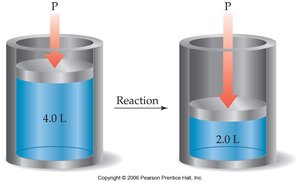
The most common type of work in chemistry is pressure-volume (PV) work:
Formula:
If the system expands, (work done by the system)
If the system contracts, (work done on the system)
If volume is constant,
Energy Units and Conversions
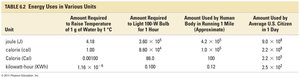
Energy is measured in several units, including joules (J), calories (cal), and kilowatt-hours (kWh). Power is the rate of energy transfer, measured in watts (W).
Unit | Amount Required to Raise Temp of 1g Water 1°C | Amount Used to Light 100W Bulb for 1hr | Amount Used by Human Body in Running 1 Mile | Amount Used by Average U.S. Citizen in 1 Day |
|---|---|---|---|---|
Joule (J) | 4.18 | 3.60 × 10⁵ | 4.2 × 10³ | 1.2 × 10⁷ |
Calorie (cal) | 1.00 | 8.60 × 10⁴ | 1.0 × 10³ | 2.9 × 10⁶ |
Calorie (kcal) | 0.00100 | 86.0 | 1.0 | 2.9 × 10³ |
kilowatt hour (kWh) | 1.16 × 10⁻⁶ | 1.00 | 0.012 | 3.3 × 10⁻¹ |
Enthalpy and Calorimetry
Enthalpy (H)
Enthalpy is the heat content of a system at constant pressure. The change in enthalpy () is equal to the heat flow at constant pressure.
Formula:
Relationship to internal energy:
Calorimetry
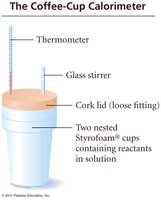
Calorimetry is the measurement of heat absorbed or released during a process. There are two main types:
Bomb calorimeter: Measures heat at constant volume ()
Solution calorimeter (coffee-cup calorimeter): Measures heat at constant pressure ()
Heat Capacity
Heat capacity (C): Amount of heat required to raise the temperature of a substance by 1°C.
Molar heat capacity (Cm): Heat capacity per mole.
Specific heat capacity (s or Cs): Heat capacity per gram.
Formulas:
Heat capacity of water:
State Functions
State functions depend only on the initial and final states of a system, not the path taken. Examples include internal energy (E) and enthalpy (H). Heat (q) and work (w) are not state functions.
Enthalpy of Reaction and Thermochemical Equations
Enthalpy of Reaction ()
The enthalpy change for a reaction is calculated as:
When a thermochemical equation is multiplied by a factor, is multiplied by the same factor.
When the equation is reversed, changes sign.
Stoichiometry and Heats of Reaction
Heats of reaction can be used as conversion factors in stoichiometric calculations. For example, if 10 g of hydrogen reacts, the heat released can be calculated using per mole.
Hess's Law
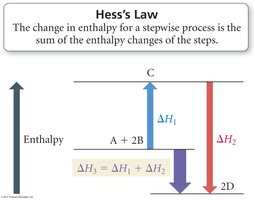
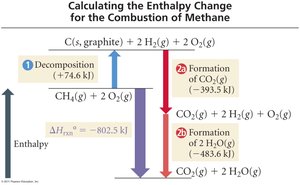
Hess's Law states that the enthalpy change for a stepwise process is the sum of the enthalpy changes of the steps. This allows calculation of for reactions that are difficult to measure directly.
Reactants and products must be arranged so that substances not in the overall reaction cancel out.
Enthalpy is a state function, so the path does not affect the total .
Standard Enthalpy of Formation ()
The standard enthalpy of formation is the enthalpy change for the formation of 1 mole of a compound from its elements in their standard states at 25°C and 1 atm.
Standard state: Most stable form of a substance at 1 atm and 25°C.
Calculation:
is zero for elements in their standard state.
Physical Changes and Enthalpy
Phase Changes
Melting: Heat of fusion ()
Freezing: Opposite of melting
Evaporating: Heat of vaporization ()
Condensing: Opposite of vaporization
Sublimation: Heat of sublimation ()
Spontaneity, Entropy, and Free Energy
Spontaneity of Reaction
A process is spontaneous if it occurs without outside intervention. Spontaneity is not determined solely by enthalpy; entropy and free energy also play roles.
Entropy (S): Measure of molecular randomness or disorder.
Free Energy (G):
Exergonic (–ΔG) processes: Spontaneous
Energy in Everyday Life
Food and Metabolism
Carbohydrates and fats react with O2 in the bloodstream, producing energy.
Metabolism of proteins produces energy and other products.
The enthalpies of these reactions can be calculated to determine the energy value of foods.
Energy Uses and Sources
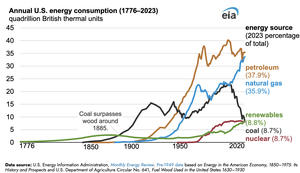
Residential, transportation, commercial, and industrial sectors use energy in various forms.
Energy sources: Fossil fuels, nuclear, renewables.
Summary Table: Sign Conventions for Energy Transfer
Quantity | Positive Sign | Negative Sign |
|---|---|---|
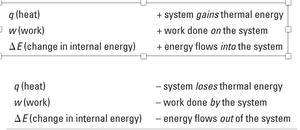
q (heat) | System gains thermal energy | System loses thermal energy |
w (work) | Work done on the system | Work done by the system |
ΔE (change in internal energy) | Energy flows into the system | Energy flows out of the system |