 Indietro
Thermochemistry: Energy, Heat, and Enthalpy in Chemical Reactions
Guida di studio - Note intelligenti
 Appunti personalizzati basati sui tuoi materiali, ampliati con definizioni chiave, esempi e contesto.
Thermochemistry Foundations
Introduction to Thermochemistry
Thermochemistry is the study of energy changes, particularly heat, that accompany chemical reactions and physical transformations. Understanding these energy exchanges is crucial for predicting reaction behavior and designing chemical processes.
Energy: The capacity to do work or transfer heat.
Kinetic Energy: Energy of motion (e.g., movement, vibration, rotation of particles).
Potential Energy: Energy due to position or composition (e.g., chemical energy in bonds).
Internal Energy (E): The sum of kinetic and potential energies of all particles in a system.
Systems, Surroundings, and Conservation of Energy
Defining the System and Surroundings
To analyze energy changes, we must define the system (the part under study, such as reacting chemicals) and the surroundings (everything else).
Law of Conservation of Energy: Energy cannot be created or destroyed; it can only be transferred or converted. If the system loses energy, the surroundings gain the same amount, and vice versa.
Units of Energy
Common Energy Units
Joule (J): SI unit of energy; 1 kJ = 1000 J.
Calorie (cal): 1 cal = 4.184 J (exact); the energy needed to raise 1 g of water by 1°C.
Food Calorie (Cal): 1 Cal = 1 kcal = 1000 cal.
Internal Energy Changes
Calculating Changes in Internal Energy
The change in internal energy (ΔE) is the difference between the final and initial energies of the system:
ΔE = Efinal − Einitial
For chemical reactions: ΔE = Eproducts − Ereactants
Energy Diagrams and Interpretation
Energy Loss and Gain
If ΔE < 0: The system loses energy (exothermic).
If ΔE > 0: The system gains energy (endothermic).
First Law of Thermodynamics
Energy Transfer Mechanisms
Energy can cross the system boundary as heat (q) or work (w):
ΔE = q + w
q > 0: System absorbs heat; q < 0: System releases heat.
w > 0: Work done on the system; w < 0: Work done by the system.
Heat and Temperature
Distinguishing Heat from Temperature
Temperature: Measure of thermal energy within a sample.
Heat: Transfer of thermal energy due to a temperature difference.
Heat flows from high to low temperature until thermal equilibrium is reached.
Heat Capacity and Specific Heat
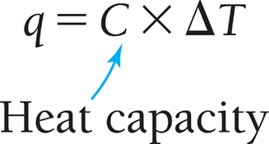
Heat Capacity (C)
The heat capacity of an object is the amount of heat required to raise its temperature by 1°C.
Unit: J/°C or J/K
Formula:
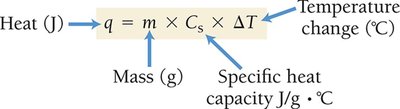
Specific Heat Capacity (c or Cs)
Specific heat capacity is the heat required to raise the temperature of 1 gram of a substance by 1°C.
Unit: J/(g·°C)
Formula:
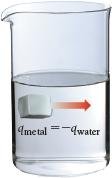
Thermal Energy Transfer
When two objects at different temperatures are in contact, heat lost by the hot object equals heat gained by the cold object:
Pressure–Volume Work
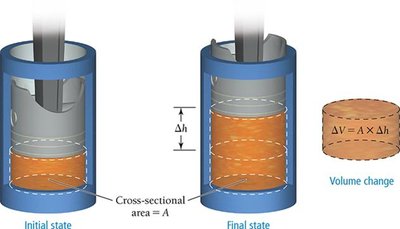
Work Done by Expanding or Compressing Gases
When a gas expands or contracts against an external pressure, it does pressure–volume (PV) work:
Formula:
1 L·atm = 101.3 J (for unit conversion)
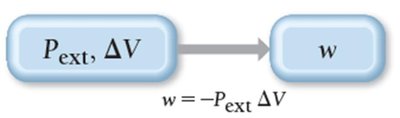
Summary of Energy Exchange
Heat and work are two ways energy is exchanged between a system and its surroundings:
Heat:
Work:

Calorimetry
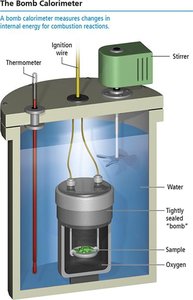
Bomb Calorimeter (Constant Volume)
A bomb calorimeter measures the change in internal energy (ΔE) for combustion reactions at constant volume. The calorimeter's heat capacity (Ccal) is used to calculate the heat absorbed:
Formula:
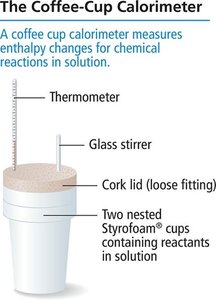
Coffee-Cup Calorimeter (Constant Pressure)
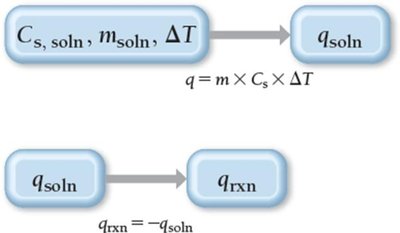
This device measures enthalpy changes (ΔH) for reactions in solution at constant pressure. The heat absorbed by the solution is calculated using:
Formula:
Enthalpy (H) and Enthalpy Change (ΔH)
Definition and Calculation
Enthalpy (H):
Change in enthalpy:
At constant pressure: (heat at constant pressure)
Exothermic vs. Endothermic Reactions
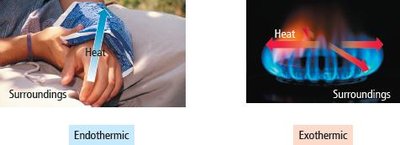
Exothermic: ΔH < 0, heat is released to surroundings (e.g., combustion).
Endothermic: ΔH > 0, heat is absorbed from surroundings (e.g., evaporation).
Stoichiometry and Enthalpy Calculations
Relating Moles to Heat
The enthalpy change (ΔH) is proportional to the amount of substance reacted. Use stoichiometry to relate moles to heat evolved or absorbed:
Example: 1 mol C3H8 releases 2044 kJ upon combustion.
For 3.00 mol: kJ

Hess's Law and Standard Enthalpy of Formation
Hess's Law
Hess's Law states that the total enthalpy change for a reaction is the same, regardless of the pathway taken, because enthalpy is a state function. This allows calculation of unknown ΔH values by combining known reactions.
When reversing a reaction, change the sign of ΔH.
When multiplying a reaction, multiply ΔH by the same factor.
Standard Enthalpy of Formation (ΔH°f)
ΔH°f: Enthalpy change for forming 1 mol of a compound from its elements in their standard states.
Elements in their standard states have ΔH°f = 0.
Calculating ΔH°rxn Using Formation Enthalpies
Formula:
n = stoichiometric coefficient from the balanced equation.
Summary Table: Key Thermochemical Equations
Equation | Description |
|---|---|
Change in internal energy | |
Heat with heat capacity | |
Heat with specific heat | |
Pressure–volume work | |
Change in enthalpy | |
Standard enthalpy of reaction |
Additional info: This guide covers the core concepts of thermochemistry, including energy transfer, calorimetry, enthalpy, and Hess's Law, with relevant equations and examples for General Chemistry students.
