 Indietro
Thermochemistry: Energy, Heat, and Enthalpy in Chemical Reactions
Guida di studio - Note intelligenti
 Appunti personalizzati basati sui tuoi materiali, ampliati con definizioni chiave, esempi e contesto.
Thermochemistry: The Energy of Chemical Reactions
What is Energy?
Energy is the capacity to do work or transfer heat. In chemistry, energy is central to understanding how and why reactions occur. The two main forms of energy relevant to chemical processes are work and heat:
Work: Energy that causes an object with mass to move. For example, hitting a tennis ball with a racket transfers energy as work.
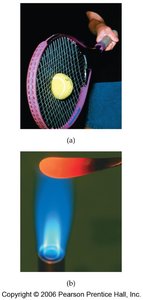
Heat: Energy that causes the temperature of an object to rise, such as heating a metal rod in a flame.

The SI unit of energy is the joule (J), and another common unit is the calorie (cal), where 1 cal = 4.184 J.
Kinetic and Potential Energy
Kinetic energy is the energy an object possesses due to its motion, given by:
$ KE = \frac{1}{2}mv^2 $
Potential energy is the energy stored due to an object's position or chemical composition. For example, lifting a ball increases its potential energy, which is converted to kinetic energy as it falls. 


System and Surroundings
In thermochemistry, it is important to distinguish between the system (the part of the universe we are studying, e.g., reactants in a cylinder) and the surroundings (everything else). 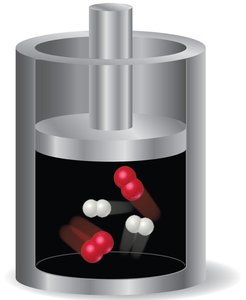
Internal Energy and the First Law of Thermodynamics
Internal Energy (E)
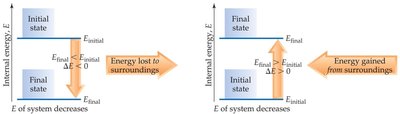
The internal energy of a system is the sum of all kinetic and potential energies of its components. The change in internal energy is:
$ \Delta E = E_{final} - E_{initial} $
We focus on changes in energy, as total internal energy is nearly impossible to measure directly.
Heat and Work
Energy exchange between system and surroundings occurs as heat (q) or work (w):
$ \Delta E = q + w $
Signs for q and w:
Quantity | Positive (+) | Negative (-) |
|---|---|---|
q | System gains heat | System loses heat |
w | Work done on system | Work done by system |
ΔE | Net gain of energy | Net loss of energy |
Heat Transfer and Molecular Motion
Heat is the transfer of random kinetic energy from higher temperature (faster-moving molecules) to lower temperature (slower-moving molecules). 
First Law of Thermodynamics
The First Law of Thermodynamics states that energy is conserved: the total energy of the universe is constant.
$ \Delta E_{system} = -\Delta E_{surroundings} $
Endothermic and Exothermic Processes
Changes in Internal Energy
If $\Delta E > 0$, the system absorbs energy (endergonic).
If $\Delta E < 0$, the system releases energy (exergonic).

Heat Exchange: Endothermic vs. Exothermic
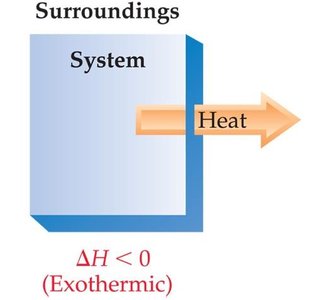
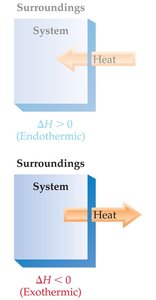
Endothermic: Heat absorbed by system from surroundings ($\Delta H > 0$).
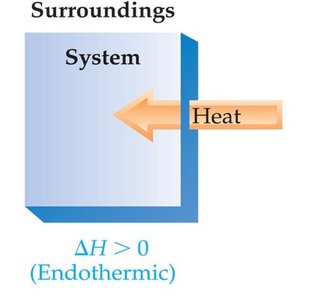
Exothermic: Heat released by system to surroundings ($\Delta H < 0$).
State Functions
Definition and Examples
A state function is a property that depends only on the current state of the system, not the path taken to reach that state. Examples include internal energy, temperature, volume, and mass. 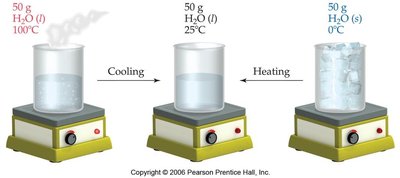
Heat (q) and work (w) are not state functions, as their values depend on the process path. 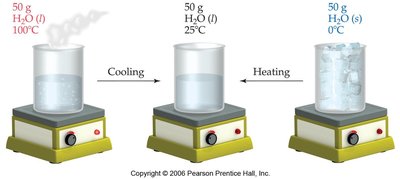
Work in Chemical Systems
Pressure-Volume Work
When a chemical reaction produces a gas, it can do work by pushing against the surroundings. The work done is:
$ w = -P\Delta V $
Where P is pressure and ΔV is the change in volume. 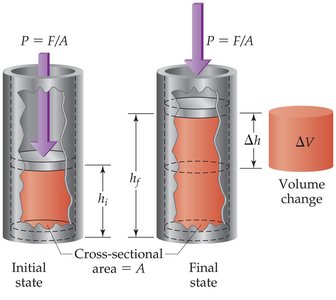
Enthalpy (H) and Enthalpy Changes
Definition of Enthalpy
Enthalpy (H) is defined as:
$ H = E + PV $
At constant pressure, the change in enthalpy is:
$ \Delta H = \Delta E + P\Delta V $
For reactions at constant pressure, the heat flow (q) equals the enthalpy change ($\Delta H$).
Enthalpy of Reaction
The enthalpy change for a reaction is:
$ \Delta H = H_{products} - H_{reactants} $
This value is called the enthalpy of reaction or heat of reaction.
Calorimetry: Measuring Heat Flow
Heat Capacity and Specific Heat
Heat capacity is the amount of energy required to raise the temperature of an object by 1 K. Specific heat is the energy required to raise the temperature of 1 g of a substance by 1 K.
Specific heat formula:
$ s = \frac{q}{m \Delta T} $
Where q is heat transferred, m is mass, and ΔT is temperature change.
Constant Pressure Calorimetry
In constant pressure calorimetry, the heat change for the system is measured indirectly by observing the heat change in water. 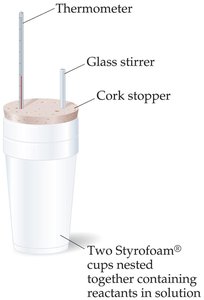
For water, $s = 4.184 \text{ J/g-K}$, and the heat change is:
$ q = m \cdot s \cdot \Delta T $
Bomb Calorimetry
Bomb calorimetry measures heat at constant volume, so what is measured is the change in internal energy ($\Delta E$), not enthalpy ($\Delta H$). 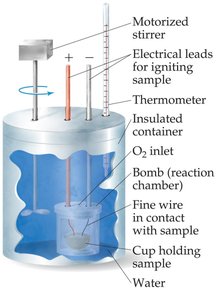
Hess's Law and Enthalpies of Formation
Hess's Law
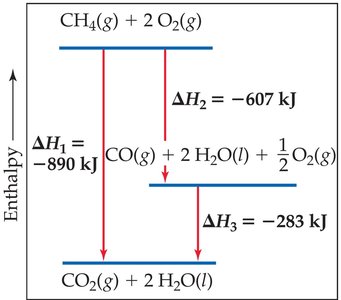
Hess's Law states that the enthalpy change for an overall reaction is the sum of the enthalpy changes for individual steps:
$ \Delta H_{overall} = \sum \Delta H_{steps} $
Enthalpy of Formation ($\Delta H_f$)
The enthalpy of formation is the enthalpy change when a compound is formed from its elements in their most stable forms. Standard enthalpies of formation are measured at 25°C and 1 atm.
Calculation of reaction enthalpy:
$ \Delta H = \sum n \Delta H_f (\text{products}) - \sum m \Delta H_f (\text{reactants}) $
Phase Changes and Heating Curves
Phase Changes
Phase changes involve energy transfer as heat. For example, melting (solid to liquid) and boiling (liquid to gas) require energy to overcome intermolecular forces.
Heating Curves
A heating curve plots temperature versus heat added. During phase changes, temperature remains constant while heat is absorbed or released.
Within a phase: $ q = ms\Delta T $
During melting: $ q = \Delta H_{fus} m $
During boiling: $ q = \Delta H_{vap} m $
Bond Enthalpy and Energy in Foods
Bond Enthalpy
Bond enthalpy is the energy required to break a bond. Average bond enthalpies can be used to estimate reaction enthalpy:
$ \Delta H_{rxn} = \sum (\text{bond enthalpies of bonds broken}) - \sum (\text{bond enthalpies of bonds formed}) $
Energy in Foods
Most energy in food comes from carbohydrates and fats, which undergo combustion reactions to release energy.
Fuels and Energy Cycles
Fossil Fuels and Alternatives
Fossil fuels are the primary energy source, but alternatives like hydrogen and ethanol are being explored for sustainability and reduced environmental impact.
Summary Table: Key Thermochemistry Concepts
Concept | Definition | Formula |
|---|---|---|
Internal Energy (E) | Total energy (kinetic + potential) in a system | $ \Delta E = q + w $ |
Enthalpy (H) | Heat content at constant pressure | $ H = E + PV $ |
Specific Heat (s) | Energy to raise 1 g by 1 K | $ s = \frac{q}{m \Delta T} $ |
Hess's Law | Sum of enthalpy changes for steps equals overall change | $ \Delta H_{overall} = \sum \Delta H_{steps} $ |
Bond Enthalpy | Energy to break a bond | $ \Delta H_{rxn} = \sum D_{broken} - \sum D_{formed} $ |
