 Indietro
Thermochemistry: Enthalpy, Calorimetry, and Enthalpies of Formation
Guida di studio - Note intelligenti
 Appunti personalizzati basati sui tuoi materiali, ampliati con definizioni chiave, esempi e contesto.
Thermochemistry
Enthalpy and Heat Transfer
Thermochemistry is the study of energy changes, particularly heat, that accompany chemical reactions. The enthalpy (H) of a system is a measure of its total heat content. The change in enthalpy, ΔH, represents the heat transferred during a chemical reaction at constant pressure.
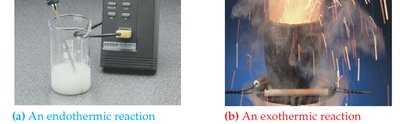
Endothermic reactions absorb heat from the surroundings (ΔH > 0).
Exothermic reactions release heat to the surroundings (ΔH < 0).
The SI unit for heat is the Joule (J); the calorie (cal) is a non-SI unit, where 1 cal = 4.18 J.

Enthalpy Changes in Chemical Reactions
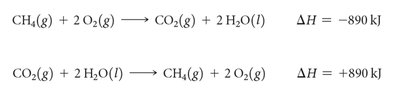
The enthalpy change for a reaction can be represented as:
For combustion of methane:
For the reverse reaction:
Calorimetry
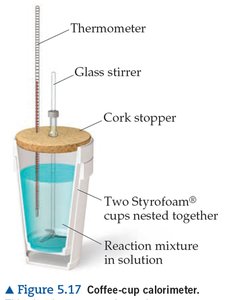
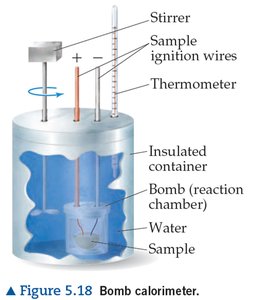
Calorimetry is the measurement of heat flow in chemical reactions. Two common types of calorimeters are used:
Coffee-cup calorimeter: Used for reactions in solution at constant pressure.
Bomb calorimeter: Used for measuring heat of combustion at constant volume.
Heat Capacity
Molar heat capacity (Cm): Heat required to raise the temperature of 1 mole of a substance by 1 K.
Specific heat capacity (Cs): Heat required to raise the temperature of 1 gram of a substance by 1 K.
Formula: , where q is heat absorbed, m is mass, and ΔT is temperature change.
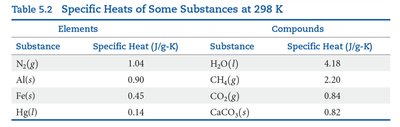
Specific Heats of Substances
The specific heat values of various substances are important for calorimetry calculations.
Substance | Specific Heat (J/g·K) |
|---|---|
N2(g) | 1.04 |
Al(s) | 0.90 |
Fe(s) | 0.45 |
Hg(l) | 0.14 |
H2O(l) | 4.18 |
CH4(g) | 2.20 |
CO2(g) | 0.84 |
CaCO3(s) | 0.82 |
Example Calculation
To calculate the heat absorbed by a sample:
Given: 35.2 g iron, temperature increases from 23.7°C to 29.5°C, Cs = 0.450 J/g·K.
ΔT = 29.5°C - 23.7°C = 5.8 K
q = m × Cs × ΔT = 35.2 g × 0.450 J/g·K × 5.8 K = 91.8 J

Hess's Law
Hess's Law states that the enthalpy change for a reaction is the sum of the enthalpy changes for individual steps, regardless of the pathway taken. This allows calculation of ΔH for reactions that are difficult to measure directly.
Basic rule:


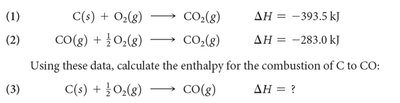
Example: Combustion of Carbon
Given reactions: (1) (2) Find ΔH for: (3)
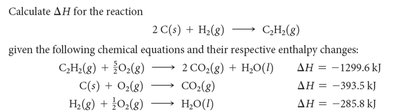
Example: Formation of Acetylene
Given reactions and enthalpy changes, use Hess's Law to calculate ΔH for .
Enthalpies of Formation
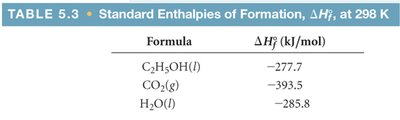
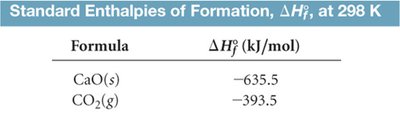
The standard enthalpy of formation (ΔHf°) is the enthalpy change when one mole of a compound is formed from its elements in their standard states at 1 atm and 298 K.
ΔHf° of the most stable form of an element is zero (e.g., C(graphite), O2(g)).
ΔHf° is not zero for less stable forms or compounds.

Calculating Enthalpy Change Using Enthalpies of Formation
Enthalpy change for a reaction:
Example: Combustion of ethanol Use tabulated ΔHf° values to calculate ΔH°rxn.
Formation Reactions
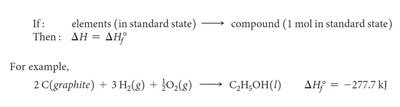
If elements in their standard state form 1 mole of a compound in its standard state, then ΔH = ΔHf°.
Example:
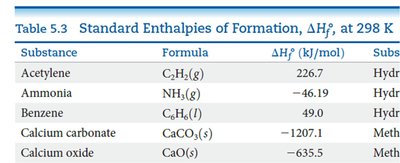
Summary Table: Standard Enthalpies of Formation
Substance | Formula | ΔHf° (kJ/mol) |
|---|---|---|
Acetylene | C2H2(g) | 226.7 |
Ammonia | NH3(g) | -46.19 |
Benzene | C6H6(l) | 49.0 |
Calcium carbonate | CaCO3(s) | -1207.1 |
Calcium oxide | CaO(s) | -635.5 |
Key Points
Enthalpy changes can be calculated using calorimetry, Hess's Law, or standard enthalpies of formation.
Specific heat and molar heat capacity are essential for measuring heat changes in substances.
Formation reactions and tabulated ΔHf° values are used to determine reaction enthalpies.
Additional info: Academic context was added to clarify definitions, formulas, and examples for completeness and exam preparation.
