 Indietro
Thermodynamics: Entropy, Free Energy, and Equilibrium – Study Notes
Guida di studio - Note intelligenti
 Appunti personalizzati basati sui tuoi materiali, ampliati con definizioni chiave, esempi e contesto.
Thermodynamics: Entropy, Free Energy, and Equilibrium
Introduction to Thermodynamics
Thermodynamics is the branch of chemistry that studies the relationships between heat, work, and energy. It provides a framework for understanding how energy is transferred and transformed during chemical reactions and physical changes.
Work and heat are both forms of energy.
Internal energy (E) is the sum of heat and work: .
In most chemical reactions, heat flow dominates over work.
Measurement of Heat and Enthalpy
Heat capacity is a measure of how much heat is required to change the temperature of a substance. For reactions at constant pressure, the heat released or absorbed is called the enthalpy change ().
for exothermic reactions (heat released).
for endothermic reactions (heat absorbed).
Enthalpy is related to heat: at constant pressure.
Enthalpy of Physical Change
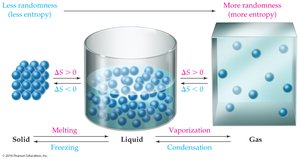
Phase changes involve changes in enthalpy due to the breaking or forming of intermolecular attractions.
Vaporization is endothermic (energy added).
Freezing is exothermic (energy released).
Stronger intermolecular forces (e.g., hydrogen bonds) result in higher enthalpies of vaporization.
Enthalpy of Chemical Change
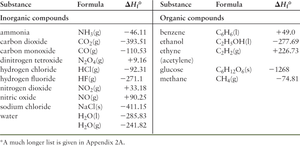
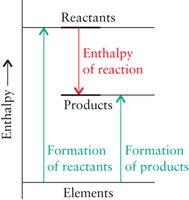
The heat output of reactions is measured by the enthalpy change. Standard enthalpies of formation () are used to calculate reaction enthalpies.
Standard enthalpy of formation: The enthalpy change for forming 1 mole of a compound from its elements in their standard states.
Reaction enthalpy:
Spontaneous Change and Entropy
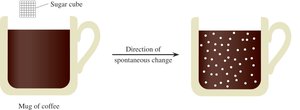
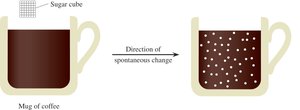
A spontaneous change occurs naturally without external influence. Entropy (S) is a measure of disorder or randomness in a system.
Spontaneous processes increase the total entropy of the universe.
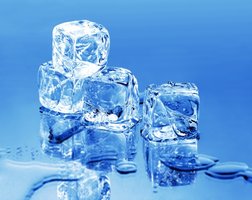
Examples: Rusting of iron, melting of ice, dissolving sugar in coffee.

The Second Law of Thermodynamics
The second law states that the total entropy change () is the sum of the entropy change of the system and surroundings:
If , the process is spontaneous.
If , the reverse process is spontaneous.
If , the process is at equilibrium.
Predicting Entropy Changes
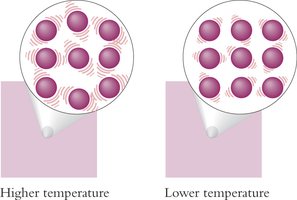
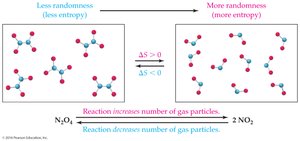
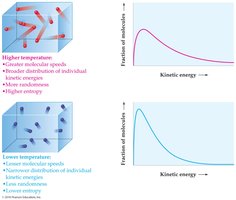
Entropy increases with phase changes (solid to liquid to gas), temperature increases, mixing, and increases in the number of gas particles.
Phase change:
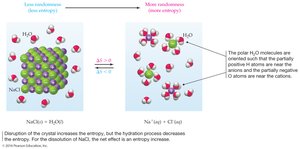
Mixing and dissolving increase entropy.
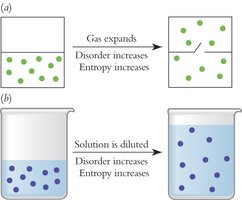
Expansion of gases and dilution of solutions increase entropy.
Calculating Entropy Change
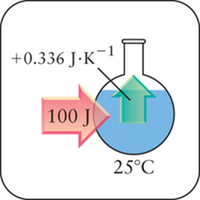
Entropy change can be calculated for heat transfer at constant temperature:
Example: Adding 100 J of energy to water at 25°C increases entropy.
Entropy and Probability
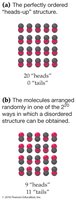
Entropy is related to the number of possible microstates (W) of a system:
k = Boltzmann’s constant ( J/K)
More microstates mean higher entropy.
The Third Law of Thermodynamics
The third law states that the entropy of a perfectly ordered crystalline substance at 0 K is zero.
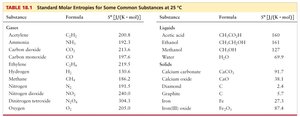
Standard molar entropy (): Entropy of 1 mole of a pure substance at 1 atm and a specified temperature.
Standard Entropies of Reaction
To calculate the change in entropy for a reaction:
n = stoichiometric coefficients
= standard molar entropy
Gibbs Free Energy
Gibbs free energy (G) is a state function that predicts spontaneity at constant temperature and pressure.
If , the process is spontaneous.
If , the process is nonspontaneous.
Gibbs Free Energy of Reaction
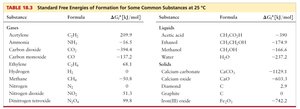
There are two methods to calculate Gibbs free energy of reaction:
Method 1:
Method 2:
Free Energy and Temperature
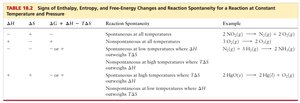
The spontaneity of a reaction can depend on temperature, as both enthalpy and entropy contribute to .
Free Energy Changes and the Reaction Mixture
For reactions under nonstandard conditions, the free energy change is:
Q = Reaction quotient
Free Energy and Chemical Equilibrium
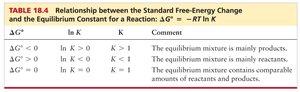
At equilibrium, and (equilibrium constant). The relationship between free energy and equilibrium is:
If , K > 1 (products favored).
If , K < 1 (reactants favored).
If , K = 1 (comparable amounts of reactants and products).
Summary Table: Signs of Enthalpy, Entropy, and Free Energy
The signs of , , and determine reaction spontaneity at constant temperature and pressure.
Spontaneity | Example | |||
|---|---|---|---|---|
- | + | - | Spontaneous at all temperatures | 2H2(g) + O2(g) → 2H2O(g) |
+ | - | + | Nonspontaneous at all temperatures | H2O(g) → H2(g) + O2(g) |
- | - | Depends on T | Spontaneous at low T | 2HgO(s) → 2Hg(l) + O2(g) |
+ | + | Depends on T | Spontaneous at high T | 2Hg(l) + O2(g) → 2HgO(s) |
Summary Table: Relationship Between Free Energy and Equilibrium Constant
ln K | K | Comment | |
|---|---|---|---|
< 0 | > 0 | > 1 | The equilibrium mixture is mainly products. |
> 0 | < 0 | < 1 | The equilibrium mixture is mainly reactants. |
= 0 | = 0 | = 1 | The equilibrium mixture contains comparable amounts of reactants and products. |
Additional info: Academic context and explanations have been expanded for clarity and completeness. All included images directly reinforce the adjacent educational content.
