 Indietro
Thermodynamics: Entropy, Spontaneity, and Gibbs Free Energy
Guida di studio - Note intelligenti
 Appunti personalizzati basati sui tuoi materiali, ampliati con definizioni chiave, esempi e contesto.
Thermodynamics: Entropy, Spontaneity, and Gibbs Free Energy
Introduction to Thermodynamics and Spontaneity
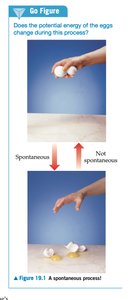
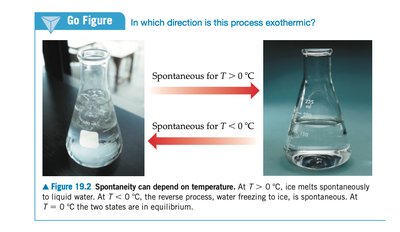
Thermodynamics is the study of energy changes and the direction of chemical processes. While enthalpy changes (ΔH) indicate whether a reaction is endothermic or exothermic, they alone do not determine if a reaction is spontaneous. Spontaneity also depends on entropy changes and temperature. For example, the melting of ice is endothermic but spontaneous above 0°C, while freezing is spontaneous below 0°C.
Spontaneous process: Occurs naturally without external intervention and only in one direction under given conditions.
Nonspontaneous process: Requires continuous external energy to proceed.

Entropy and the Second Law of Thermodynamics
Entropy (S) is a measure of the disorder or randomness of a system. It quantifies the tendency for energy to disperse and for systems to move toward greater disorder. Entropy is a state function, meaning its change depends only on the initial and final states, not the path taken.
Change in entropy:
Isothermal process: , where is the reversible heat transfer and is the absolute temperature.
The Second Law of Thermodynamics states that the entropy of the universe increases for any spontaneous process:
This law explains why certain processes are spontaneous and why their reverse is not.
Standard Molar Entropies
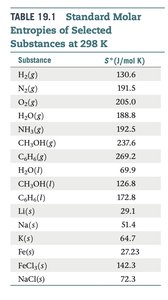
Standard molar entropy () is the entropy content of one mole of a substance in its standard state (pure substance at 1 atm and 298 K). These values are used to calculate entropy changes in reactions.
Substance | So (J/mol·K) |
|---|---|
H2(g) | 130.6 |
N2(g) | 191.5 |
O2(g) | 205.0 |
H2O(g) | 188.8 |
NH3(g) | 192.5 |
CH4(g) | 186.3 |
C2H6(g) | 229.2 |
H2O(l) | 69.9 |
CH3OH(l) | 126.8 |
Li(s) | 29.1 |
Na(s) | 51.4 |
K(s) | 64.7 |
Fe(s) | 27.2 |
FeCl3(s) | 142.3 |
NaCl(s) | 72.3 |
Calculating Entropy Changes in Reactions
The standard entropy change for a reaction () is calculated as the difference between the sum of the standard molar entropies of the products and the reactants, each multiplied by their stoichiometric coefficients:
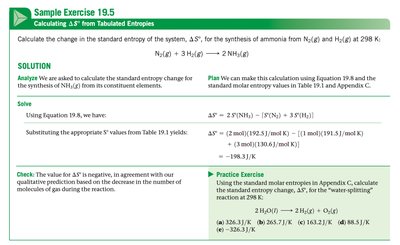
Example: For the synthesis of ammonia:
Using standard molar entropies,
Gibbs Free Energy and Spontaneity
Gibbs free energy (G) is a thermodynamic function that combines enthalpy and entropy to predict the spontaneity of a process at constant temperature and pressure. It is defined as:
Change in free energy:
Under standard conditions:
The sign of determines spontaneity:
: Reaction is spontaneous in the forward direction.
: Reaction is at equilibrium.
: Reaction is nonspontaneous in the forward direction.
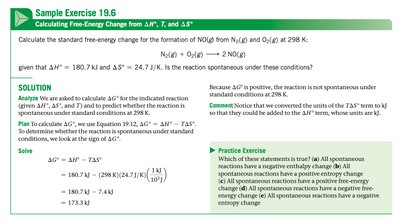
Example: For the formation of NO2 from N2 and O2:
Given and , calculate using
Summary Table: Criteria for Spontaneity
Condition | Spontaneity |
|---|---|
Spontaneous | |
Equilibrium | |
Nonspontaneous |
Additional info: The examples and sample exercises provided illustrate the calculation of entropy and free energy changes, reinforcing the connection between thermodynamic quantities and the prediction of reaction spontaneity.
