 Indietro
Units, Measurement, and Problem Solving in General Chemistry
Guida di studio - Note intelligenti
 Appunti personalizzati basati sui tuoi materiali, ampliati con definizioni chiave, esempi e contesto.
Introduction: The Importance of Units and Measurement in Chemistry
Overview
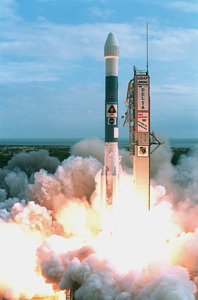
Accurate measurement and proper use of units are foundational to all scientific work, especially in chemistry. Miscommunication or errors in units can lead to significant mistakes, as illustrated by historical events such as the loss of the Mars Climate Orbiter due to a unit conversion error.
The International System of Units (SI)
SI Base Units
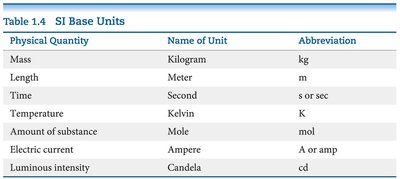
The International System of Units (SI) is the globally accepted standard for measurement in science. Each physical quantity has a specific base unit.
Mass: kilogram (kg)
Length: meter (m)
Time: second (s or sec)
Temperature: kelvin (K)
Amount of substance: mole (mol)
Electric current: ampere (A or amp)
Luminous intensity: candela (cd)
Metric System Prefixes
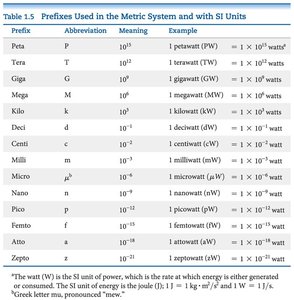
Prefixes are used to express multiples or fractions of base units, making measurements more practical for everyday and scientific use. Each prefix represents a power of ten.
Measurement of Mass and Length
Mass
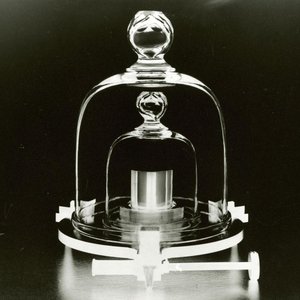
Mass is a measure of the amount of matter in an object. The SI unit is the kilogram (kg), while the gram (g) is commonly used for smaller quantities. Weight, in contrast, is the force of gravity acting on an object’s mass.
Length
Length is measured in meters (m). The meter was originally defined as a fraction of the distance from the equator to the North Pole, but is now defined by the distance light travels in a vacuum in 1/299,792,458 seconds.

Measurement of Time
The Second
The second (s) is the SI unit of time, defined by the duration of 9,192,631,770 cycles of radiation from the cesium-133 atom.
Derived Units: Volume and Density
Volume
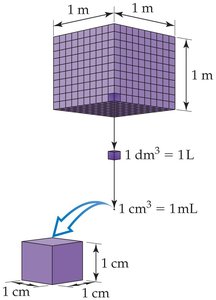
Volume is a derived unit, calculated as length cubed (m3). Common units include the liter (L) and milliliter (mL), where 1 L = 1 dm3 and 1 mL = 1 cm3.
Density
Density is a physical property defined as mass per unit volume:
Common units: g/mL, g/cm3, kg/L
Density determines whether a substance will float or sink in another substance.
Temperature and Temperature Scales
Temperature
Temperature measures the average kinetic energy of particles in a substance. Heat flows from higher to lower temperature objects.
Temperature Scales
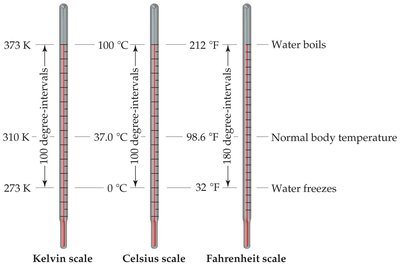
Celsius (°C): 0°C is the freezing point, 100°C is the boiling point of water.
Kelvin (K): The SI unit; absolute zero (0 K) is the lowest possible temperature.
Fahrenheit (°F): Commonly used in the United States.
Conversion formulas:
Uncertainty in Measurement
Accuracy and Precision
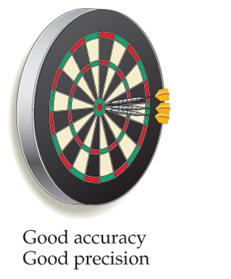
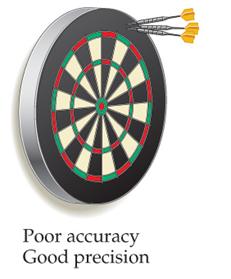
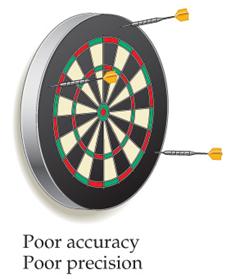
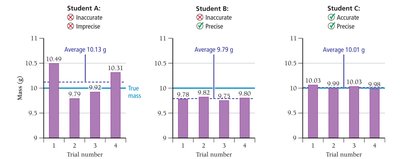
All measurements have some degree of uncertainty. Accuracy refers to how close a measurement is to the true value, while precision refers to the reproducibility of measurements.
Accurate and precise: Measurements are close to the true value and to each other.
Precise but not accurate: Measurements are close to each other but not to the true value.
Neither accurate nor precise: Measurements are scattered and not close to the true value.
Significant Figures
Rules for Significant Figures
All nonzero digits are significant.
Zeros between significant digits are significant.
Leading zeros are not significant.
Trailing zeros are significant if a decimal point is present.
Significant Figures in Calculations
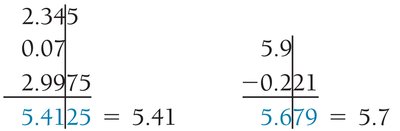
Multiplication/Division: The result has the same number of significant figures as the factor with the fewest significant figures.
Addition/Subtraction: The result has the same number of decimal places as the quantity with the fewest decimal places.

Rounding Rules
Round down if the digit dropped is less than 5; round up if it is 5 or more.
If the digit dropped is exactly 5, round to the nearest even number to avoid bias.
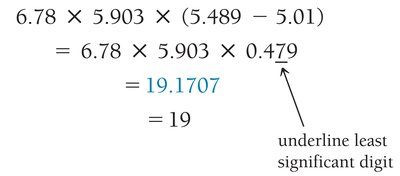
Significant Figures in Multistep Calculations
Do not round intermediate results; only round the final answer to the correct number of significant figures.
Dimensional Analysis and Unit Conversions
Dimensional Analysis
Dimensional analysis is a systematic approach to problem solving that uses conversion factors to move from one unit to another. Units are treated algebraically and can be canceled when appropriate.

Example: Unit Conversion
To convert 1 kilometer to miles, use the following relationships:
1 mile = 5280 feet
1 foot = 12 inches
1 inch = 2.54 cm (exact)
General Problem Solving Strategy
Identify the starting point (given information).
Identify the end point (what you must find).
Devise a conceptual plan using known relationships.
Solve and check that your answer makes sense.
Energy: Kinetic and Potential
Kinetic Energy
Kinetic energy is the energy of motion, given by:
Unit: Joule (J), where
Potential Energy
Potential energy due to gravity is calculated as:
Where m is mass, g is acceleration due to gravity (9.8 m/s2), and h is height.

Summary Table: Common Densities
Substance | Density (g/cm3) |
|---|---|
Charcoal (oak) | 0.57 |
Ethanol | 0.789 |
Ice (0°C) | 0.917 |
Water (4°C) | 1.00 |
Sugar (sucrose) | 1.58 |
Table salt (NaCl) | 2.16 |
Glass | 2.6 |
Aluminum | 2.70 |
Titanium | 4.51 |
Iron | 7.86 |
Copper | 8.96 |
Lead | 11.4 |
Mercury | 13.55 |
Gold | 19.3 |
Platinum | 21.4 |
Conclusion
Understanding and applying the correct units, significant figures, and problem-solving strategies are essential skills for success in general chemistry. Mastery of these foundational concepts ensures accuracy and reliability in scientific measurement and calculation.
