 Indietro
Valence Bond Theory and Hybridization: Lecture 17
Guida di studio - Note intelligenti
 Appunti personalizzati basati sui tuoi materiali, ampliati con definizioni chiave, esempi e contesto.
Valence Bond Theory
Introduction to Valence Bond Theory
Valence Bond Theory (VBT) is a fundamental model in chemistry that explains how atoms combine to form molecules through the overlap of atomic orbitals. It addresses the limitations of simple atomic orbitals in predicting molecular shapes and bonding angles, as observed in real compounds.
Atomic Orbitals: The basic regions in an atom where electrons are likely to be found (s, p, d, f).
Bond Formation: Bonds form when atomic orbitals from different atoms overlap, allowing electrons to be shared.
Hybridization: Atomic orbitals (such as s and p) mix to form new, equivalent hybrid orbitals that better explain observed molecular geometries.
VSEPR Model: Valence Shell Electron Pair Repulsion (VSEPR) theory predicts the shapes of molecules based on electron pair repulsion, but VBT explains how these shapes arise from orbital hybridization.
Key Points of Valence Bond Theory
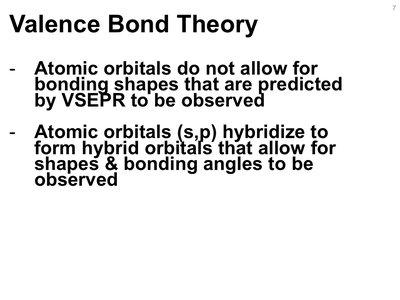
Limitation of Pure Atomic Orbitals: Pure s and p orbitals do not allow for the bonding shapes predicted by VSEPR to be observed.
Hybridization: The process by which atomic orbitals mix to form hybrid orbitals, enabling the correct shapes and bonding angles.
Types of Hybrid Orbitals: Common types include sp3, sp2, and sp, each corresponding to different electron geometries.
Hybridization and Electron Geometry
Types of Hybridization
Hybridization is the mixing of atomic orbitals to form new hybrid orbitals suitable for the pairing of electrons to form chemical bonds. The type of hybridization depends on the number of electron groups (EG) around the central atom.
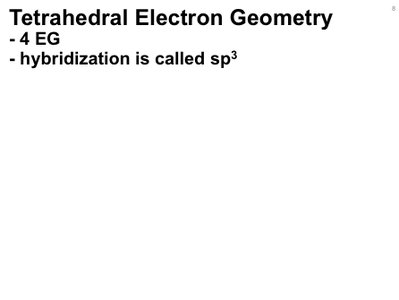
sp3 Hybridization: Occurs when there are four electron groups around the central atom, resulting in a tetrahedral geometry.
sp2 Hybridization: Occurs with three electron groups, resulting in a trigonal planar geometry.
sp Hybridization: Occurs with two electron groups, resulting in a linear geometry.
Example: Tetrahedral Electron Geometry
Four Electron Groups: The central atom has four regions of electron density (bonding or lone pairs).
Hybridization: The orbitals mix to form four sp3 hybrid orbitals.
Bond Angle: The ideal bond angle is 109.5°.

Application: Hybridization in Covalent Compounds
Central atoms in covalent compounds typically employ hybridized orbitals to achieve the observed molecular shapes and bond angles. This is a universal feature for central atoms in molecules.
Hybrid Orbitals: Allow for the correct spatial arrangement of bonds.
Bonding: Sigma (σ) bonds are formed by the direct overlap of hybrid orbitals, while pi (π) bonds arise from the side-to-side overlap of unhybridized p orbitals.
Bond Types and Energies
Sigma and Pi Bonds
Chemical bonds can be classified as sigma (σ) or pi (π) bonds, depending on the type of orbital overlap.
Sigma (σ) Bonds: Formed by the head-on overlap of orbitals; every single bond is a sigma bond.
Pi (π) Bonds: Formed by the side-to-side overlap of p orbitals; present in double and triple bonds.
Bond Length and Bond Energy
Bond length and bond energy are important properties that vary with bond type:
Bond Type | Bond Length (pm) | Bond Energy (kJ/mol) |
|---|---|---|
C≡C (Triple Bond) | 120 | 837 |
C=C (Double Bond) | 134 | 611 |
C-C (Single Bond) | 154 | 347 |
Example:
In a molecule with 12 sigma bonds and 1 pi bond, most bonds are single (sigma), with one double bond (containing a pi bond).
Electron Geometry and Hybridization in Molecules
Labeling Electron Geometry
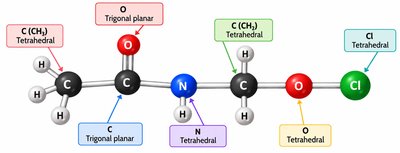
Each non-hydrogen atom in a molecule can be assigned an electron geometry and hybridization based on its bonding and lone pairs.
Tetrahedral: Four electron groups, sp3 hybridization.
Trigonal Planar: Three electron groups, sp2 hybridization.
Linear: Two electron groups, sp hybridization.
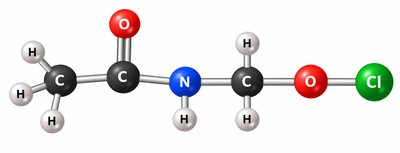
Example: Molecular Structure Analysis
Assign electron geometry and hybridization to each atom in a molecule.
Count the number of sigma and pi bonds present.

Practice and Further Study
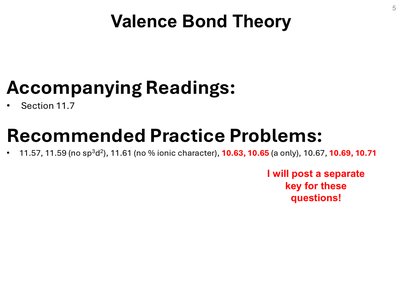
Recommended Practice Problems
To reinforce understanding of valence bond theory and hybridization, students should practice problems from the textbook and accompanying readings.
Section 11.7 (Valence Bond Theory)
Problems: 11.57, 11.59 (no sp3d2), 11.61 (no % ionic character), 10.63, 10.65 (a only), 10.67, 10.69, 10.71
Summary Table: Hybridization and Electron Geometry
Electron Groups | Electron Geometry | Hybridization | Bond Angle |
|---|---|---|---|
2 | Linear | sp | 180° |
3 | Trigonal Planar | sp2 | 120° |
4 | Tetrahedral | sp3 | 109.5° |
Key Equations
Hybridization Formula: Number of electron groups = number of hybrid orbitals formed.
Bond Energy:
Bond Length:
Additional info: These notes expand on brief lecture points to provide a comprehensive overview of valence bond theory, hybridization, and their application to molecular structure and bonding. Practice problems and tables are included for exam preparation.
