 Indietro
Water and Carbon: The Chemical Basis of Life – General Chemistry Foundations
Guida di studio - Note intelligenti
 Appunti personalizzati basati sui tuoi materiali, ampliati con definizioni chiave, esempi e contesto.
The Structure of Atoms, Ions, and Molecules
Atoms: The Fundamental Units of Matter
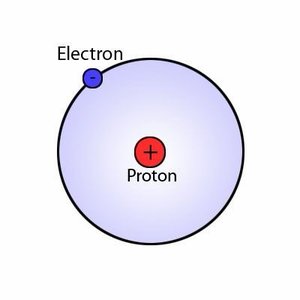
Atoms are the smallest units of elements that retain the properties of the element. They are composed of a central nucleus containing protons (positively charged) and neutrons (neutral), surrounded by electrons (negatively charged) in orbitals.
Element: A pure substance consisting of only one type of atom.
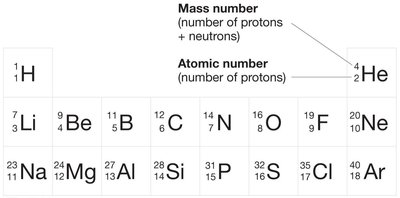
Atomic Number (Z): The number of protons in the nucleus, unique to each element.
Mass Number (A): The sum of protons and neutrons in the nucleus.
Isotopes: Atoms of the same element with different numbers of neutrons, resulting in different mass numbers.
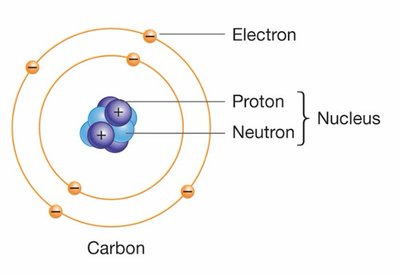
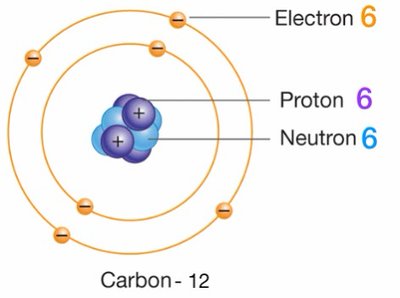
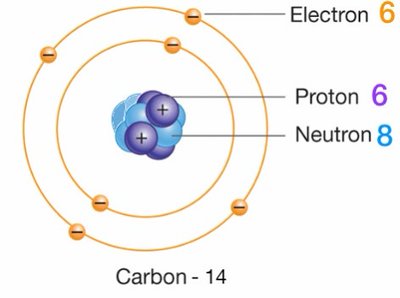
Example: Carbon-12 has 6 protons and 6 neutrons, while Carbon-14 has 6 protons and 8 neutrons.
Electron Shells and Valence Electrons
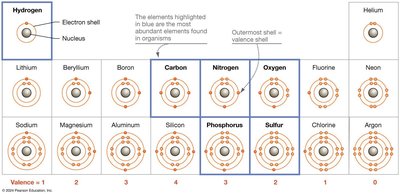
Electrons occupy energy levels or shells around the nucleus. The outermost shell is called the valence shell, and the electrons in this shell (valence electrons) determine the chemical reactivity of the atom.
Atoms are most stable when their valence shell is full.
The number of unpaired electrons in the valence shell determines the number of bonds an atom can form.
Chemical Bonds: How Atoms Combine
Covalent Bonds
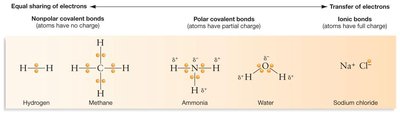
Covalent bonds form when two atoms share one or more pairs of electrons. These bonds are strong and are the primary way atoms are held together in molecules.
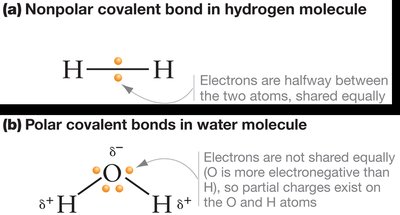
Nonpolar Covalent Bond: Electrons are shared equally between atoms (e.g., H2, O2).
Polar Covalent Bond: Electrons are shared unequally due to differences in electronegativity, resulting in partial charges (e.g., H2O).
Electronegativity: The ability of an atom to attract electrons in a bond. Order: O > N > C ≈ H.
Ionic Bonds
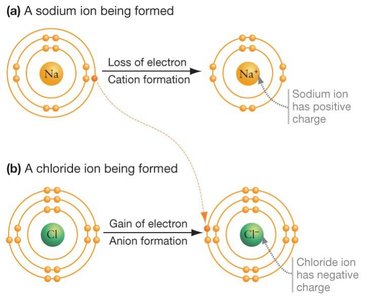
Ionic bonds form when one atom transfers electrons to another, resulting in the formation of oppositely charged ions that attract each other.
Cation: An atom that loses electrons and becomes positively charged.
Anion: An atom that gains electrons and becomes negatively charged.
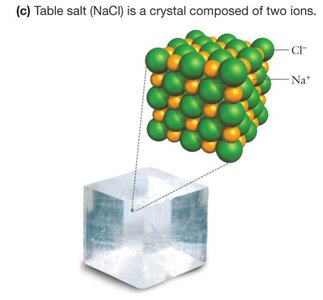
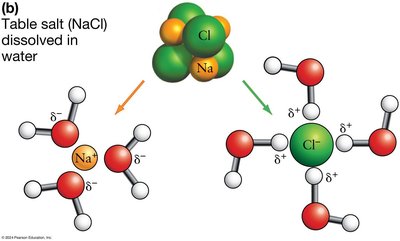
Example: Sodium (Na) loses an electron to become Na+, and chlorine (Cl) gains an electron to become Cl-. They form NaCl (table salt).
Bond Continuum
The degree to which electrons are shared in chemical bonds forms a continuum from equal sharing (nonpolar covalent) to complete transfer (ionic).
Molecules and Compounds
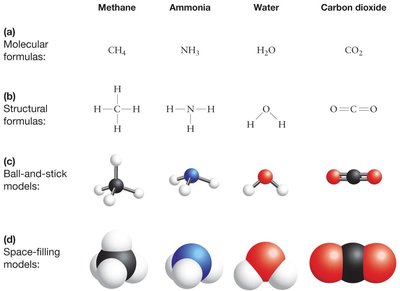
A molecule is a group of atoms held together by covalent bonds. A compound is a substance made of atoms of different elements bonded together.
Example: H2O is both a molecule and a compound; O2 is a molecule but not a compound.
The Unique Properties of Water
Polarity and Hydrogen Bonding
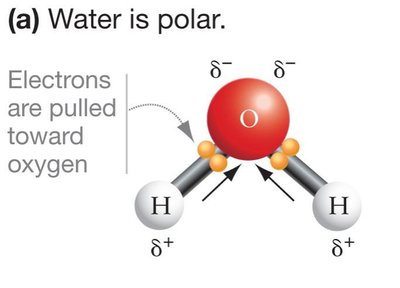
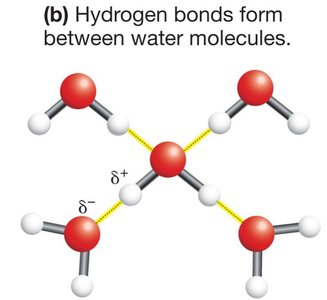
Water is a polar molecule with a bent geometry. The oxygen atom is more electronegative than hydrogen, creating partial negative (δ-) and positive (δ+) charges. This allows water molecules to form hydrogen bonds with each other and with other polar molecules.
Hydrogen Bond: A weak attraction between a hydrogen atom with a partial positive charge and another atom with a partial negative charge (often oxygen or nitrogen).
Solvent Properties
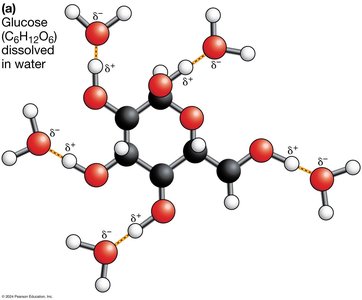
Water is an excellent solvent for ions and polar molecules (hydrophilic substances) due to its polarity and ability to form hydrogen bonds. Nonpolar molecules (hydrophobic) do not dissolve in water and tend to aggregate together.
Hydrophilic: "Water-loving"; substances that dissolve in water.
Hydrophobic: "Water-fearing"; substances that do not dissolve in water.
Cohesion, Adhesion, and Surface Tension
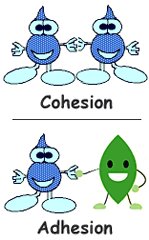
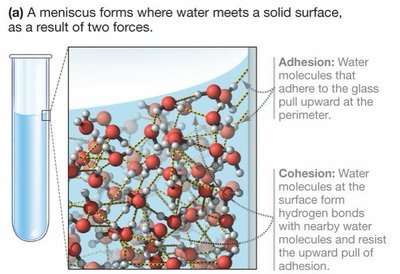
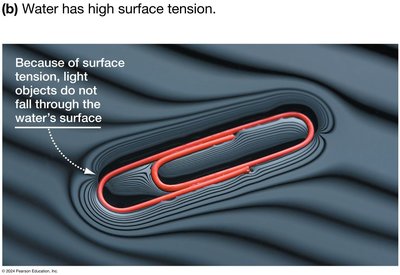
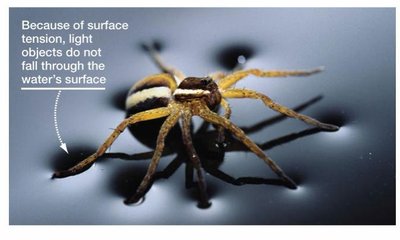
Water molecules exhibit cohesion (attraction to each other) and adhesion (attraction to other substances), leading to high surface tension. These properties are essential for processes like water transport in plants.
Cohesion: Water molecules stick to each other via hydrogen bonds.
Adhesion: Water molecules stick to other polar or charged surfaces.
Surface Tension: The energy required to increase the surface area of a liquid due to cohesive forces.
Density and States of Water
Water is denser as a liquid than as a solid. As water freezes, it forms an open crystal structure stabilized by hydrogen bonds, making ice less dense and allowing it to float.
Biological significance: Ice floating insulates aquatic environments, protecting life during cold periods.
Thermal Properties: Specific Heat and Heat of Vaporization
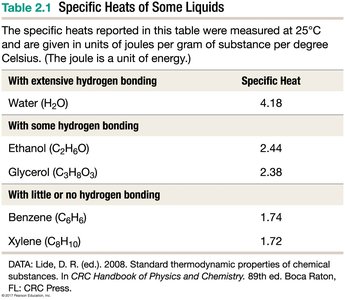
Water has a high specific heat and heat of vaporization due to extensive hydrogen bonding. This allows water to absorb and release large amounts of energy with minimal temperature change, stabilizing environments and organisms.
Specific Heat: The energy required to raise the temperature of 1 gram of a substance by 1°C.
Heat of Vaporization: The energy required to convert 1 gram of a liquid to gas.
Acids, Bases, and pH
Dissociation of Water and pH Scale
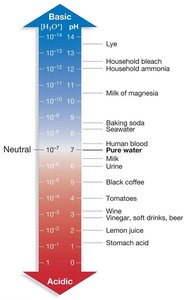
Water can dissociate into hydrogen ions (H+) and hydroxide ions (OH-). The concentration of H+ ions determines the acidity of a solution, measured by the pH scale.
Acid: Substance that donates protons (H+), increasing [H+].
Base: Substance that accepts protons, decreasing [H+].
pH:
Neutral solution: pH = 7 (pure water)
Acidic solution: pH < 7
Basic solution: pH > 7
Buffers
Buffers are substances that minimize changes in pH by absorbing or releasing H+ ions. They are essential for maintaining homeostasis in biological systems.
Example: Bicarbonate buffer system in blood helps maintain a stable pH.
Summary Table: Properties of Water
Property | Cause | Biological Consequences |
|---|---|---|
Solvent for charged or polar compounds | Electrostatic attractions between partial charges on water and opposite charges on other polar molecules or ions | Facilitates chemical reactions in cells |
Denser as a liquid than a solid | Hydrogen bonds stabilize open crystal structure in ice | Ice floats, insulating aquatic life |
High specific heat | Hydrogen bonds must be broken for temperature to rise | Stabilizes temperature in organisms and environments |
High heat of vaporization | Hydrogen bonds must be broken for evaporation | Evaporative cooling (e.g., sweating) |
